novembro 21, 2026
|
5 min read


Obtenha acesso instantâneo a um ambiente TrueFoundry ao vivo. Implante modelos, direcione o tráfego de LLM e explore a plataforma completa — seu sandbox estará pronto em segundos, sem necessidade de cartão de crédito.



Blazingly fast way to build, track and deploy your models!
O IAM corporativo foi criado para humanos e contas de serviço. Agentes não são nenhum dos dois: eles agem por em nome de um usuário, em várias ferramentas, frequentemente em cadeias. Se o seu provedor de identidade não possui capacidade de identidade de agente — ou se você simplesmente ainda não quer depender de uma — você fica com as três opções ruins com as quais toda implementação de agente começa: pegar emprestado o token do usuário, compartilhar uma conta de serviço ou realizar falsificação de identidade (impersonation). Todas as três quebram a trilha de auditoria, como abordamos em o que é identidade de agente de IA.
O padrão identity-broker permite que você pule a espera. Um componente confiável torna-se o emissor e a autoridade para a identidade do agente, para que você tenha agentes governados hoje e mantenha a opção de federar com seu IdP mais tarde.
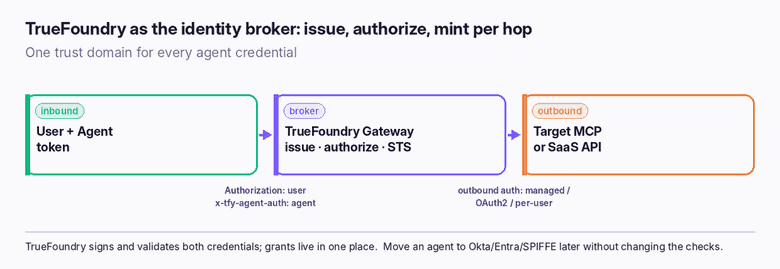
Um broker assume três funções que, de outra forma, seriam distribuídas entre seu IdP, o código do seu aplicativo e cada ferramenta. Com o TrueFoundry como broker, elas são mapeadas da seguinte forma:
O registro cria a identidade do agente. O agente obtém seu token do registro (via ⋮ → Obter Token) e o envia junto com o token do usuário em cada chamada:
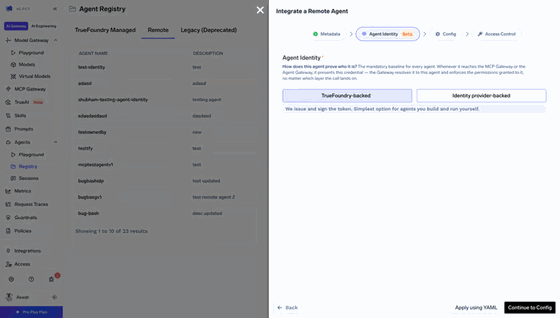
Registrando um agente. O cenário de broker usa uma identidade suportada pelo TrueFoundry; você pode migrar um agente para um IdP posteriormente. Fonte: documentação do TrueFoundry.
Authorization: Bearer <USER_TOKEN>
x-tfy-agent-authorization: Bearer <AGENT_TOKEN>
O gateway valida ambos os tokens, verifica se o agente pode acessar o servidor MCP de destino e se ele pode agir em nome do usuário e, em seguida, encaminha a solicitação usando a autenticação de saída do destino. Qualquer coisa não permitida é negada com um erro 403. Como o TrueFoundry assina e valida ambas as credenciais, o gateway é o único domínio de confiança — não há necessidade de configurar uma troca externa.
O broker também resolve as credenciais de saída, que é onde a maioria das integrações de agentes realmente trava. Ele oferece três modos de saída, dependendo do que o destino suporta:
TrueFoundry AI Gateway delivers ~3–4 ms latency, handles 350+ RPS on 1 vCPU, scales horizontally with ease, and is production-ready, while LiteLLM suffers from high latency, struggles beyond moderate RPS, lacks built-in scaling, and is best for light or prototype workloads.

A component that takes on the agent control-plane roles your IdP and app code otherwise would: issuing each agent's identity, authorizing every call, and minting scoped credentials for each hop. In TrueFoundry the gateway is the broker, and it signs and validates the agent token itself.
When your IdP has no agent-identity capability, when you want governed agents quickly, or when your agents are in-house and their targets are internal or reachable with gateway-held credentials. If policy requires every principal in the corporate directory, use an IdP-backed scenario instead.
No. Your enterprise IdP still authenticates human users. The broker only provides and governs agent identity, carrying the user's token alongside the agent's on every call.
Through outbound auth on the MCP server: no auth or a managed header for internal targets, OAuth2 client credentials for app-to-app SaaS, or per-user OAuth (authorization code) when the SaaS needs per-user consent. The gateway stores and refreshes per-user tokens.
Yes. Only the source of the agent's identity changes; the collaborator grants, authorization checks, and audit trail stay the same. You can mix broker-backed and IdP-backed agents in one tenant.
The gateway denies it with a 403 that names the refused principal and the reason — whether the agent lacked access to the target or lacked permission to act for that user.



As últimas notícias, artigos e recursos enviados para sua caixa de entrada