


Obtenha acesso instantâneo a um ambiente TrueFoundry ao vivo. Implante modelos, direcione o tráfego de LLM e explore a plataforma completa — seu sandbox estará pronto em segundos, sem necessidade de cartão de crédito.


What Is a Private Cloud and How Does It Work?

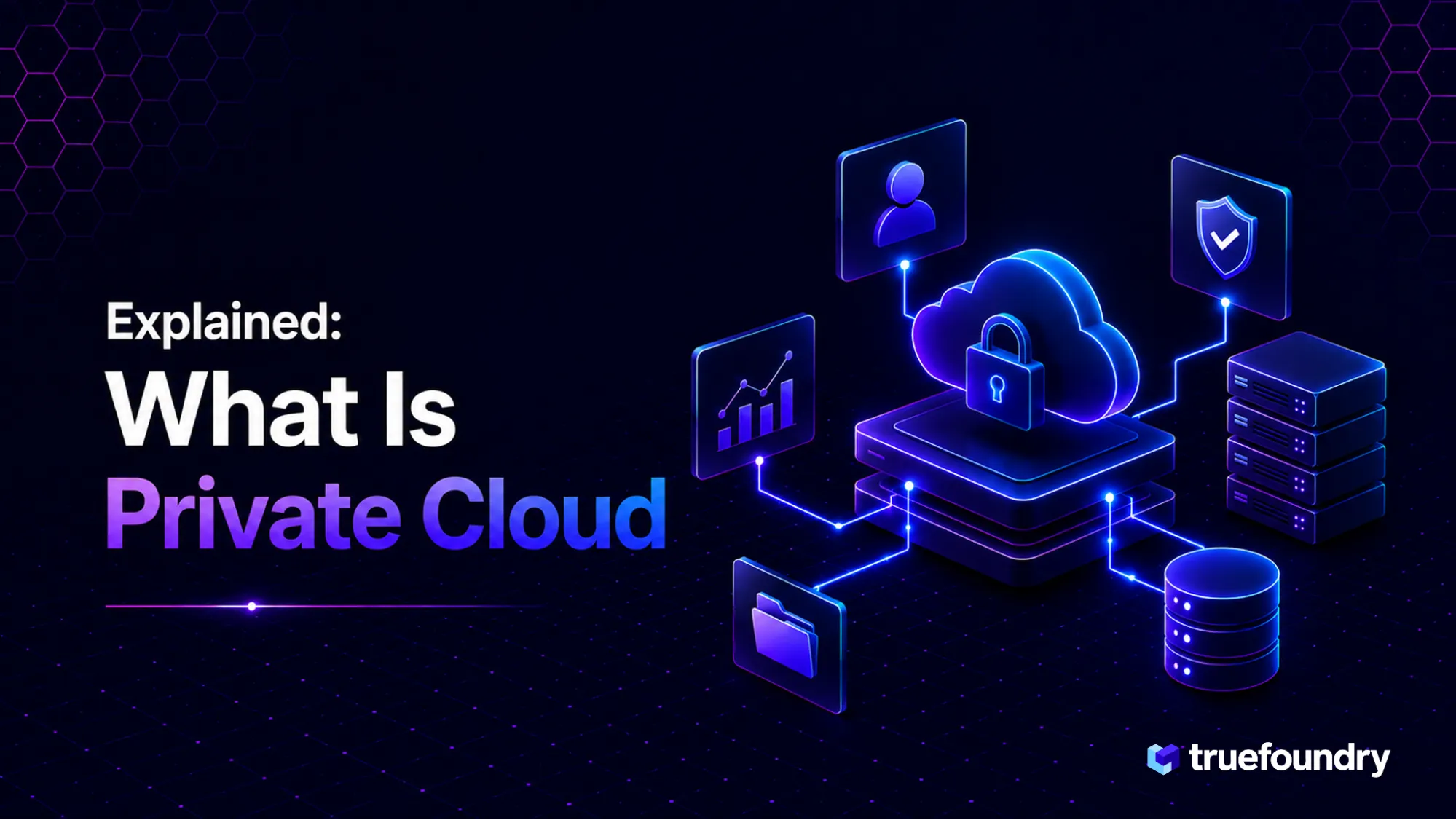
A private cloud refers to a cloud-based environment designed for one business. The computing resources, including servers, storage and networking components, are exclusively for use by one organization. However, it still includes self-service, automation and flexible scaling. Such a cloud may be located in-house or in a facility of a cloud provider.
Here, we are going to cover what a private cloud is, how it works, the types of such clouds, use cases, and the differences and similarities between private cloud, public cloud and hybrid cloud.
What is a private cloud?
It is possible to view it as an adaptation of the cloud computing concept to a dedicated environment. Teams request resources via a web interface or API as they do in public clouds, yet all workloads run on infrastructure which is used by only one company. This provides an opportunity to control the location of the data, the access level to it and the configuration of the system.
The downside is that someone has to buy, operate and update the underlying infrastructure. This can be done either by your internal teams or by a managed cloud provider.
How does a private cloud work?
- Virtualization and containerization: physical servers, storage and networking are pooled and segmented into virtual machines or containers for better efficiency of hardware use.
- Management layer: software like VMware, OpenStack or Kubernetes platforms allows controlling usage of the infrastructure, setting quotas and requesting resources.
- Automation: deployment, scaling, maintenance and backups are automated, thus creating cloud-like behavior rather than a rack of servers.
- Self-service and chargeback: teams order what they need from a catalog and the usage is monitored to allocate costs to each of the teams.
- Security and isolation: network segmentation, access controls and encryption ensure that workloads are isolated.
What types of private clouds are there?
- On-premises private cloud: the cloud is operated in your own data center. You get full control, but you pay for the hardware up front and still need a team to manage the infrastructure.
- Hosted private cloud: the provider hosts your dedicated infrastructure in its own facilities. So you do not have to build and power it, yet you keep exclusivity.
- Managed private cloud: the provider not only hosts but also operates the cloud: it manages updates and monitors it.
- Virtual private cloud (VPC): a private network inside a public cloud like AWS, Azure or Google Cloud. It is not dedicated infrastructure, but you get network isolation with a less complex setup.
Private cloud vs public cloud vs hybrid cloud
The main difference between a private cloud and a public cloud is the number of customers sharing infrastructure, and the pricing model. In a public cloud, infrastructure is shared by multiple companies and pricing is pay-per-use. A private cloud uses exclusively dedicated infrastructure, and it is usually more expensive up front.
A hybrid cloud combines public and private clouds together. Some sensitive workloads run in the private cloud, others run in the public cloud to take advantage of bursting and auto-scaling.
What are the advantages of a private cloud?
- Security and privacy: because there are no other customers, you control storage and access to the data.
- Compliance: you can more easily meet the requirements of regulations like HIPAA, PCI DSS or GDPR.
- Predictable performance: because there are no other tenants on the same physical hardware, the performance of your cloud does not suffer from noisy neighbors.
- Customization: you are free to choose the hardware, network and software stack.
- Cost predictability at scale: for stable, heavy workloads owned infrastructure may prove more cost-effective compared to a rented one.
Private cloud use cases
- Regulated industries: banks, healthcare providers and government organizations prefer to keep their sensitive data on controlled infrastructure.
- Application modernization: legacy applications migrate to a virtualized environment without a complete rewrite.
- Steady, large workloads: databases and core systems with predictable demand run cheaper on dedicated hardware.
- Private AI: teams which are not allowed to send data outside can deploy machine learning models on their own infrastructure. The platform TrueFoundry allows deploying models to your own cloud account or Kubernetes cluster, and the TrueFoundry AI Gateway provides a controlled way to access those models.
What are the disadvantages of a private cloud?
- High upfront cost: you have to pay for hardware, software licensing and facilities even before you start using the infrastructure.
- Operational overhead: you need people to update, monitor and operate the stack.
- Limited elasticity: you can scale only as far as you have resources. Bursting into a public cloud needs an extra connection to one, and autoscaling only goes as far as your capacity.
- Slow availability of new services: public clouds release new managed services faster than a private stack can catch up.
Conclusion
A private cloud is a good choice for organizations which require control, compliance and predictable performance and which are ready to invest in owning the infrastructure. Many teams end up with a hybrid setup that combines private and public clouds together.
Govern, Deploy and Trace AI in Your Own Infrastructure


- © 2022 ENSEMBLE Tecnologias



Assine nossa newsletter
As últimas notícias, artigos e recursos enviados para sua caixa de entrada


