|
5 min read


Obtenha acesso instantâneo a um ambiente TrueFoundry ao vivo. Implante modelos, direcione o tráfego de LLM e explore a plataforma completa — seu sandbox estará pronto em segundos, sem necessidade de cartão de crédito.



Published: novembro 23, 202620
Blazingly fast way to build, track and deploy your models!
This guide walks through each meter so you can estimate your own cost. Kong figures come from Kong’s pricing page and developer documentation. Where Kong hasn’t published something, we say so.
Kong Konnect is Kong’s control plane, delivered as a managed service. Kong runs the control plane. Who runs the gateway nodes depends on the control plane type: on Hybrid, you run them; on Serverless and Dedicated Cloud Gateway, Kong does.
Your configuration, analytics and admin UI sit in Kong’s cloud. On Hybrid, your proxy nodes run in your own infrastructure and pull config down securely. Kong’s pricing page lists AI Management, API Management and Event Management under Konnect.
For AI, the deployment model is worth knowing up front. Kong describes the AI gateway as running “in a single deployment mode: hybrid,” with no “fully self-hosted control plane for AI Gateway entities today.” Its FAQ answers “Can I run AI Gateway on-prem?” with “Yes. AI Gateway supports both Konnect and self-hosted deployments.”
Both are accurate. Self-hosted Kong runs the AI plugins; the newer AI entity model, the admin UI and Konnect analytics are part of the managed service. The pricing page lists the fully self-hosted route as a “separate Gateway Enterprise offering” that is “fully custom and must be discussed with a Kong commercial team.” If everything must run inside your network, that’s a sales conversation — our AI gateway on-premise guide covers what to ask.
There are two plans, Plus and Enterprise, with a 30-day trial on Plus, no credit card required. A free tier existed previously; Kong’s FAQ still references signups “before March 1, 2025.”
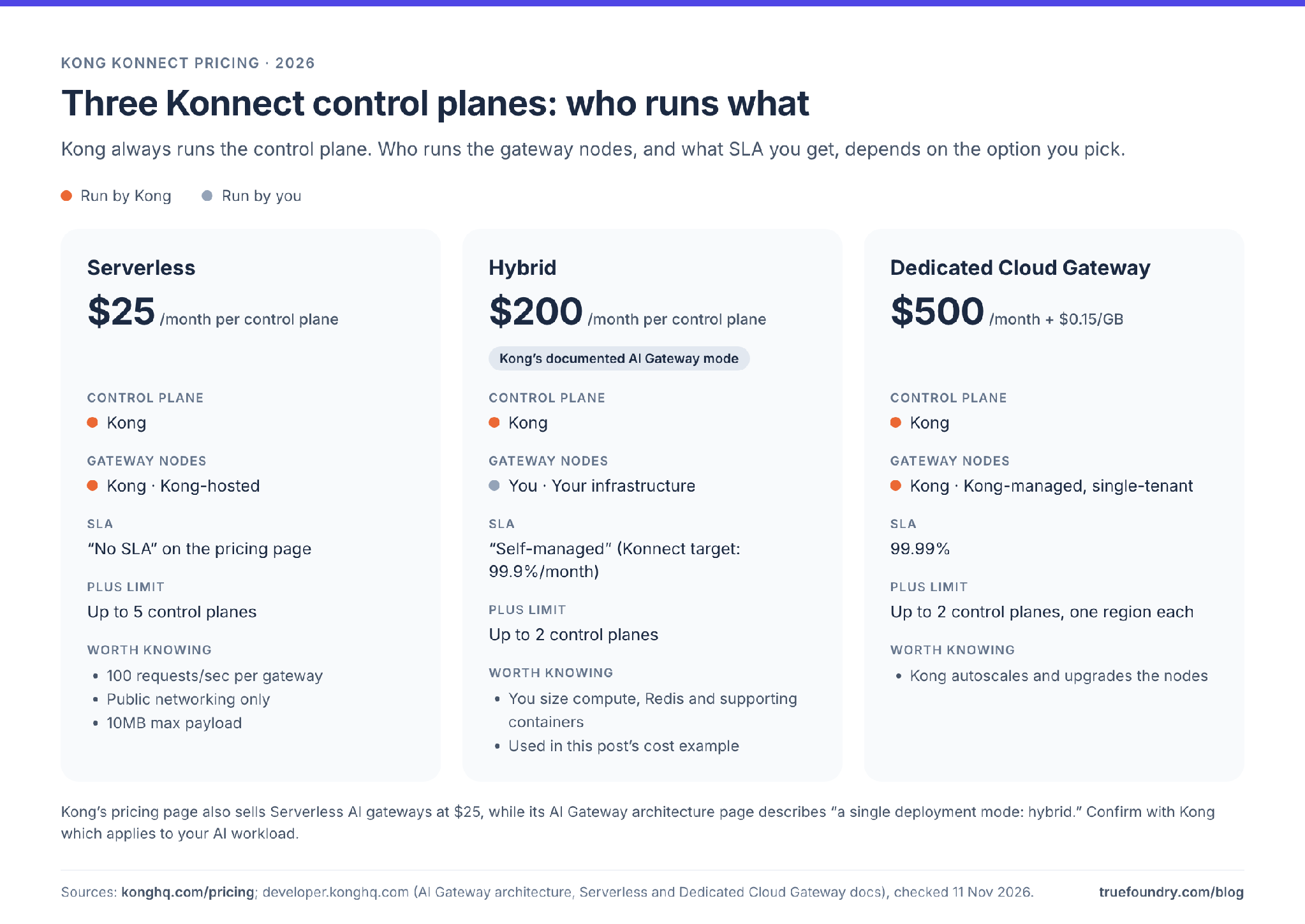
Serverless is the source of the “From $25/month” headline. Kong’s pricing page lists no SLA for it, but its Serverless reference says it is “backed by a service-level agreement (SLA)” without giving terms. It is capped at 100 requests per second, supports public networking only, and accepts payloads up to 10MB, so it suits evaluation best.
Kong’s pricing page sells Serverless AI gateways at $25, but its AI Gateway architecture page says AI Gateway “runs in a single deployment mode: hybrid.” Confirm with Kong which applies before relying on the $25 figure for AI workloads.
Plus also limits control planes: up to 5 Serverless ($25 each), up to 2 Hybrid ($200 each), and up to 2 Dedicated Cloud Gateways ($500 each, one region per control plane).
Hybrid at $200/month is the mode Kong’s architecture page describes for AI Gateway: a Konnect-managed control plane with data plane nodes in your own infrastructure. Its SLA reads “Self-managed,” since you run the nodes. Kong’s pricing FAQ gives a separate availability target for Konnect itself: “The target availability for Kong Konnect is 99.9% per calendar month.”
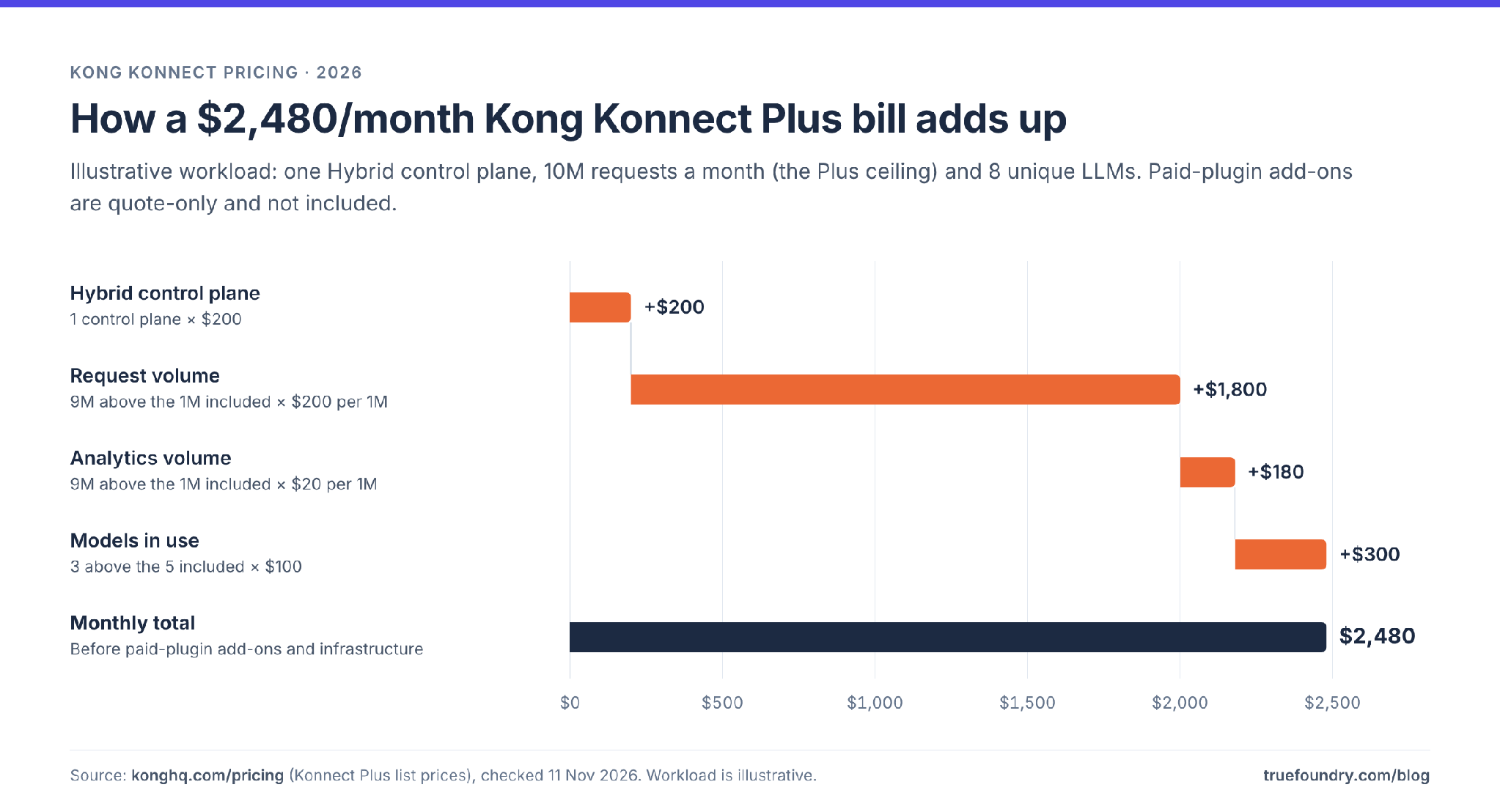
Running total: $200.
Plus includes 1 million requests a month, then “$200/month per additional 1 million requests,” capped at 10 million.
At 10 million, that’s 9 million extra — $1,800.
Running total: $2,000.
Analytics is billed on its own meter. First million included, then $20 per million, same 10 million cap, 14 months retention at no charge.
Keep the two apart: $200 per million for gateway requests, $20 per million for analytics on them. Above a million, both apply. (The line “No cost for less than 1B contracted requests” is in Enterprise’s analytics row, not Plus’s. It is often quoted as Enterprise’s overall allowance, but it applies only to analytics.)
At 10 million, analytics adds $180.
Running total: $2,180.
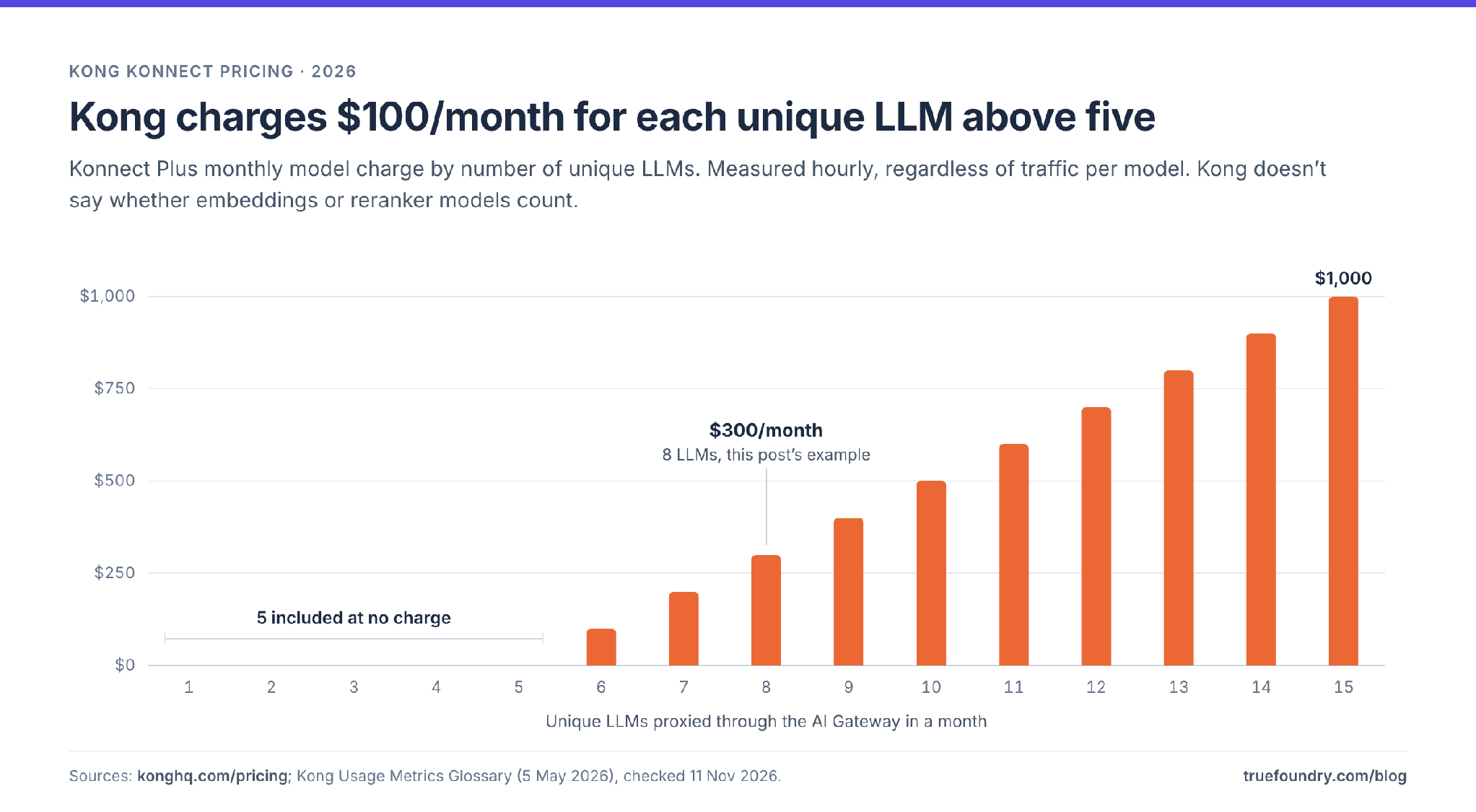
Kong bills per distinct model: five included, then $100/month each, counted as “Unique LLMs proxied by AI plugins measured hourly, enforced monthly.”
Model count can change independently of traffic, so it’s worth modelling. As an illustration, suppose you proxy two OpenAI models, two Anthropic models, one Google Gemini model and three self-hosted open-weight models. That is eight unique LLMs, three above the five included — $300/month, independent of volume. This is an example mix, not a Kong-published configuration. Kong’s glossary defines a billable model as a “unique large-language model” and doesn’t say whether embeddings or reranker models count, so confirm that with Kong if you use them.
Running total: $2,480.
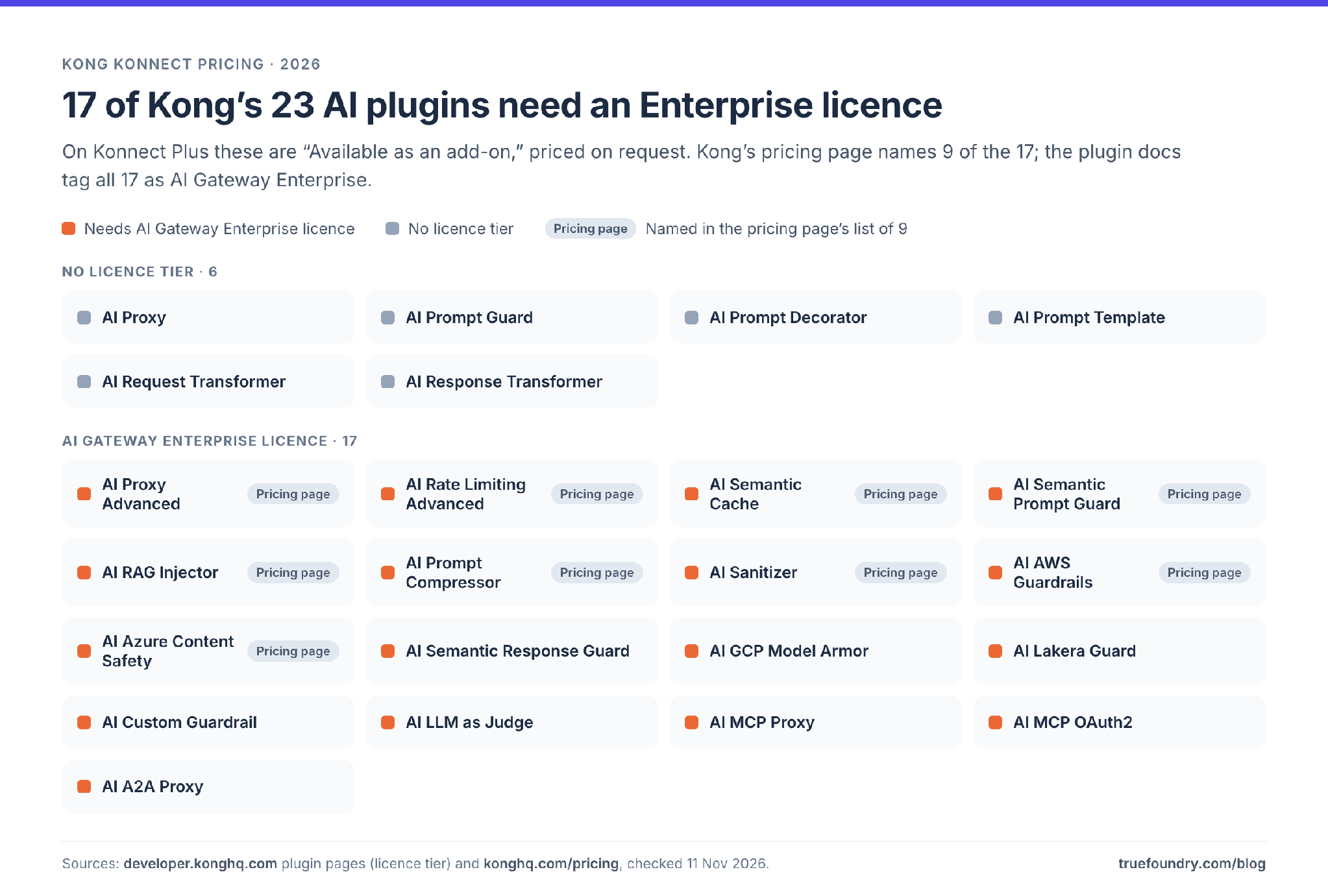
Six AI plugins are free: ai-proxy, ai-prompt-guard, ai-prompt-decorator, ai-prompt-template, ai-request-transformer and ai-response-transformer. We checked all 23 of Kong’s AI plugin pages. Six carry no licence tier.
The other 17 are tagged AI Gateway Enterprise and cover features such as semantic caching, PII redaction, RAG injection, prompt compression, the guardrail plugins, multi-model proxying (AI Proxy Advanced), and MCP and agent-to-agent support. AI Gateway Manager is a separate paid add-on rather than a plugin, and Kong lists it on the pricing page alongside them.
For Plus these are marked “Available as an add-on” with no published price, so this line comes from a quote. Two things to clarify when you ask:
SSO and audit logging are Enterprise features — “Advanced features like SSO and Audit Logs are only available with Enterprise.” If either is required, that decides the tier regardless of volume.
On Hybrid, the gateway nodes run in your infrastructure, so compute and supporting services sit alongside the subscription.
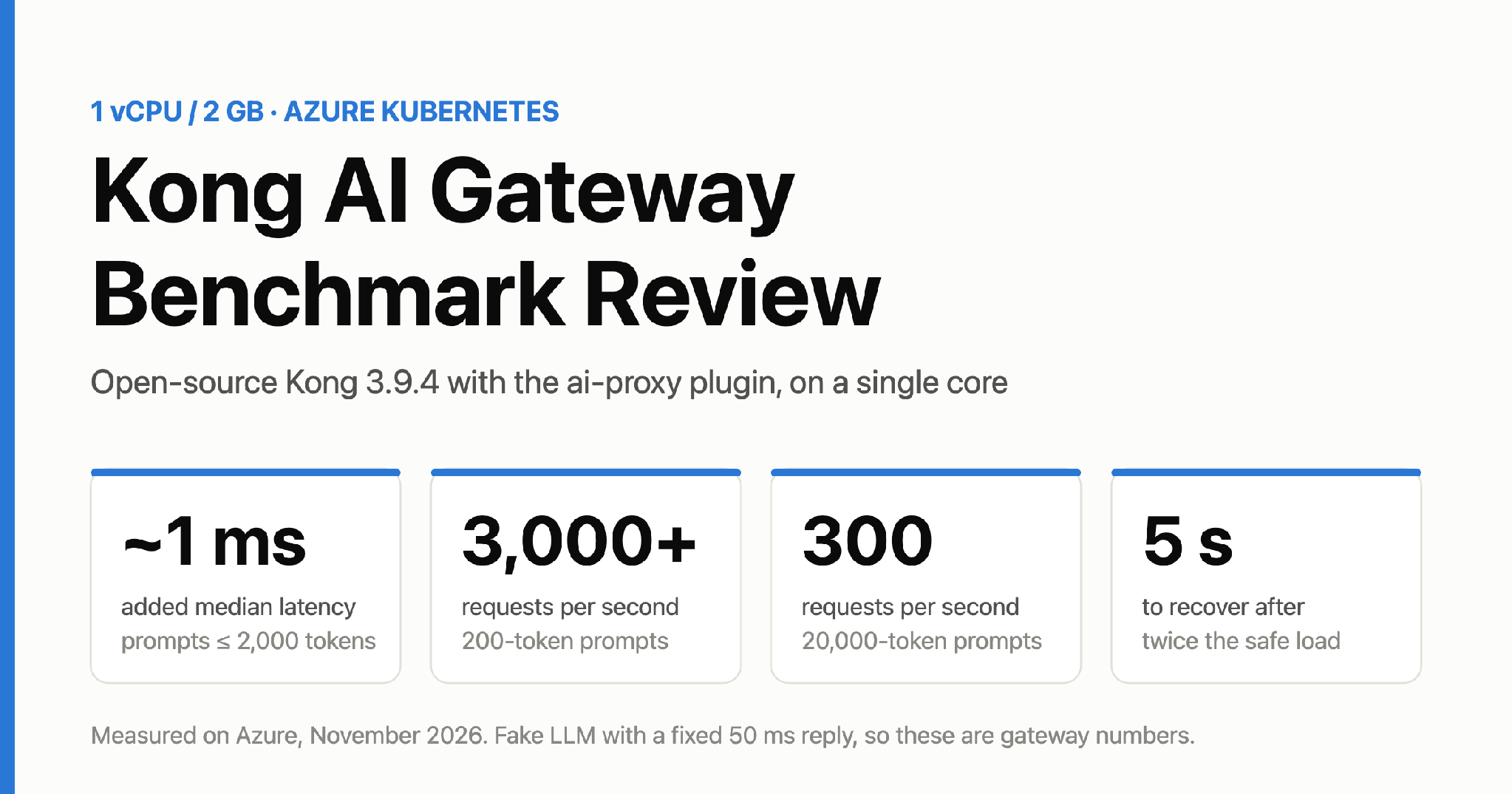
Compute. Kong publishes concrete AI sizing, which helps at planning time: 18 vCPUs for a small deployment (under 100 services and routes), 100 for medium (100–500), and 360 for large (500–2,000), at “1 vCPU : 2 GB memory” with a “redundancy factor 2×–4x.” Kong sizes by configured services and routes and by token throughput, not by request count, and says to size “for token/s, not just RPS.” It advises avoiding burstable instances (AWS t, Azure B), which “can introduce token delay spikes and unstable throughput.”
Redis. Consistent rate limiting across nodes needs it, as Kong’s shared-counter strategy is “Not supported in hybrid mode or Konnect deployments.” Semantic features need Redis with “the Redis Query Engine (RediSearch)” and “the Redis JSON data type” — both, or vector indexing fails. Postgres with pgvector is the alternative. Semantic caching also makes an extra embedding call on a miss.
Supporting containers. PII redaction runs as a separate private-repo service, nine language images each needing “at least 600MB of free memory.” Prompt compression uses another private image from “a Cloudsmith repository.” On databases, Kong notes: “We do not provide any specific numbers for database sizing.”
Support and upgrades. Kong’s Support and Maintenance Policy (16 October 2026) sets initial response targets for urgent, Severity 1 issues: 30 minutes on Diamond and 1 hour on Platinum (both 24x7), and 2 business hours on Business. Resolution is covered by “continuous efforts” rather than a deadline. The AI gateway ships a minor release “approximately every 4 weeks” — rolling releases supported one month, stable six — so upgrades are an ongoing task.
Regulated data. If you handle health information, confirm the position with Kong directly, as it spans documents. The Konnect Customer Agreement’s terms for Dedicated and Serverless Cloud Gateways state that customers “may not store or process protected health information (PHI) using the Cloud Services.” The Kong Customer Agreement references “a Business Associate Agreement between the parties (if applicable),” and Kong’s startup-programme page lists “HIPAA-ready.”
Kong’s column comes from its pricing page, developer documentation and startup-programme page. TrueFoundry’s comes from its pricing page, AI Gateway page, published docs and benchmark. For background, see our complete guide to AI gateways.
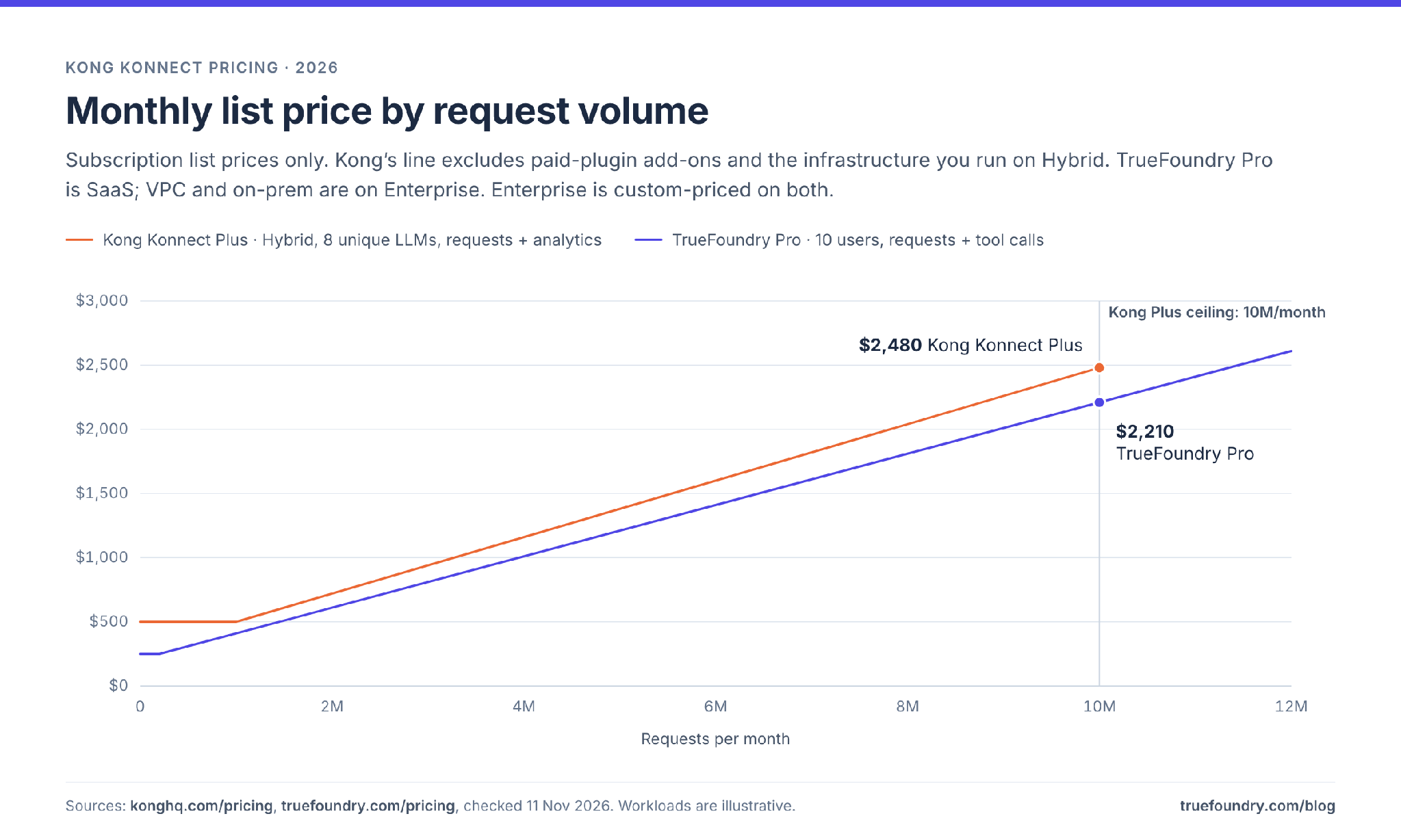
Two notes for a fair read. The request rates match: Kong’s $200 per million and our $20 per 100,000 are the same per request. Kong’s analytics adds $20 per million on top, so its effective rate is $220 per million. And on latency, TrueFoundry’s published benchmark reports 3–5 ms of added latency, scaling to about 350 requests per second on one vCPU (1 GB), against a mocked OpenAI endpoint. Kong’s sizing guide says gateway overhead “typically adds < 10ms” with no stated test conditions, so the two aren’t directly comparable.
Like-for-like at 10M requests a month. On TrueFoundry Pro with 10 users, list price is 10 × $25 = $250, which includes 200,000 requests and tool calls (10 × 20K). The other 9.8M at $20 per 100K is $1,960, for $2,210/month. Kong’s example above is $2,480. Treat both as list-price subscription estimates. Kong’s excludes paid-plugin quotes and your gateway infrastructure. TrueFoundry counts LLM requests and MCP tool calls together, and Pro is its SaaS offering: VPC and on-prem deployment is on Enterprise, which is custom-priced.
Best for: teams running many models or multi-agent systems, in regulated industries, or needing the full platform inside their own network.
A good fit if you already run Kong for API traffic and AI is an extension of it — a few models, volume under the ceiling, and a platform team with its own observability stack. Kong publishes its meters, so you can price the AI addition directly. Kong also runs a startup programme: “Up to $100,000 in credits, valid for 12 months” on Konnect Plus, then “50% off list pricing for two full years”, for early-stage companies, typically under $10M in total funding.
Other options may suit better if you run many models, you need SSO on an entry plan (Kong’s SSO is Enterprise-only per its pricing page), you need a signed agreement for regulated data, or you need the control plane inside your own network.
Q: What is Kong Konnect pricing in 2026? A: Two plans. Plus starts at $25/month for a Serverless control plane, $200/month for Hybrid, or $500/month plus bandwidth for a Dedicated Cloud Gateway — then 1 million requests included with $200 per additional million up to a 10 million cap, a separate analytics meter at $20 per million, and five models included with each extra model at $100/month. Enterprise is custom-priced.
Q: Is Kong Konnect free? A: There are two paid plans and a 30-day trial, no card required. A free tier existed before March 1, 2025. Six of Kong’s 23 AI plugins carry no licence tier and can run on self-hosted Kong Gateway, without the AI entity model, admin UI, MCP or agent support.
Q: Does Kong Konnect charge per model? A: Yes — five included on Plus, then $100/month each, regardless of traffic per model. It’s billed separately from request volume.
Q: Can I deploy TrueFoundry in my own VPC or on-prem? A: Yes, on the Enterprise plan. TrueFoundry’s pricing page lists “VPC, on-prem & data residency,” and its AI Gateway page lists VPC, on-prem, air-gapped and multi-cloud deployment.
Q: What latency does the TrueFoundry AI Gateway add? A: TrueFoundry’s published benchmark reports 3–5 ms of added latency, with the gateway scaling to about 350 requests per second on a single vCPU (1 GB) against a mocked OpenAI endpoint.
Q: Is TrueFoundry SOC 2 / HIPAA / GDPR compliant? A: TrueFoundry’s AI Gateway page states SOC 2, HIPAA and GDPR standards, with custom roles and SSO on Pro and audit exports on Enterprise. Its trust centre is at trust.truefoundry.com.
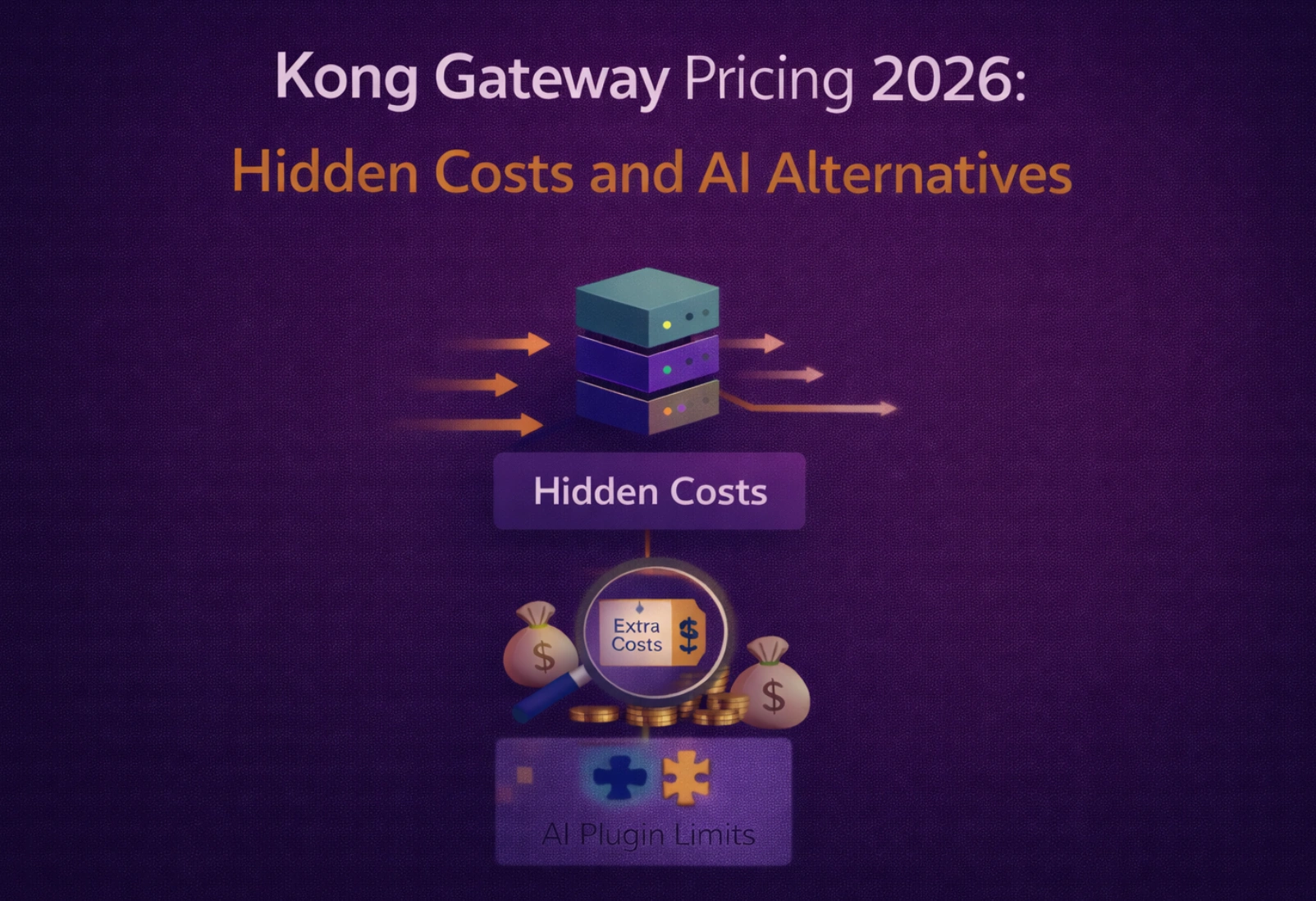
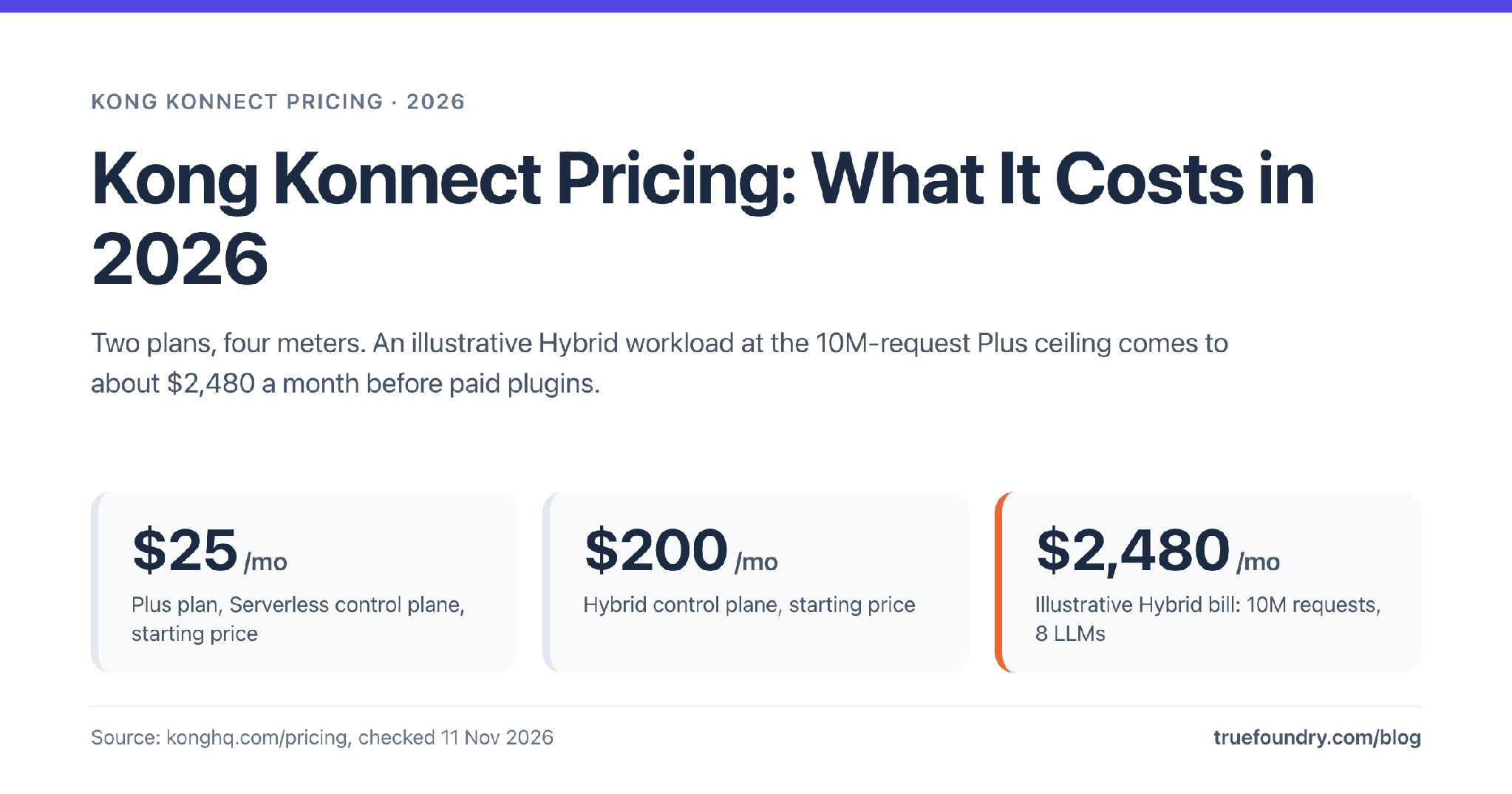
Kong Konnect pricing is built from four meters — control plane, request volume, analytics volume and model count. All four meters are published, so subscription cost for a defined workload is straightforward to estimate. Paid-plugin add-ons are quote-only and infrastructure is excluded. Our Plus-ceiling example on Hybrid lands at $2,480/month.
One input comes from a conversation rather than the pricing page: the cost of the paid plugins and add-ons. If you plan to use caching, PII redaction or MCP controls, get a quote early.
If the per-model charge, deployment model or compliance requirements are central to your decision, book a demo to see how TrueFoundry handles governance, agent tool controls and 1,600+ models, including in your own VPC or on-prem on its Enterprise plan.
Verification note: Kong figures and quotations were checked against Kong-owned sources between 19 and 21 October 2026 and re-checked on 11 November 2026: konghq.com/pricing, the Usage Metrics Glossary (5 May 2026), the Konnect Customer Agreement (17 November 2025), the Kong Customer Agreement (10 August 2026), the Support and Maintenance Policy PDF (16 October 2026), the startup-programme page, and the AI Gateway architecture, sizing, version-support and plugin pages on developer.konghq.com. TrueFoundry figures come from truefoundry.com/pricing, its AI Gateway page, its docs and its published benchmark, checked on 11 November 2026. The example workload (eight unique LLMs, 10M requests a month, 10 TrueFoundry users) is illustrative. Pricing changes; confirm current figures with Kong before making a decision.
TrueFoundry AI Gateway delivers ~3–4 ms latency, handles 350+ RPS on 1 vCPU, scales horizontally with ease, and is production-ready, while LiteLLM suffers from high latency, struggles beyond moderate RPS, lacks built-in scaling, and is best for light or prototype workloads.



As últimas notícias, artigos e recursos enviados para sua caixa de entrada