


October 1, 2026
|
5 min read


Published: September 23, 2026
Blazingly fast way to build, track and deploy your models!
Imagine every AI model and agent in your organization speaking a different language. One knows how to talk to your CRM, another understands your data warehouse, while a third has its own way of calling APIs. You could build a translator for every interaction, but as you add more models, that quickly becomes impossible to manage.
That's the challenge many enterprises face today. As AI ecosystems grow, managing different models, tools, and platforms becomes increasingly complex. AI interoperability solves this by giving them a common way to communicate, share information, and work together.
The result is less provider-specific integration work and greater flexibility to adopt or switch AI models without repeatedly rebuilding application integrations. This guide explains what AI interoperability is, why it matters, the components and standards that support it, and how enterprises can put it into practice.
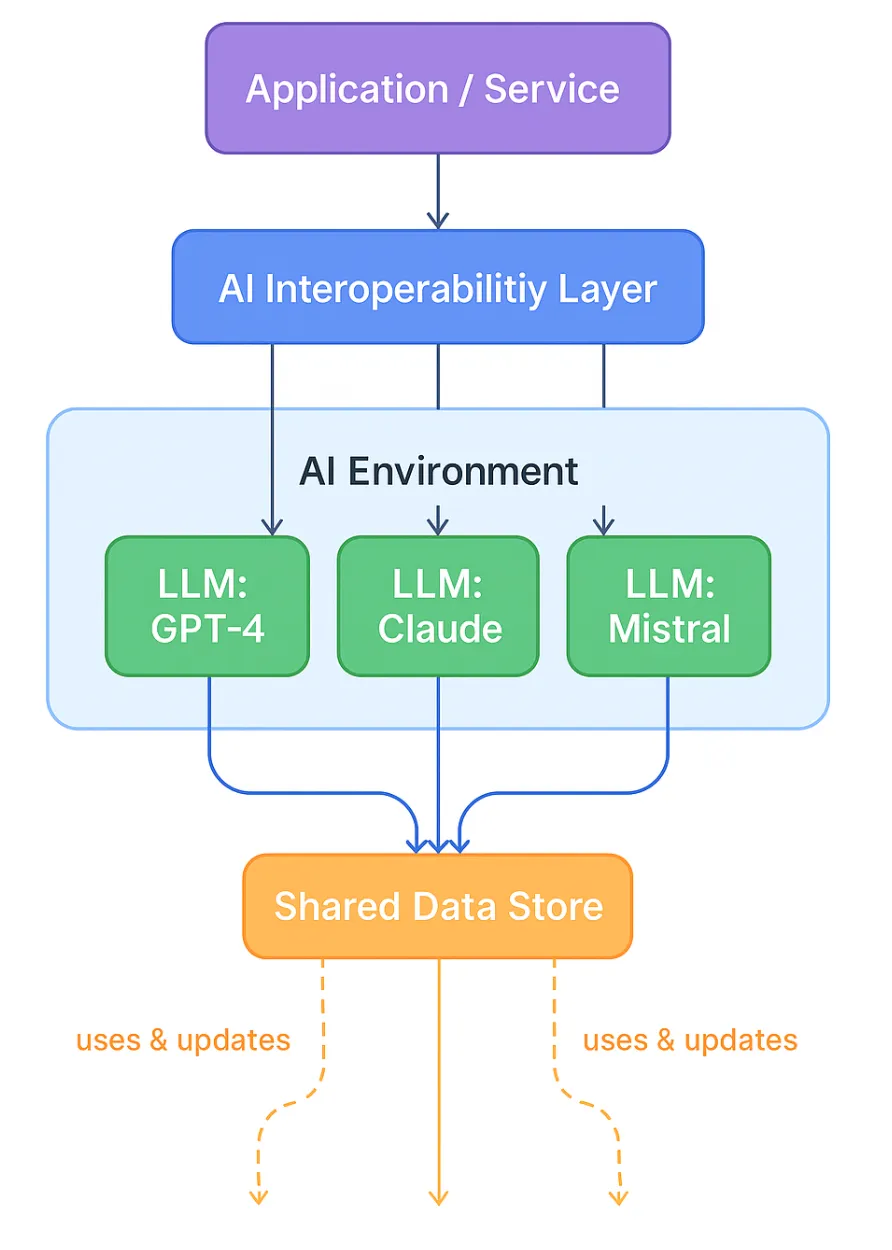
AI interoperability is the ability of different AI models, platforms, tools, and enterprise systems to work together through a common interface. Instead of building separate integrations for every AI provider, you can connect applications to multiple models through a common interface.
In practical terms, this can make it easier to adopt a new model, replace a provider, or combine several LLMs in one workflow without extensive provider-specific application changes. As your AI strategy evolves, your infrastructure remains stable.
AI interoperability can be understood across three key layers:
Together, these layers make it easier to build AI applications that are flexible, scalable, and resilient.
In simple terms, interoperability in AI means creating AI systems that can work together regardless of the model provider, framework, or underlying technology powering them.
The need for interoperability becomes more important as organizations add more models, providers, tools, and agents to their AI stack.
As your AI ecosystem grows, so do the decisions you need to make. Should you switch to a more capable model? Use a smaller model for routine requests? Adopt a new provider that offers better pricing or performance? Without interoperability, each decision can trigger weeks of integration work.
With an interoperable AI stack, those decisions become much simpler. You can adopt new models, combine multiple providers, and evolve your AI strategy without constantly rebuilding your applications.
That flexibility delivers benefits across the board:
.webp)
Delivering these benefits in production requires a set of capabilities that keep model access, routing, observability, and governance consistent as the AI stack grows.
The following components help turn interoperability from a design principle into a production-ready architecture:
Every AI provider exposes its models differently. A standardized API abstracts those differences, allowing your applications to interact with multiple models through a consistent interface instead of provider-specific integrations.
Not every request needs the same model. An interoperable system can route requests based on factors like cost, latency, performance, or model capabilities. For example, a customer support chatbot might use a smaller model to answer FAQs but automatically switch to a more capable model for complex troubleshooting.
Different models often expect different input formats and produce responses in different structures. Normalization ensures your applications receive consistent outputs regardless of which model generates the response, reducing the amount of provider-specific logic developers need to maintain.
As AI workloads scale, monitoring becomes just as important as inference. Centralized logging, metrics, tracing, and usage analytics help teams troubleshoot issues, compare model performance, and understand how AI applications behave in production.
Enterprise AI requires consistent security controls across every model and provider. Centralized authentication, access policies, rate limiting, and audit logs help organizations enforce consistent security policies and support compliance requirements while adopting new models.
Just as the internet relies on shared standards to connect billions of devices, AI interoperability depends on common protocols that allow models, agents, and enterprise systems to communicate consistently.
Here are some of the most important ones shaping enterprise AI today:
One of the biggest challenges for AI models is accessing information outside the model itself. Whether it's querying a database, retrieving documents, or interacting with business applications, every integration traditionally required custom development.
The Model Context Protocol (MCP) addresses this by standardizing how AI applications connect to external tools, resources, and data sources through MCP servers. Instead of creating separate integrations for every application, developers can expose resources through a common interface, making AI applications easier to build, maintain, and extend.
While MCP focuses on connecting AI applications to tools and data, A2A addresses interoperability between agents themselves. In multi-agent systems, different agents may need to discover one another's capabilities, exchange information, coordinate tasks, and collaborate across frameworks or vendors.
For example, one agent might retrieve customer information, another analyze it, and a third generate a response or trigger an action. The Agent2Agent (A2A) protocol provides a common approach for this communication, helping teams build more modular multi-agent systems.
Interoperability isn't limited to communication; it also applies to AI models themselves.
ONNX is an open format that provides a common representation for machine learning models. Models can be exported from supported frameworks into ONNX and then used with compatible runtimes and tools, reducing dependence on a single training or deployment framework. This gives organizations more flexibility to train, optimize, and deploy models using the tools that best fit their needs.
Beyond model portability, interoperability also depends on consistent ways to represent and exchange data. Common formats and schemas such as JSON and JSON Schema help systems exchange information consistently across applications and services.
Standards can also provide shared concepts for describing AI systems. ISO/IEC 22989 defines AI concepts and terminology, while ISO/IEC 23053 provides a framework for describing AI systems that use machine learning.
Interoperability is often discussed alongside integration and orchestration, but the three describe different functions in an AI architecture.
AI integration is the process of connecting AI models or applications with other software, databases, APIs, or business systems so they can exchange data and perform specific tasks. For example, integrating an AI chatbot with your CRM allows it to access customer information and respond with relevant answers.
AI orchestration focuses on managing and coordinating multiple AI models, tools, and workflows. Instead of just connecting systems, orchestration decides which model or service should run, in what order, and how data should flow between them. It helps automate complex, multi-step AI workflows while improving efficiency, reliability, and scalability.
AI interoperability focuses on ensuring that different AI systems, models, frameworks, and platforms can work together across shared interfaces, formats, or protocols.
In simple terms, integration connects systems, orchestration manages workflows, and interoperability enables different AI ecosystems to communicate and work together smoothly.
As organizations adopt more AI tools, several misconceptions about AI interoperability continue to persist. Understanding these myths can help businesses build more scalable and flexible AI systems.
AI integration connects AI applications with other systems, such as databases or APIs. AI interoperability enables different AI models, platforms, and tools to communicate and work together using shared interfaces, formats, or standards.
Running multiple AI models does not guarantee interoperability. Different models may use different APIs, data formats, and protocols, making standardization essential for seamless collaboration.
Interoperability benefits organizations of every size. Even small businesses often rely on multiple AI tools, and interoperability makes it easier to scale, avoid vendor lock-in, and add new technologies.
Interoperability improves communication between AI systems but does not replace governance. Organizations still need policies for security, privacy, compliance, and responsible AI usage.
Technology is only part of the solution. Successful AI interoperability also requires common data standards, governance, and collaboration between technical and business teams.
Getting different AI systems to work together is one thing. Keeping them working together as your AI ecosystem grows is where things get tricky. Every new model, tool, or agent adds another layer of complexity, making it harder to maintain consistency, security, and performance across your AI stack.
Here are some of the biggest challenges enterprises face when building interoperable AI systems.
Every AI provider has its own APIs, authentication methods, rate limits, and model-specific capabilities. Supporting each one individually can quickly lead to fragmented integrations that are difficult to maintain, especially as new models are introduced.
Even when two models perform the same task, they don't always accept the same inputs or return responses in the same format. Without standardization, developers end up writing provider-specific logic to validate, transform, and process every request and response.
The most powerful model isn't always the right choice. Some requests need advanced reasoning, while others can be handled by smaller, faster, and more affordable models. Deciding which model to use and when requires routing policies that account for factors such as task requirements, cost, latency, and model capabilities.
As AI usage expands across teams, so do security and compliance requirements. Managing authentication, access controls, audit logs, and usage policies separately for every provider creates operational overhead and increases the risk of inconsistent governance.
When requests pass through multiple models and services, identifying performance bottlenecks or failures becomes much more challenging. Without centralized observability, it's difficult to understand which model handled a request, why latency increased, or where errors originated.
Building an interoperable AI system isn't just about connecting models, it's about ensuring they continue to work reliably as your AI ecosystem evolves. The more seamlessly you can manage that complexity, the easier it becomes to scale AI across the enterprise.
Interoperability needs to be designed so it can evolve as models, providers, and requirements change. The following practices can help teams build a more flexible and maintainable AI architecture.
Build on open standards: Use shared standards where they fit your architecture. MCP can standardize access to tools and data, A2A can support communication between AI agents, and ONNX can improve model portability across compatible runtimes and frameworks.
Design for a multi-model future: If multi-model or multi-provider use is likely, separate application logic from provider-specific APIs so new models can be evaluated with less integration work.
Standardize inputs and outputs: Different models often expect different prompts and return responses in different formats. Defining common request and response schemas reduces provider-specific logic and keeps downstream applications consistent, regardless of which model processes the request.
Centralize observability and governance: As AI adoption grows, so does the need for visibility. Monitor latency, token usage, costs, and model performance from a single place, while enforcing consistent authentication, access controls, and audit policies across all AI workloads.
Continuously evaluate models: The best model today may not be the best one six months from now. Regularly benchmark models for quality, latency, and cost so you can take advantage of new capabilities without disrupting your applications.
AI interoperability isn't about predicting which model will win. It's about building an architecture that gives you the freedom to choose the right model whenever your business needs change.
.webp)
One way to put these interoperability principles into practice is through an AI gateway. It provides a centralized layer between applications and multiple AI providers, allowing requests to use a common entry point while the gateway handles provider-specific APIs, authentication, routing, security, and monitoring. This reduces the provider-specific logic applications need to manage when models or providers change.
TrueFoundry extends this concept through its AI Gateway, supporting 1,600+ models across multiple providers and self-hosted deployments. The gateway also supports MCP servers, allowing teams to manage model and tool access through the same platform. This makes it easier to adopt new models and maintain interoperability as your AI stack evolves.
Beyond simplifying model access, the gateway also centralizes the operational capabilities needed to run enterprise AI at scale:
This means platform teams can manage models, security policies, and routing rules centrally instead of configuring them separately for every provider. The result is an AI platform that's easier to scale and govern while remaining flexible as new models, agents, and capabilities emerge.
If your teams are managing multiple model providers, tools, and AI workloads, TrueFoundry's AI Gateway provides one place to manage access, routing, governance, and observability. Connect to 1,600+ models through a unified gateway and scale AI with greater control. Sign up today.
TrueFoundry AI Gateway delivers ~3–4 ms latency, handles 350+ RPS on 1 vCPU, scales horizontally with ease, and is production-ready, while LiteLLM suffers from high latency, struggles beyond moderate RPS, lacks built-in scaling, and is best for light or prototype workloads.



AI interoperability allows enterprises to combine multiple LLMs, tools, and agents without rebuilding applications around every provider. It enables flexibility, reduces vendor dependency, improves cost control, and helps organizations adopt new AI capabilities as models continue to evolve.
AI integration connects an AI system with a specific tool or application. AI agent interoperability focuses on enabling different agents to communicate, share context, coordinate tasks, and collaborate across platforms, even when they are built using different frameworks or providers.
Data governance ensures AI agents access, process, and share information securely and consistently. It defines permissions, data quality standards, and compliance policies, helping agents collaborate while reducing the risk of unauthorized access, data leakage, and inconsistent handling of information.
Enterprises secure AI agents through authentication, access controls, encryption, monitoring, and audit logging. Centralized governance policies help control what agents can access, which actions they can perform, and how sensitive information is handled across different systems.
MCP and A2A address different interoperability needs. MCP standardizes how AI applications connect to tools and data, while A2A supports communication and collaboration between independent AI agents. Organizations may use both when agents need to communicate with one another and access external systems.
AI gateways provide a common layer between applications and multiple AI providers. They can standardize API access and centralize routing, authentication, governance, rate limits, and observability, reducing the provider-specific logic applications need to manage.



The latest news, articles, and resources sent to your inbox
.png)
.png)
.png)
.png)
.png)
.png)
.png)
.png)
.png)
.png)
.png)


