November 5, 2025
|
5 min read


Blazingly fast way to build, track and deploy your models!
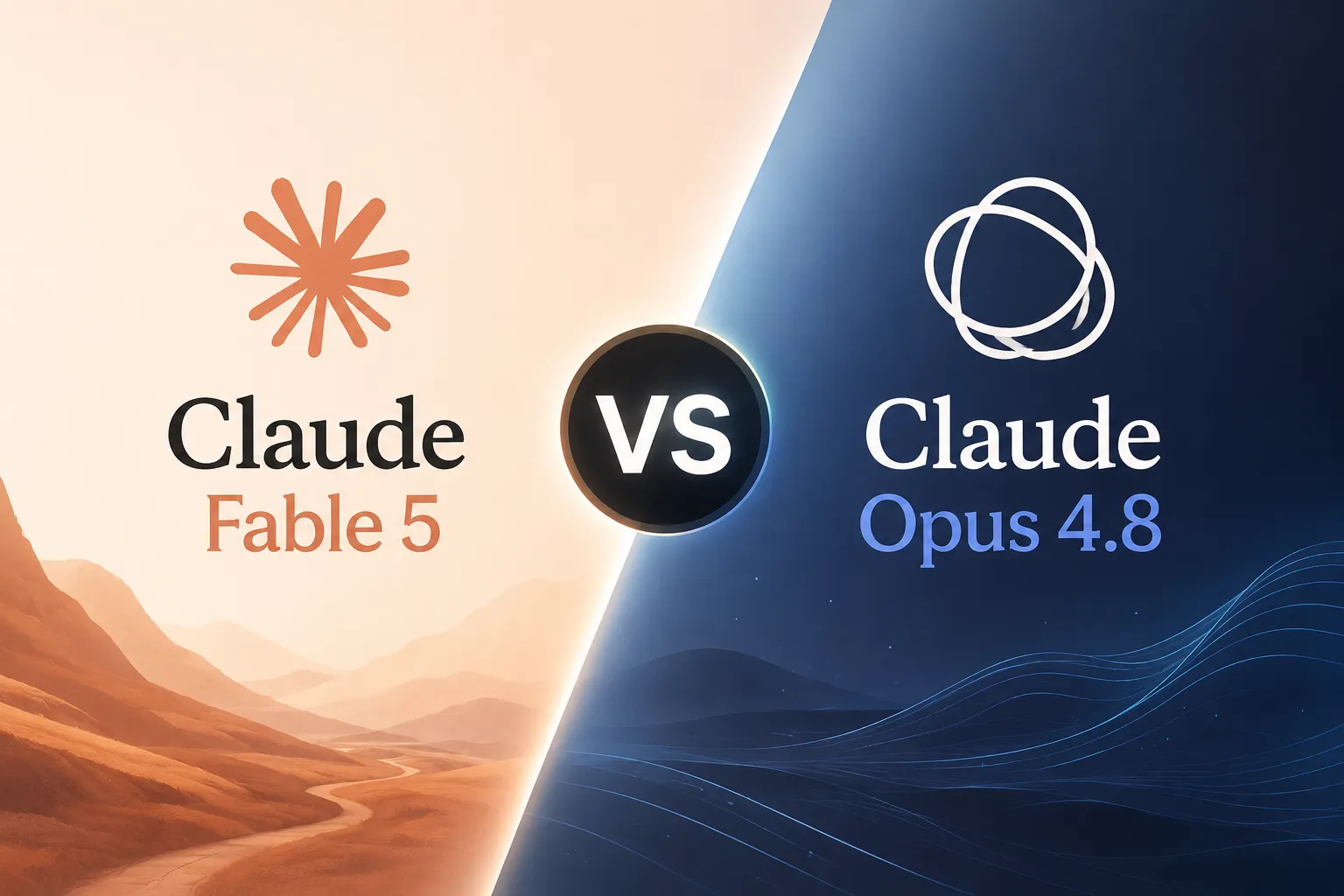
When Claude Fable 5 launched on June 9, 2026, it gave developers a second tier above Opus for the first time. The first question was simple: is the jump worth double the price? This post answers that for Fable 5 and Opus 4.8, the pair most people searched for, and then brings the picture up to date.
Short version: Fable 5 beat Opus 4.8 by a wide margin on hard coding and long-running work. Since then Anthropic has shipped Opus 5, Opus 5.5, Fable 5.1 and Fable 5.2, and both original models have been replaced. The gap and the price question haven't gone away, they've just moved up a version.
As of November 16, 2026, these are the models in play. Prices are from Anthropic's pricing page, and all of them have a 1M-token context window and 128K output.
Fable 5 was built for demanding reasoning, software engineering, research and long-running tasks. Opus 4.8 was aimed at agentic coding and everyday enterprise work. Here's the launch-day comparison:
Fable 5 scored 11.1 points higher on SWE-Bench Pro and 15.9 points higher on FrontierCode. The gap shows up most on large codebases, multi-file debugging and tasks that run for hours. For a small bug fix, you probably won't notice it.
Benchmarks measure specific tasks under specific conditions, so treat them as a starting point. Run your own prompts and track completion rate, retries, latency, token use and how often a human has to step in. Our guide to benchmark scores in production explains why.
At launch Fable 5 cost twice as much as Opus 4.8 on every line:
The sticker price overstates the gap a little. Fable often finishes in fewer turns, and you don't pay Fable rates for requests that get rerouted to Opus. Even so, for high-volume or simple work, the cheaper model usually wins. Newer pricing narrowed the spread in absolute terms: Fable 5.2 is $8 / $40, and Opus 5.5 is $4 / $20. The ratio is still 2 to 1. For more on keeping spend down, see our LLM cost optimization guide.
Usually, yes, on hard tasks. Fable works through more steps before it answers, which is where the quality comes from and also where the extra seconds go. On short prompts the difference is small. If your app is latency-sensitive, such as a chat UI or an autocomplete, Opus is the safer pick. If a job runs in the background, the wait rarely matters.
Reasoning and coding. Fable holds up better on repository-level changes and problems that need many dependent steps. Opus is plenty for scoped tasks.
Long-running work. Fable stays on track across long agent runs more reliably, so it needs fewer restarts and less hand-holding.
Limits. Both have a 1M-token context window and 128K output, so context size won't decide it.
Safeguards. Fable includes classifiers for cybersecurity, biology and chemistry, and distillation. Anthropic says fewer than 5% of sessions trigger them.
If a Fable request trips a safeguard, it can be handed to Opus, and the user is told. In the Claude apps this happens automatically. API customers set it up through Anthropic's Fallback API, so it isn't on by default. Plan for it: treat the two models as a pair and make sure your app handles an answer that came from the other one.
Choose Fable for long multi-stage work such as large migrations or multi-day agent runs, for hard problems where quality matters more than token cost, and for deep research or coding where Opus has stopped improving.
Choose Opus for well-defined routine tasks, anything where latency or cost comes first, and high-volume traffic where double pricing adds up fast.
Most teams don't need to pick one. Send each request to the model that fits it. Useful signals are task complexity, traffic volume, per-team budget and what should happen on an error or rate limit. Default to the cheaper model and escalate when the task needs it.
An AI gateway makes this practical because both models sit behind one OpenAI-compatible endpoint. Changing models is a one-line change, not a new integration.
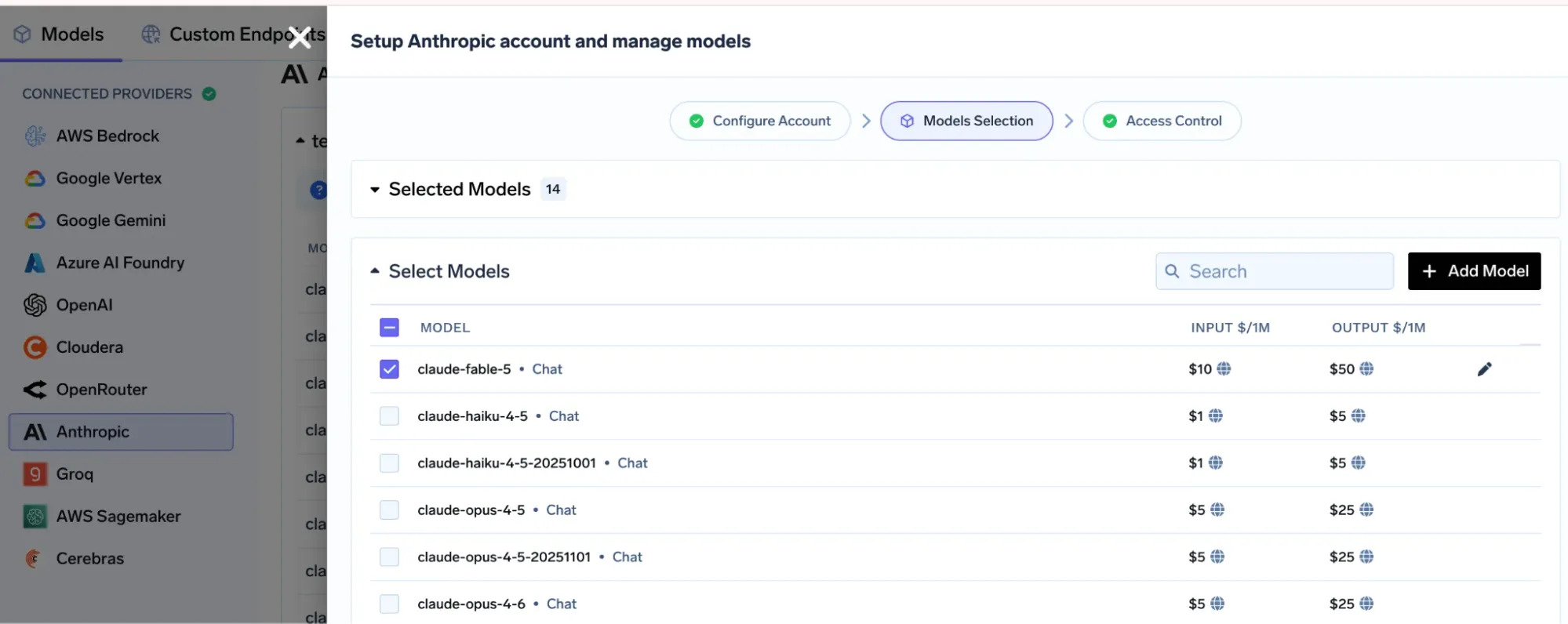
Step 1. In your connected Anthropic provider, open Models Selection and enable the Fable and Opus models you want. Use Access Control to decide which teams and apps can call each one.
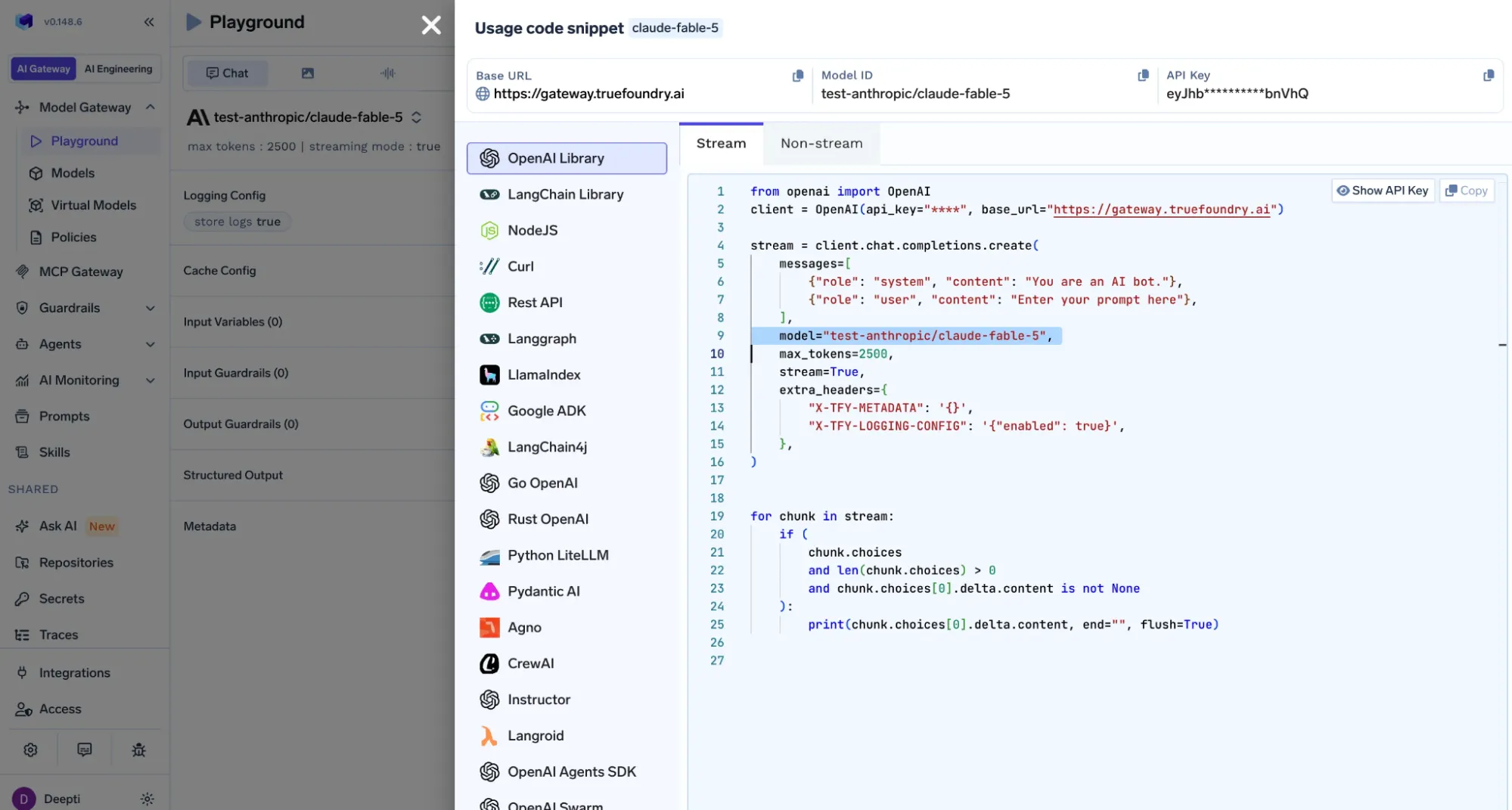
Step 2. Open the Playground, pick a model and copy the usage snippet. To switch models later, change the model ID.
Once routing is live, watch cost per request, latency, completion rate, retries, errors and how often fallback fires. Those numbers tell you whether the split is working. Our AI usage analysis shows how to break them down by team. For the full model-by-model rundown, see Claude Fable 5 API, benchmarks and pricing.
TrueFoundry AI Gateway delivers ~3–4 ms latency, handles 350+ RPS on 1 vCPU, scales horizontally with ease, and is production-ready, while LiteLLM suffers from high latency, struggles beyond moderate RPS, lacks built-in scaling, and is best for light or prototype workloads.

Anthropic’s published benchmarks show Fable 5 ahead on several demanding coding and reasoning tests, including SWE-Bench Pro and FrontierCode. The difference is more relevant for complex, long-running tasks; for routine workloads, Opus 4.8 may still meet your requirements at a lower cost.
Fable 5 costs $10 per million input tokens and $50 per million output tokens. Opus 4.8 costs $5 and $25 respectively. That makes Fable 5 roughly twice the price on both input and output tokens.
Anthropic says some flagged cyber, bio-chemical, or model-distillation requests may be routed from Fable 5 to Opus 4.8. This applies to a small share of sessions, and those requests are billed at the Opus 4.8 rate rather than the Fable 5 rate.
Fable 5 is positioned for more demanding reasoning, coding, and long-horizon agentic workloads. However, benchmark differences do not mean that Opus 4.8 cannot perform these tasks. The practical difference depends on task complexity, accuracy requirements, cost, and how much supervision your workflow needs.
Fable 5 is the newer, higher-priced model, while Opus 4.8 costs about half as much per input and output token. Their reported benchmark performance also differs, particularly on complex coding and reasoning workloads.
Yes. Both models can be accessed through the same TrueFoundry AI Gateway endpoint. You can route requests to either model using its model ID, allowing your application to switch between models without maintaining separate integrations.
Check the current model documentation before implementation, as context limits can vary by model and API configuration. Context window size should be evaluated alongside output limits, pricing, and actual prompt requirements rather than treated as the only capacity metric.
Yes. If you are selecting a model for a new deployment, compare the models currently available for your platform rather than relying only on a Fable 5 vs Opus 4.8 comparison. Anthropic's current documentation lists newer models, including Fable 5.1 and Opus 5.5.
For workloads where Opus 4.8 provides sufficient quality, its lower token price can make it a practical option. Teams can also use both models, routing more demanding tasks to Fable 5 while keeping routine or high-volume traffic on Opus 4.8.



The latest news, articles, and resources sent to your inbox