November 18, 2026
|
5 min read



Blazingly fast way to build, track and deploy your models!
Large language models become core components of production software. Swap providers, iterate prompt structures, experiment with datasets, or build complex chains: there comes a point where every dev wants a uniform experience working with multiple LLMs. LiteLLM aims to deliver that. It is a Python library offering a consistent API to multiple providers via abstraction layers, including OpenAI, Anthropic, Cohere, and several open-source projects such as LLaMA and Mistral.
The benefits are clear: lightweight, trivially integrated into your app, and convenient to prototype or switch between different models. The drawbacks set in when teams grow and applications evolve past these requirements. This analysis summarizes developer feedback on LiteLLM, compares it against competing platforms, identifies key weaknesses, and proposes alternatives based on actual use cases rather than surface-level metrics.
Overview of Common Problems We Hear From Developers About LiteLLM here.
LiteLLM is a great tool to get started with multi-model routing. It abstracts over different LLM providers like OpenAI, Anthropic, Cohere, and more — making it easier to prototype agent workflows with a single interface.
However, when moving beyond local development into enterprise-grade use cases, several critical challenges emerge -
In this article, we’ll break down what LiteLLM does well and where it might fall short. Then, we’ll explore five strong alternatives that offer broader capabilities. Whether you're looking for more control, deeper observability, or better scalability, these tools can help you find the right fit for your growing GenAI infrastructure needs.
LiteLLM solves a very tangible pain point in large-scale AI development. Switching among various providers' APIs during the prototyping phase of a project, comparing output quality across multiple models, testing prompt modifications for performance and accuracy, this is where LiteLLM shines. It offers a single API layer wrapping OpenAI, Anthropic, Cohere, HuggingFace transformers, and several other popular providers. Configuration changes allow developers to swap implementation details at runtime, enabling seamless switching and comparison processes within their applications. These are precisely the scenarios where LiteLLM delivers value, so long as the use case remains prototypical.
Here are some core limitations to note upfront:
Key Features:
Pricing: LiteLLM itself is completely free and open source. Since it doesn't host or serve models directly, you only pay for the usage of the underlying LLM providers (like OpenAI or Anthropic). There’s no licensing fee to use LiteLLM.
Challenges: While LiteLLM is great for quick integrations and prototyping, it may fall short for production-grade applications. It lacks advanced observability, security controls, audit trails, and enterprise features like model performance tracking or fine-tuning support. There’s also limited built-in support for self-hosted or open-source model deployment, which some teams may need as they scale. As teams scale, understanding LLM licenses also becomes important, especially when mixing commercial APIs with open-source models that may carry different usage restrictions. It’s a powerful abstraction layer but not a full-fledged infrastructure platform.
One of the most cited concerns with LiteLLM is the significant latency it introduces, especially when acting as a proxy for external LLM providers like OpenAI, Anthropic, or Cohere. In performance benchmarks, this latency overhead becomes a bottleneck for real-time applications such as chat agents, voice assistants, and AI-powered customer support tools. The additional delay often outweighs the benefits of its abstraction, especially when used in agent loops where multiple LLM calls are chained together.
LiteLLM’s lightweight nature makes it appealing for simple use cases, but deploying it in enterprise-grade environments—such as on-premise servers, secure VPCs, or Kubernetes clusters, requires significant manual scaffolding. There’s no built-in support for platform-level concerns like service discovery, autoscaling, centralized logging, or secure configuration. As a result, teams in regulated industries or with strict compliance needs find it hard to adopt and operationalize LiteLLM in production.
LiteLLM is an open-source project with no formal commercial backing, which means there’s no enterprise support plan, no SLAs for uptime, and no dedicated escalation path. This makes it a risky dependency for mission-critical AI workloads where reliability, accountability, and proactive support are essential. Teams building production systems need guarantees and support structures that LiteLLM currently does not offer.
Due to its rapid development cycle and community-driven nature, LiteLLM can be unstable when used at scale. Users have reported frequent regressions between versions, edge-case bugs, and inconsistent behavior in concurrent or multi-tenant scenarios. Without rigorous testing pipelines or backward compatibility guarantees, deploying LiteLLM into high-scale systems often leads to unpredictable production issues.
While LiteLLM simplifies the task of routing API calls across multiple LLM providers, it does little beyond that. It doesn’t support open-source model hosting, fine-tuning workflows, observability such as tracing of agents, multi-tenant governance, or agent tool integration—features often required by enterprises deploying LLMs at scale. Teams looking for a unified GenAI platform will find LiteLLM too narrow in scope, requiring them to build or bolt on these missing capabilities themselves.
LiteLLM is well-suited for developers who need to quickly test different LLM APIs or prototype new ideas. However, the moment those prototypes need to scale into production, especially in terms of observability, security, and reliability—it starts to fall short. Managing API keys, usage quotas, latency metrics, and routing logic manually becomes a burden that doesn’t scale with growing workloads or team needs.
Also Read: Kong vs LiteLLM
LiteLLM works by sitting between your application and multiple large language model (LLM) providers, acting as a lightweight abstraction layer. Instead of calling OpenAI, Anthropic, or other LLM APIs directly, you send your requests through LiteLLM, which then forwards them to the selected provider using a consistent API format. This design allows you to write your application once and swap out LLMs behind the scenes without making major changes to your codebase.
The library is built to mimic the popular OpenAI API format, so if your app already uses OpenAI’s chat/completions or completions endpoints, you can plug in LiteLLM with minimal refactoring. You can change providers simply by updating environment variables or configuration files, which makes it ideal for testing different models or balancing performance and cost.
In addition to its core abstraction layer, LiteLLM also supports a proxy mode. In this setup, LiteLLM runs as a local or hosted server that handles LLM API calls for your application. This proxy enables additional functionality, such as:
LiteLLM’s proxy mode is especially useful in development and staging environments where teams need visibility into how models behave without adding heavy infrastructure.
Behind the scenes, LiteLLM uses Python’s requests library to send and receive API calls. It supports both synchronous and asynchronous calls and includes hooks for custom logging, key rotation, and request handling. The architecture is intentionally lightweight, with minimal dependencies and a clear focus on developer experience.
While LiteLLM is not designed to manage complex model routing at scale, it gives teams an easy on-ramp to working with multiple providers and reduces integration time significantly. For many early-stage applications or experiments, it removes the friction that typically comes with managing different LLM APIs.
LiteLLM provides a convenient way to connect with multiple LLM providers through a unified API. However, as AI workloads move into production, teams may need capabilities that go beyond basic model routing and API management.
Here are some reasons to consider LiteLLM alternatives:
A side-by-side look at the top LiteLLM alternatives in 2026.
Developers researching LiteLLM alternatives often also compare abstraction layers and routing tools more directly. For example, discussions around LiteLLM vs OpenRouter typically focus on differences in provider coverage, latency overhead, caching behavior, and production readiness. While both aim to simplify multi-model access, enterprise teams often require deeper observability, governance, and scaling capabilities than lightweight wrappers provide.
Although LiteLLM serves as a useful abstraction layer to deal with several LLM vendors, it might not have all that teams require as they transition to the production stage or take up more advanced workloads. In case you need more features like observability, model orchestration, traffic control, or API management, then there are some other platforms that would suit your needs better.
Here are top seven LiteLLM alternatives to consider in 2026:
TrueFoundry is a powerful alternative to LiteLLM for teams that need more than just model abstraction. While LiteLLM is excellent for unifying APIs across LLM providers, TrueFoundry is built for teams who want to run LLMs in production—backed by robust infrastructure, observability, and full control over how models are deployed and scaled.
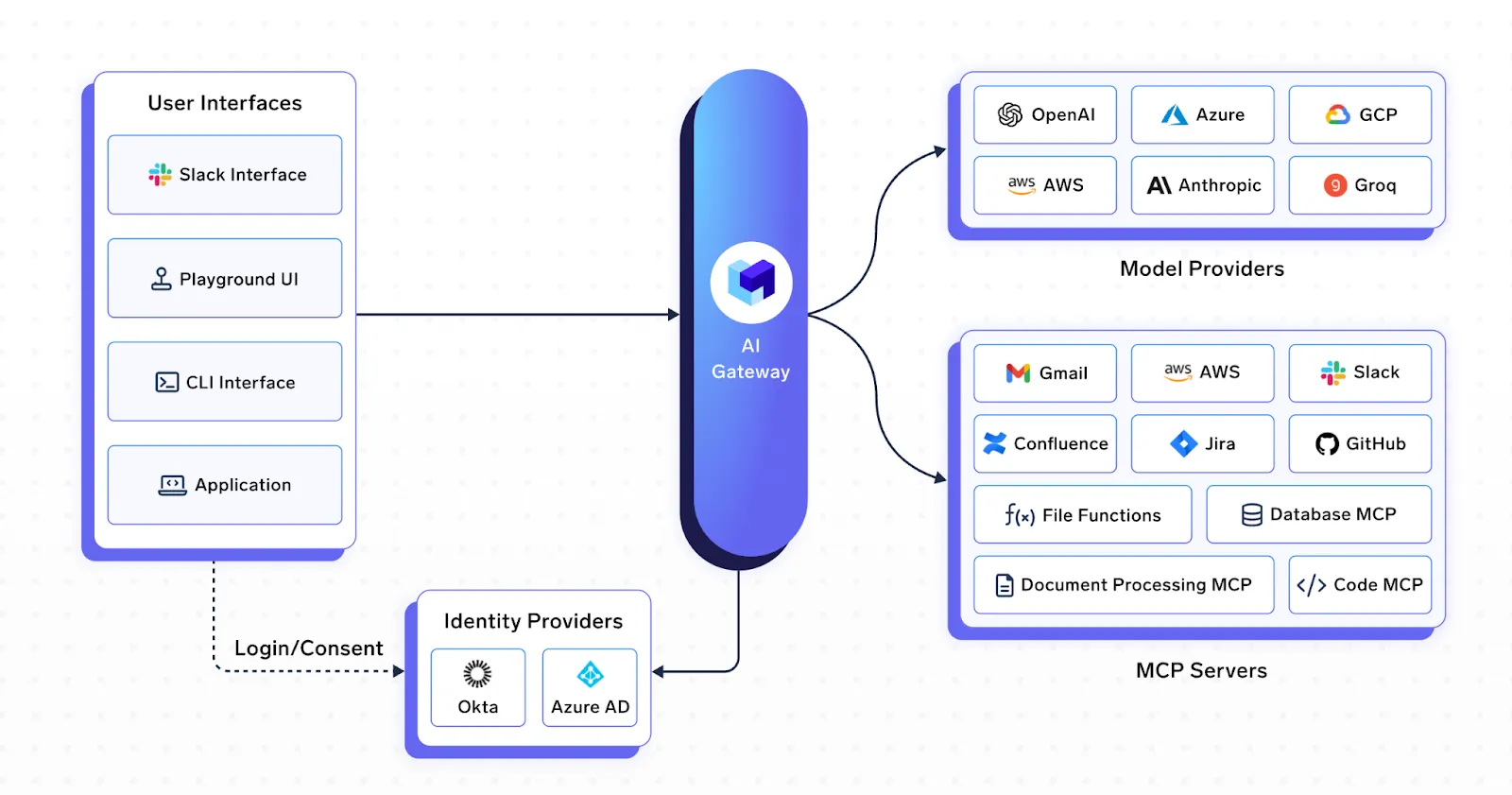
TrueFoundry comes equipped with an LLM Gateway, but it does not end there. You can deploy, train, and run open-source models such as Mistral or LLaMA in the cloud or on-premises environment. This is an improvement over LiteLLM, which provides no room for hosting or training models and depends solely on third-party APIs. Unlike LiteLLM, which comes with just a proxy server, TrueFoundry comes as a managed solution, featuring traffic routing, failover management, prompt versioning, cost analysis, and observability out of the box.
It covers a wide range of providers from OpenAI, Anthropic, and Hugging Face but also enables the deployment of self-hosted models via vLLM and TGI. It allows you to transition from API-based models to your own hosted models without changing anything about your integration.TrueFoundry being run on your Kubernetes cluster gives it an advantage over LiteLLM in terms of security and compliance.
TrueFoundry offers a free Developer plan, a Pro plan starting at $25/user/month, and custom Enterprise pricing. Plans include AI Gateway and MCP Gateway capabilities, with higher tiers offering advanced guardrails, budget controls, SSO, audit logs, and private deployment options. Model provider charges are billed separately, with no token markups.
LiteLLM simplifies development, but TrueFoundry enables scale. It’s ideal for teams moving beyond experimentation and into production, especially those who want to maintain flexibility over where and how their models run. If you're ready to build serious GenAI systems with observability, deployment control, and performance optimization, TrueFoundry offers what LiteLLM lacks out of the box.
For more details, check out our documentation.
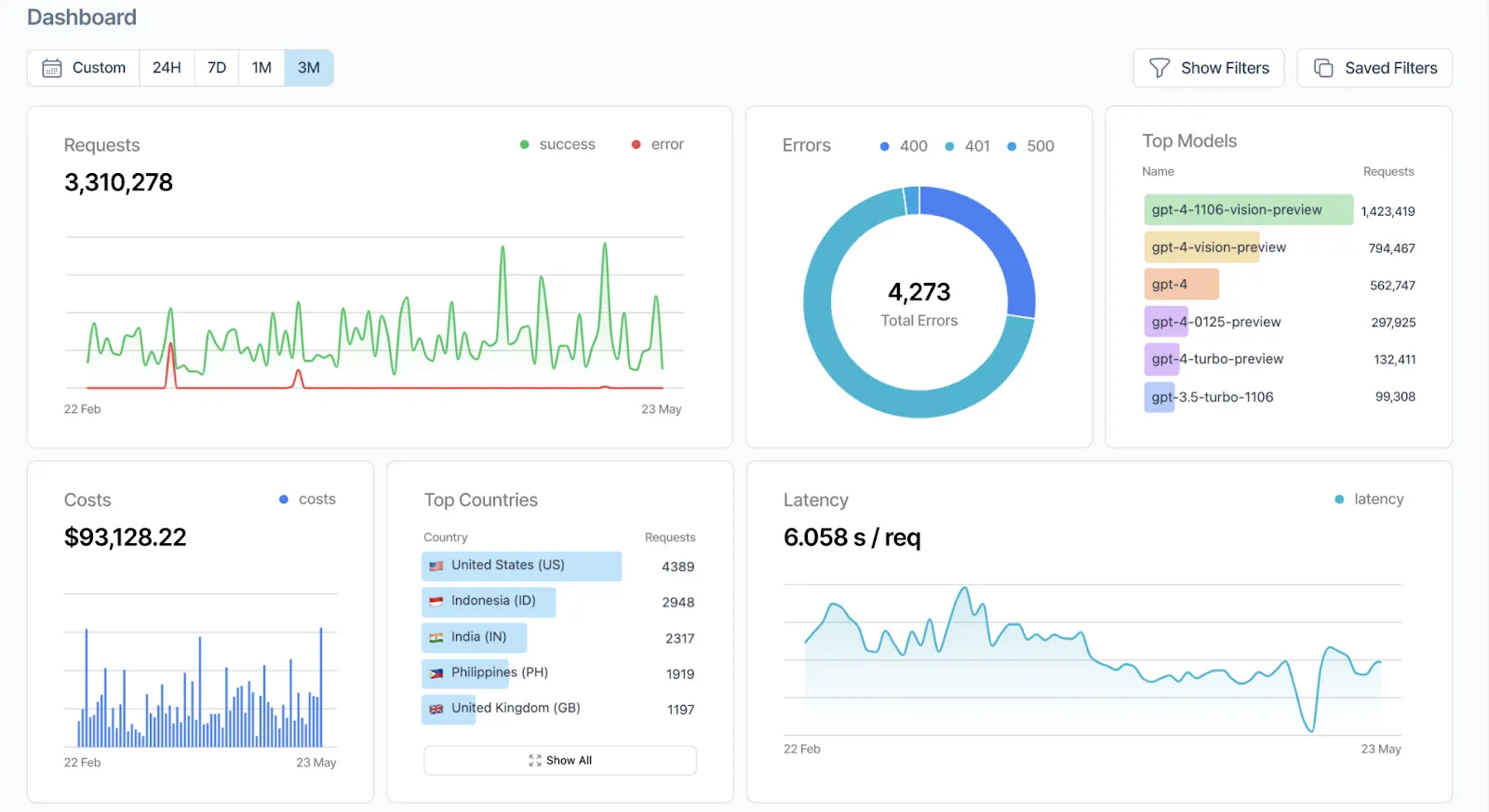
Helicone is another great open-source project, an observability layer designed specifically for organizations building with large language models. In contrast to LiteLLM, which is aimed at providing a unified access point to several providers and facilitating the routing between them, Helicone addresses another important aspect – visibility. Helicone allows you to track all the details of LLM requests that you make to gain insights into how to properly utilize the models. Helicone works as a proxy server located between your app and your provider.
Instead of making requests directly to OpenAI or Anthropic, you make all your API calls via Helicone. After that, it provides rich metadata about each request including latency, input prompt, output response, tokens, error rate, and estimation of the cost. The information about each request will be available in a neat developer-friendly dashboard.
Unlike LiteLLM, which helps to manage the heterogeneity of providers, Helicone comes in handy when the team is committed to using one or several providers, yet needs transparency. It is very useful when the quality of prompts, user activity, and performance consistency matter. Helicone is also available for self-hosting, so the organization has full control of logging and data retention. It can be easily integrated with any GenAI stack based on Python.
Helicone offers a free Hobby plan with 10,000 requests, 1 GB storage, and 7-day data retention. Its Pro plan costs $79/month, while the Team plan costs $799/month, offering higher ingestion limits, longer data retention, and additional collaboration features. The Enterprise plan has custom pricing and includes SAML SSO, on-premises deployment, and dedicated support options.
Helicone doesn’t replace LiteLLM’s routing logic, but it can act as a strong companion—or an alternative if your priority shifts from model abstraction to monitoring. If you’re using one or two primary models and need deeper insight into how they behave in production, Helicone offers visibility that LiteLLM currently lacks. It’s a focused tool that adds real value to teams aiming to debug and refine their LLM usage at scale.
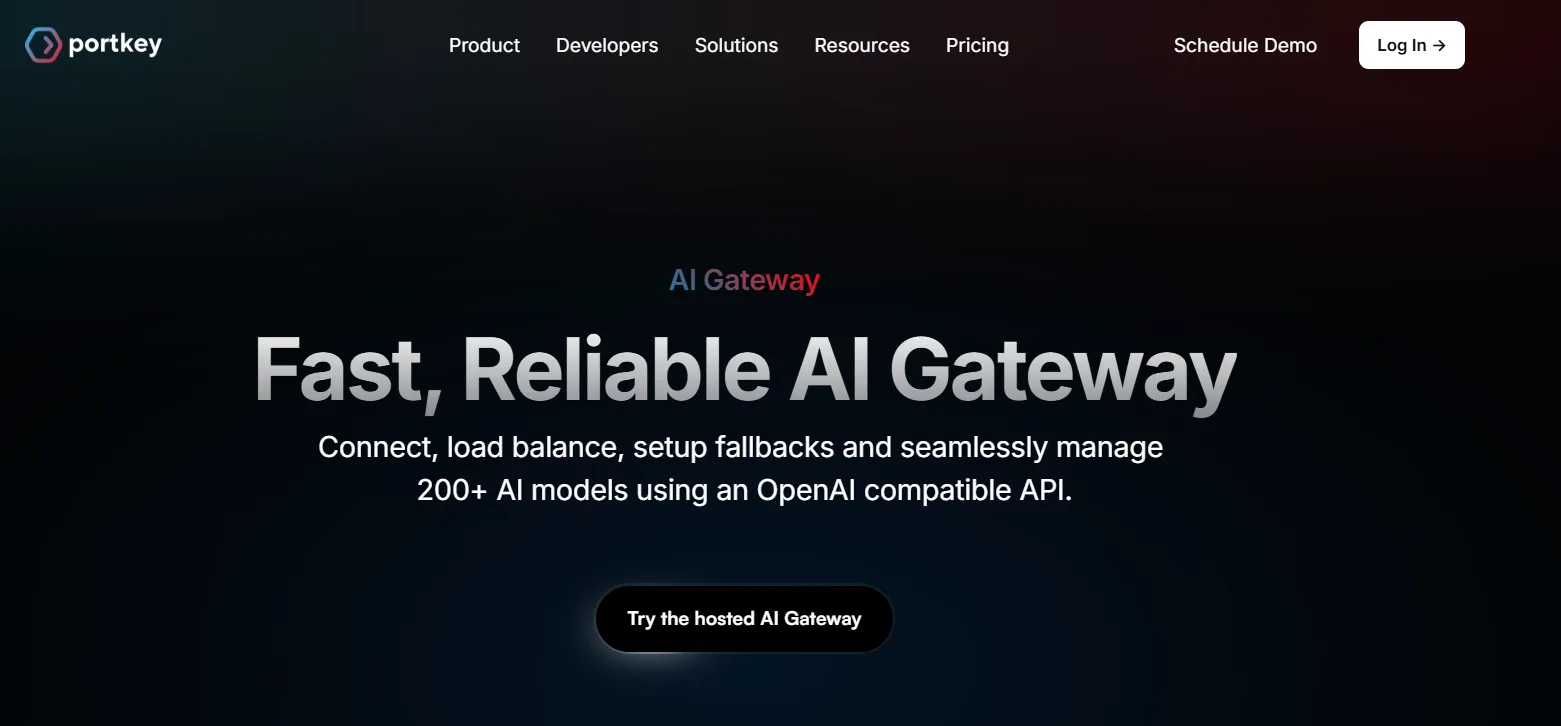
Portkey is an LLM Infrastructure Layer solution aimed at enabling developers to handle API requests across various language models providers efficiently. Similarly to LiteLLM, Portkey provides a common API to connect with LLMs from providers such as OpenAI, Anthropic, Mistral, and others. However, while LiteLLM strives for simplicity, Portkey is made specifically for a more resilient environment and provides additional features for greater control over the process.
For instance, Portkey allows you to perform request retries, caching, timeouts, and fallback routing. Thus, Portkey is especially useful for maintaining the stability of GenAI products in case of latency or outages of the providers. Furthermore, Portkey can track costs and tokens per request, which is not available in LiteLLM due to its minimalistic nature. Portkey can be run both in the cloud and in-house and is suitable for teams that need reliable infrastructure but don't want to develop their own retry and routing mechanisms.
Portkey offers a free Dev plan with 10,000 logs per month and 3-day data retention. Its Pro plan starts at $49/month and includes 100,000 logs, 30-day retention, and RBAC. The Enterprise plan has custom pricing with SSO, VPC deployment, advanced security, and governance features. Portkey also offers a free open-source, self-hosted option.
Portkey is a good step up in Portkey vs LiteLLM comparisons when your LLM calls need more than simple abstraction. It adds robustness and basic observability, making it suitable for teams moving from experimentation into production where uptime and cost efficiency start to matter.
Also explore: Top 5 Alternatives to Portkey
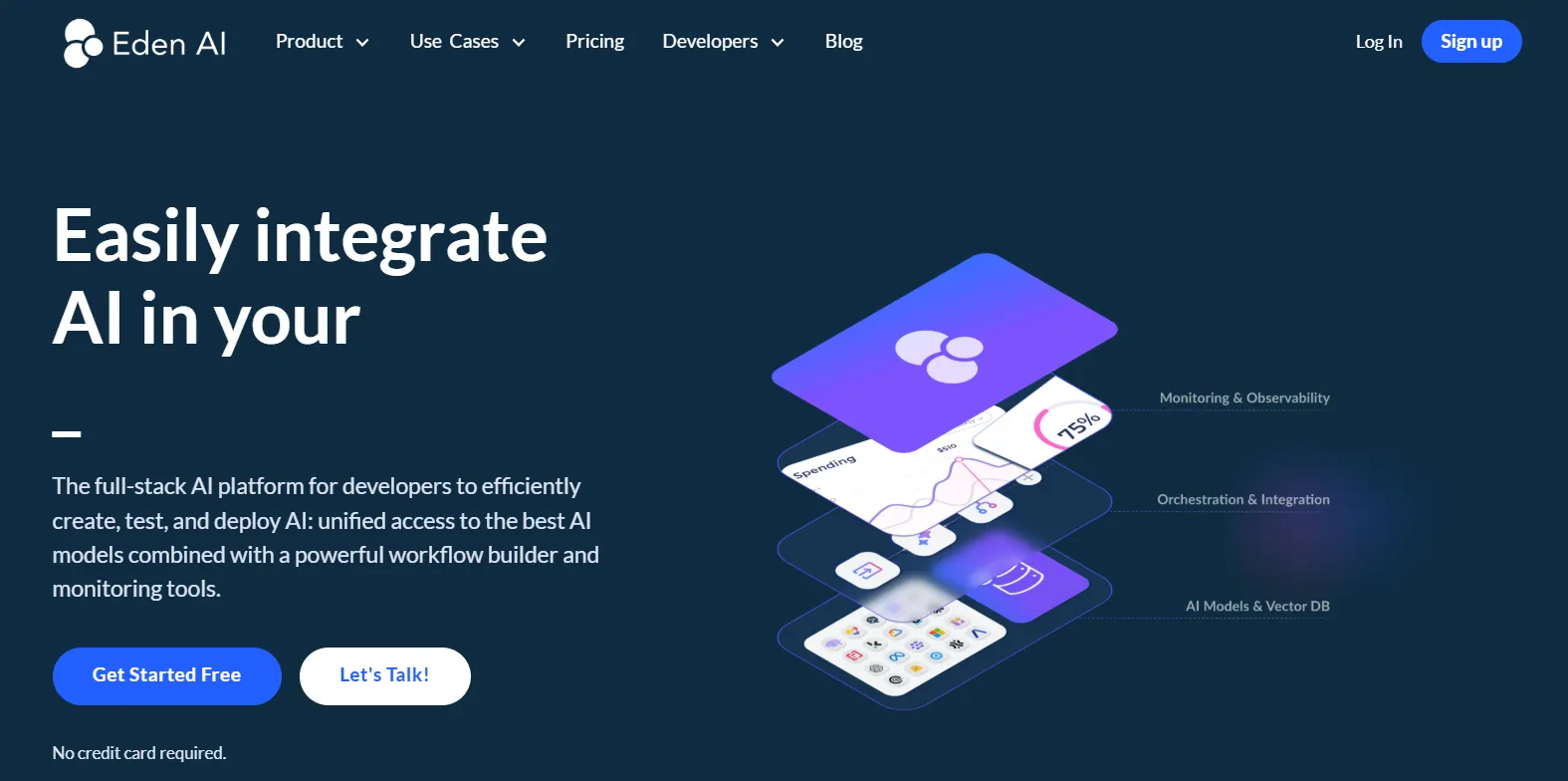
Eden AI is an API market that enables developers to access several AI providers through one unified API, such as language models, OCR, translation, and speech-to-text. Whereas LiteLLM only abstracts LLM providers,
Eden AI adopts a different strategy where the process of integrating with providers is made seamless and it becomes easy to combine services of providers without having to handle several integrations. For the case of LLMs, some of the supported providers include OpenAI, Cohere, and DeepAI.
Eden AI follows a pay-as-you-go pricing model with no monthly subscription fee. Its self-serve plan charges a 5.5% platform fee on top of provider costs and includes access to hundreds of AI models, unified API billing, and usage monitoring. The Advanced AI Platform offers custom pricing with higher rate limits, volume discounts, private deployments, and dedicated support.
If you’re looking for an easy way to connect to LLMs and other AI services without managing multiple APIs, Eden AI is a practical option. While not as developer-centric as LiteLLM, it’s ideal for teams who want a broader range of AI tools through one interface.
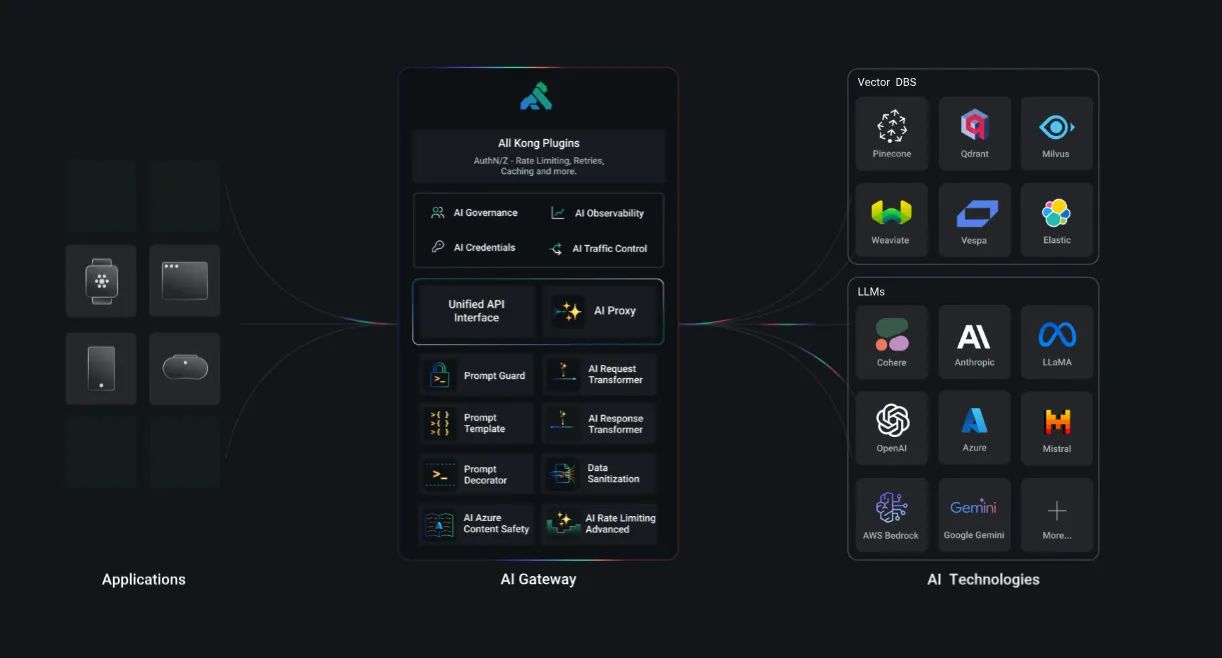
Kong AI is another implementation of the popular Kong Gateway that is designed to facilitate API management of AI workloads, including LLMs. Where LiteLLM specializes in the abstraction of LLM APIs on the application side, Kong AI introduces enterprise-level API gateway features such as traffic control, authentication, rate limiting, and observability, designed for AI applications.
Kong AI allows organizations to handle their interactions with multiple LLM providers. This solution does not offer the unified syntax for LLMs provided by LiteLLM, but it offers more advanced features in terms of managing and monitoring the interactions between an organization’s systems and LLMs. This can be an excellent choice for companies that already utilize Kong for their standard APIs and want to extend the coverage to LLMs.
Kong does not offer Kong AI as a standalone product. Its AI Gateway capabilities are included across Kong OSS, Kong Konnect, and Kong Enterprise. Kong OSS is free and self-hosted, while Kong Konnect Plus starts at $25/month, with additional charges for extra LLM models and usage. Kong Gateway Enterprise offers custom pricing with access to advanced AI plugins and enterprise management features.
Kong AI is best for teams focused on security, scalability, and governance. It’s not a model abstraction layer but a powerful infrastructure option for managing LLM traffic in production environments.
For teams evaluating a Kong alternative focused specifically on GenAI workloads, Kong AI stands out as a strong option when governance, traffic control, and enterprise security matter more than model abstraction.
Also Read: Bifrost vs LiteLLM
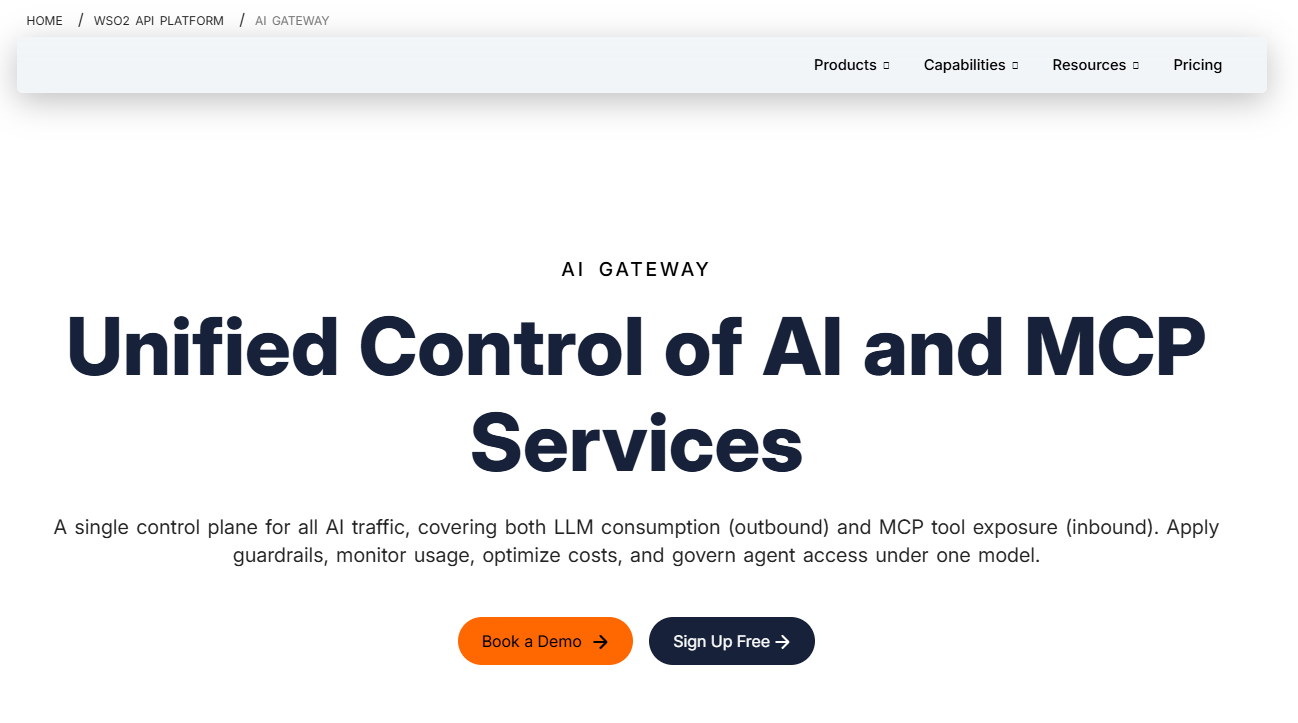
WSO2 AI Gateway is an enterprise-grade, open-source control plane designed to govern, secure, and optimize LLM traffic and MCP server interactions. Unlike standalone proxies that primarily focus on model access, WSO2 integrates AI gateway capabilities with its broader API management platform. It helps organizations manage traditional APIs, LLMs, and AI agents through a unified environment.
WSO2 AI Gateway supports interactions with multiple LLM providers, including OpenAI, Anthropic, AWS Bedrock, Azure OpenAI, and Google Gemini. It also allows organizations to convert existing REST APIs into governed MCP tools for AI agents. This makes it a suitable option for enterprises looking to manage both LLM traffic and agent integrations.
WSO2 offers a free, Apache 2.0-licensed open-source version alongside managed cloud plans. Its 30-day free trial includes up to five managed LLM APIs, five MCP servers, and one million AI gateway events. The Growth plan starts at $119/month, while Enterprise pricing is customized based on deployment and usage requirements. Self-hosted and private data plane deployment options are also available.
WSO2 AI Gateway is a strong LiteLLM alternative for enterprises that need more than a unified LLM API proxy. While LiteLLM focuses primarily on model access and routing, WSO2 extends AI governance to API lifecycle management, MCP servers, security, and monetization.
It also offers greater flexibility for enterprise deployments through its Apache 2.0-licensed core, including self-hosted and air-gapped environments. Its control plane can govern APIs across multiple gateway technologies, while built-in analytics and customizable guardrails help teams manage production AI workloads.
For organizations looking for a LiteLLM alternative with broader API management, enterprise governance, and MCP support, WSO2 AI Gateway is worth considering.
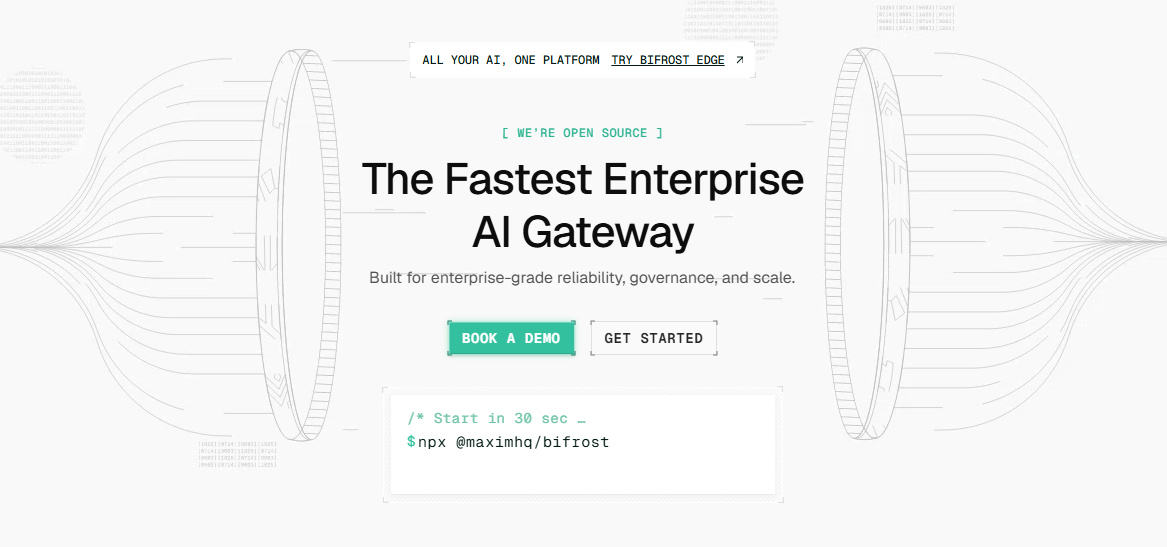
Bifrost by Maxim AI is an open-source, high-performance AI gateway written in Go. It provides access to over 1,000 models across 20+ providers through a single OpenAI-compatible API. Its low-latency architecture makes it an alternative to Python-based gateways like LiteLLM, particularly for production-scale AI workloads.
Bifrost offers a free, Apache 2.0-licensed self-hosted version with core gateway capabilities. Its Enterprise plan has custom pricing and adds high availability, SSO, RBAC, audit logs, and advanced guardrails. A 14-day Enterprise trial is available. Infrastructure and LLM API usage are billed separately.
Bifrost is a strong LiteLLM alternative for teams prioritizing low latency, high throughput, and production reliability. Its Go-based architecture reduces gateway overhead, while single-binary deployment simplifies infrastructure management.
Unlike LiteLLM's primary focus on LLM API routing, Bifrost also offers native MCP integration, agentic tool management, and a built-in administration dashboard. This makes it suitable for teams building high-performance AI applications and agent workflows.
LiteLLM is the best place to start for developers who need an easy way to plug in multiple LLMs; however, as systems evolve and scale, the requirements for infrastructure become more complicated. Be it observability, routing, or better control of traffic, platforms such as TrueFoundry, Helicone, Portkey, Eden AI, and Kong AI provide a more specialized approach to scaling GenAI. It all comes down to choosing the most suitable platform based on your priorities—be it flexibility, performance, or security at an enterprise level.
Although there are gateways available through platforms such as Portkey and Helicone, TrueFoundry emerges as the top choice compared to LiteLLM when performance requirements are concerned. This is because while LiteLLM may create a noticeable lag in terms of speed, TrueFoundry’s AI Gateway comes with low overhead of about 3-4 milliseconds and is capable of handling 350+ RPS in one vCPU.
The most common reason for teams searching for a replacement to LiteLLM is the maturing of their application and the requirement for good performance. The first reasons are high latency and its negative effect on the user experience and the absence of SLA agreements or enterprise support. Moreover, LiteLLM turns out to be hard to deploy in secure or on-premise or VPC environments. TrueFoundry can help in solving these problems.
LiteLLM is very effective at developing prototypes and applications that are in the early development stage; however, it has challenges when used in production systems. The community-based nature of LiteLLM implies that it does not have enough stability and robustness to be used in mission-critical applications. The production system requires a framework that provides features such as TrueFoundry.
TrueFoundry is the optimal option for Enterprise use-cases. While more than simply providing an API gateway layer, it offers a full-featured LLM operating system. Some of the benefits for enterprises are central key management, cost auditing, and latency-driven routing along with enterprise support and SLAs. Another advantage of TrueFoundry is that it helps you remain compliant by ensuring that your data stays within your region and can run in your current Kubernetes cluster.
LiteLLM Alternatives indeed have support for hosting models yourself, and that's the primary point which makes them unique. Unlike LiteLLM, where the focus lies on API proxying, more advanced LiteLLM alternatives such as TrueFoundry not only support API calls to propriety API providers like OpenAI but also work well with open source models hosted by yourself like Llama or Mistral. TrueFoundry takes care of complexities of hosting those models for you, wherever you want to, either on-prem or in the cloud.
Other options, including LiteLLM, are open source. Nevertheless, open-source solutions cannot be guaranteed to have the necessary technical support required for enterprise-level use cases. Platforms such as TrueFoundry have managed to unite both worlds by offering all the benefits associated with being flexible and extensible along with providing high levels of reliability and security and round-the-clock technical support.
An Agent Gateway manages communication between AI agents, LLMs, and external tools, with features like agent authentication, authorization, policy enforcement, and MCP integration. LiteLLM primarily provides a unified API for accessing multiple LLM providers, routing requests, and managing usage.
LiteLLM is an open-source library and proxy that provides unified access to multiple LLM providers, along with routing and cost tracking. An LLM Gateway offers broader infrastructure capabilities, including centralized access control, observability, guardrails, load balancing, and enterprise deployment.
TrueFoundry AI Gateway delivers ~3–4 ms latency, handles 350+ RPS on 1 vCPU, scales horizontally with ease, and is production-ready, while LiteLLM suffers from high latency, struggles beyond moderate RPS, lacks built-in scaling, and is best for light or prototype workloads.




The latest news, articles, and resources sent to your inbox