


October 1, 2026
|
5 min read


Published: August 24, 2026
Blazingly fast way to build, track and deploy your models!
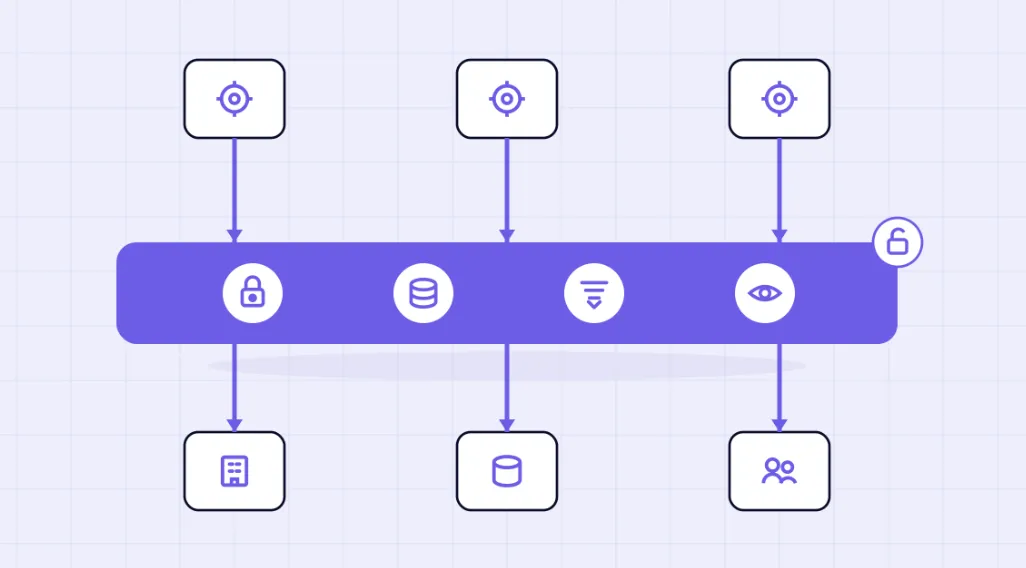
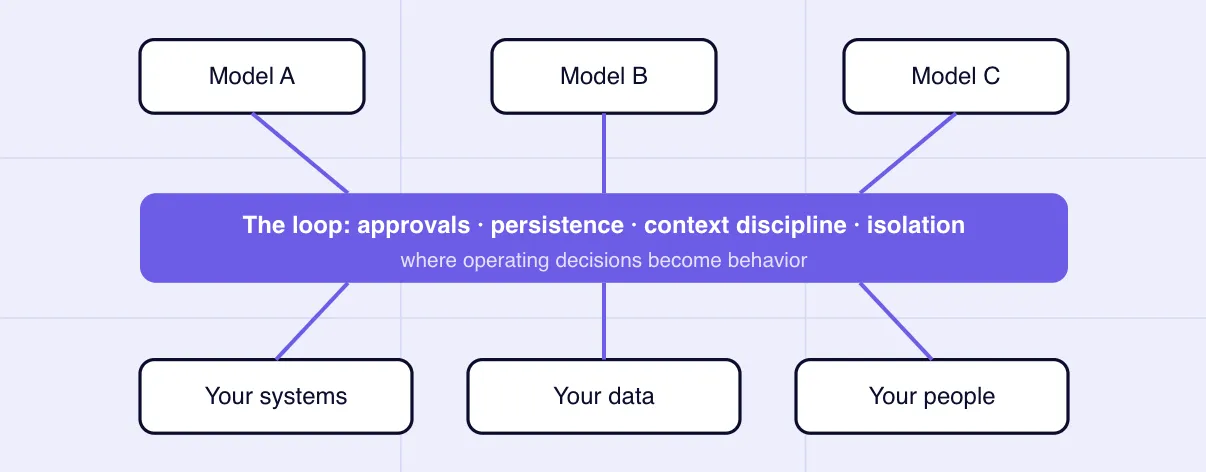
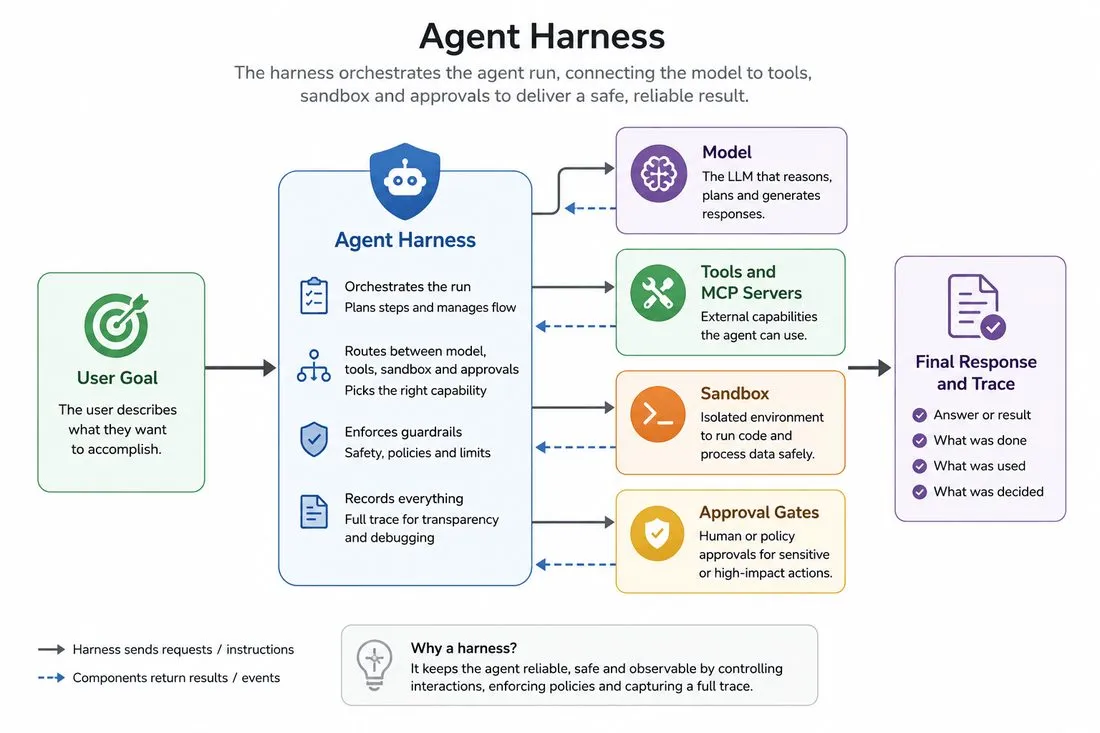
Every era of enterprise software develops a layer that looks secondary until operating decisions accumulate there. In the client-server era it was often the application server; in the cloud era, the container orchestrator; in the data era, the pipeline scheduler. The pattern is not that the celebrated component disappears, but that an increasing share of operational differentiation moves into the machinery that runs it. For AI agents, that machinery has a name. TrueForge's documentation defines the agent harness plainly: “the runtime layer around an LLM that turns it into a reliable, long-running agent.” Much of an enterprise's operational experience of an agent — whether a run survives a restart, whether a configured high-risk action waits for a human, whether working context is compacted or offloaded, whether code executes inside a sandbox, and whether a failure can be reconstructed afterward — is shaped in that runtime layer, in the execution loop between the model and the world. We have been calling the discipline of designing that cycle loop engineering, and published benchmark carry the measurements. This piece deliberately carries none. It makes the strategic argument instead: as model choice becomes more portable for a growing set of workloads, the loop increasingly resembles middleware because it concentrates persistence, context, approval, isolation, and observability decisions. Open standards and open-source implementations became strategically important in several earlier middleware categories; that history is context for, not proof of, TrueFoundry's decision to open-source its own harness.
A model is a capability; a loop is a place where policy can be enforced. The distinction becomes concrete when you list what the loop mediates on every circuit. Whether a configured tool call that writes to a production system proceeds or pauses — TrueForge's capability table states its version in six words: “Pause before write/destructive MCP tools.” Whether session state survives reconnects and restarts — the harness documentation makes that a runtime property rather than a prompt instruction. Whether generated code can see harness credentials — TrueForge's sandbox design keeps secrets in the harness and provisions compute only when needed. Whether a long task trims or offloads context; whether a delegated subtask returns its final result rather than its entire working transcript — these are runtime choices too. None of them is reliably enforced by model behavior alone. Each is an operational decision that an organization may want applied consistently, and that is one reason the loop starts to look like middleware: it is where operating intent can become repeatable behavior. The translation table is worth seeing whole, because the pattern is the argument:
Loop decisions compound differently from prompt instructions because runtime policy can mediate each turn deterministically. Change where compaction happens, and every long-running task using that runtime can inherit the change. Add an approval boundary, and a class of risky actions now requires an explicit authorization step rather than relying on behavioral discipline alone; misconfiguration, bypasses, and bad approvals are still possible. The mechanism is familiar from middleware — define a control once, apply it consistently — and it explains why senior engineering attention is moving toward the runtime. Prompt engineering asks what to say to the model. Context engineering asks what to show it. Loop engineering asks what the system does between model calls, and that question belongs as much to platform and security engineering as to prompt authors.
If the loop is where your operating judgment lives, the next question is uncomfortable: how inspectable and portable is it? The historical record is mixed, which is precisely why the useful lesson is narrower than “middleware always becomes open.” Enterprise application servers still include major proprietary products alongside open standards and open implementations. Container orchestration, by contrast, converged strongly around open-source Kubernetes, and workflow scheduling has influential open-source systems such as Apache Airflow alongside managed alternatives. The recurring pattern is not inevitability; it is that once an operational layer becomes strategically important, enterprises often value open interfaces, source availability, portability, and the ability to run or replace the layer on their own terms. A judgment layer benefits from being auditable because the judgment is yours.
The agent loop may follow part of that arc, and the argument for openness is concrete rather than ideological. Source availability makes implementation-level audit possible; it does not, by itself, prove that a deployed binary is trustworthy or correctly configured. A runtime that supports self-hosting can place the execution layer inside your boundary. An extensible open implementation can let teams change compaction, checkpointing, or integration behavior without waiting for a vendor roadmap. And public runtime semantics can reduce switching friction, although true portability still depends on data formats, integrations, external services, and operational practices. This is the context for TrueFoundry's own move: TrueForge is released under the MIT license with its runtime in the open (repository), supports local and hosted operation, treats models, MCP servers, and sandbox providers as connected dependencies, and documents its behavior publicly at trueforge.dev. We have made the fuller argument separately in Why agent harnesses should be open; the strategic summary fits on one line.
The middleware interrogation, in six questions: Does work survive a restart? What can the code-execution environment see? Which actions pause for a human — by runtime, or by hope? Does capability load on demand or ride every turn? Can a run be reconstructed from its traces? And if you left your runtime vendor tomorrow, what exactly would you lose?
Those six deserve elaboration, because the difference between a good and a bad answer is architectural, not rhetorical — and this is the interrogation we would run on any agent runtime, ours included. Continuity: if the process dies mid-task, can session state resume or does the work vanish? Containment: when the agent executes code, what can that environment see? One defensible pattern keeps harness credentials outside the sandbox; TrueForge documents this separation and provisions sandbox compute only when needed. Consent: which actions pause for a human, and is that enforced by runtime policy or merely requested in a prompt? Human approval is a mitigation, not a proof that harmful actions are impossible. Parsimony: does the runtime load capability on demand — tool definitions and skills materialized when reached for, as the harness capabilities describe — or does every agent carry the whole catalog on every turn? Legibility: when something goes wrong, can you reconstruct the steps the runtime actually recorded and correlate them with downstream logs? And portability: if you needed to leave your runtime vendor tomorrow, what code, state, integrations, and operating practices would move with you? A loop that answers these well is behaving like infrastructure. A loop that answers them only with a roadmap belongs on the risk register.
The quiet advantage of asking these questions against public documentation is that the answers are checkable. Every claim in this piece about TrueForge's behavior is a citation to its published docs, not a characterization of them — and where the evidence turns quantitative, we have kept it out of this essay deliberately and put it where methodology can travel with it: the benchmark page. Strategy pieces should argue; numbers should arrive with their error bars.
The working posture, then: treat the loop as a middleware decision. Inventory the operating judgments your agents currently enforce — and the ones they merely intend. Ask where each judgment lives: in a prompt that influences model behavior, in deterministic policy, or in a runtime whose implementation and exit path you may or may not control. Earlier infrastructure eras do not prove that agent runtimes must become open source, but they do show the value of portable interfaces and operational practices when underlying vendors change. The loop deserves the same foresight.
Disclosure first: TrueFoundry publishes this essay, sells the TrueFoundry AI Gateway, and maintains TrueForge, the open-source (MIT) agent harness discussed throughout — the argument for open runtime layers is one we have an interest in, made here with that interest visible. On method: this is a strategy essay by design — it contains no performance figures, and readers seeking evidence should consult the published benchmark and our empirical loop-engineering analysis, where numbers appear with their scope and limitations. All statements about TrueForge's behavior are quoted or tightly paraphrased from public documentation at trueforge.dev, linked at each claim; the historical analogies to application servers, orchestrators, and schedulers are editorial interpretation, offered as pattern rather than proof; and the middleware framing and the six-question interrogation are our editorial contributions. "Loop engineering" continues the vocabulary of our prior series, linked in References. No third party referenced evaluates or endorses TrueFoundry.
TrueFoundry publishes this analysis, sells the TrueFoundry AI Gateway, and maintains TrueForge (MIT). This essay intentionally contains no performance or cost figures; quantitative claims live in the linked benchmark and analysis, with methodology. Product behavior is quoted from public documentation at trueforge.dev with links at each claim. The middleware framing, historical analogies, and leader questions are editorial. Diagrams are original TrueFoundry graphics.
TrueFoundry AI Gateway delivers ~3–4 ms latency, handles 350+ RPS on 1 vCPU, scales horizontally with ease, and is production-ready, while LiteLLM suffers from high latency, struggles beyond moderate RPS, lacks built-in scaling, and is best for light or prototype workloads.






The latest news, articles, and resources sent to your inbox
.png)
.png)
.png)
.png)
.png)
.png)
.png)
.png)
.png)
.png)
.png)


