


October 1, 2026
|
5 min read


Published: June 26, 2026
Blazingly fast way to build, track and deploy your models!
Artificial intelligence is transforming how organizations operate, make decisions, and deliver value. But as AI becomes deeply embedded in business workflows, ensuring it is used responsibly is no longer optional.
Organizations must not only innovate faster but also comply with evolving regulations, protect sensitive data, and maintain trust in AI-driven decisions.
AI compliance provides the governance needed to achieve this balance. As frameworks such as the EU AI Act, NIST AI RMF, and ISO 42001 become industry benchmarks, organizations need processes and controls that ensure AI systems remain secure, transparent, and accountable throughout their lifecycle.
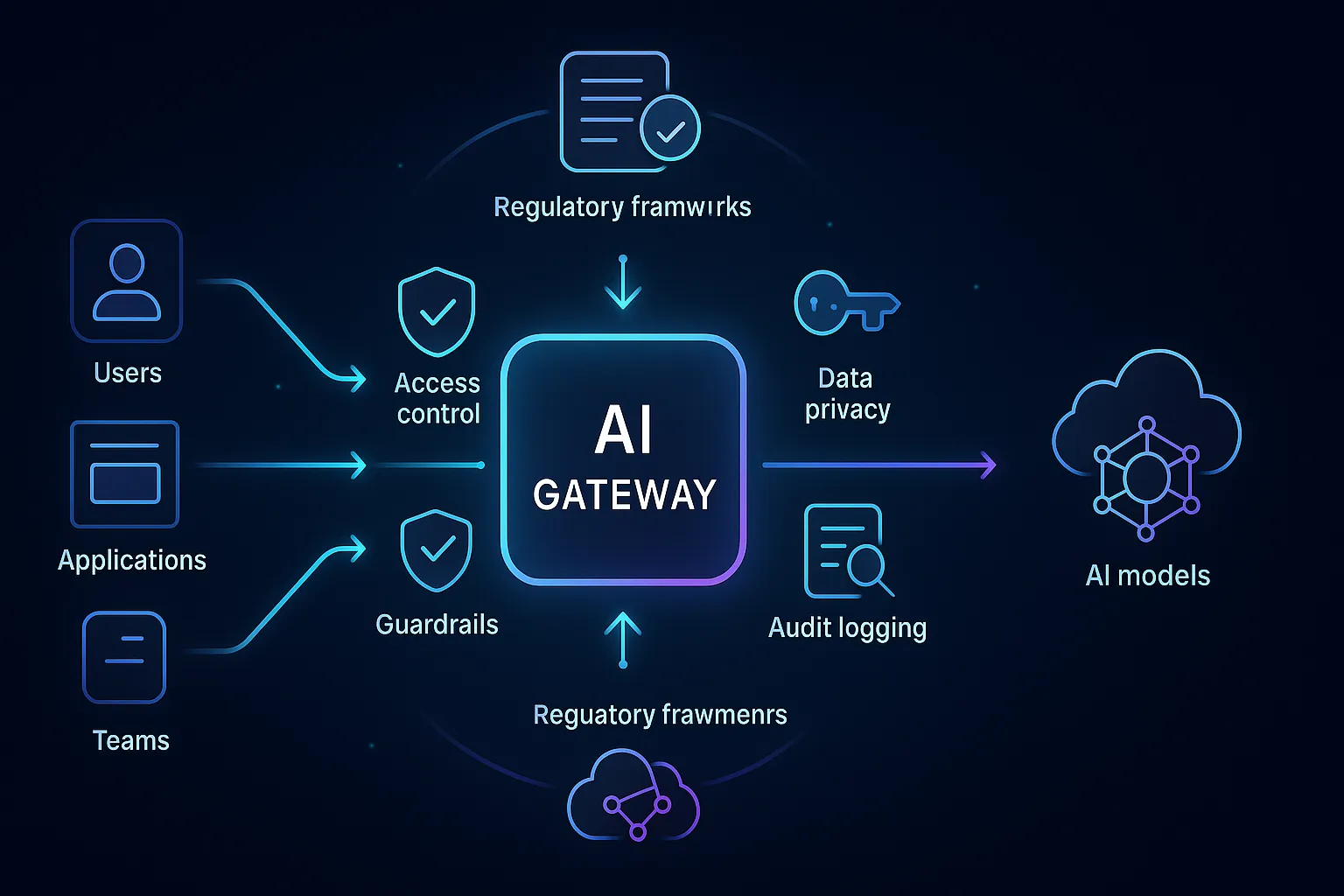
That's where an AI Gateway plays a critical role. Acting as a secure layer between users, applications, and AI models, it centralizes access control, data protection, and audit logging, making every AI interaction secure, traceable, and compliant by design.
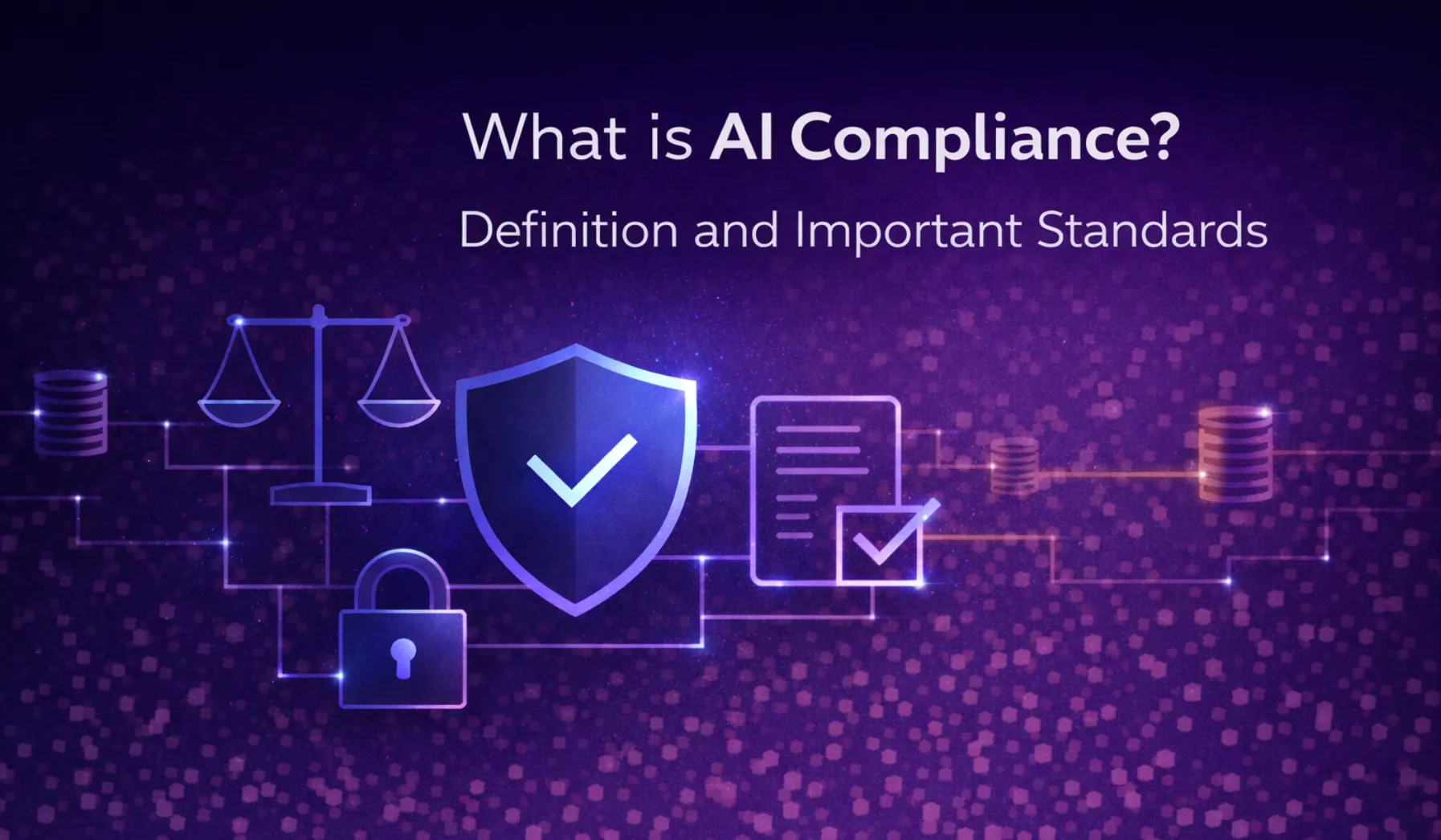
AI compliance is the practice of ensuring that artificial intelligence systems adhere to applicable laws, regulatory requirements, ethical principles, and internal governance policies throughout their lifecycle.
It governs how AI models are designed, trained, deployed, and monitored to minimize risks while ensuring responsible and trustworthy AI adoption.
Unlike traditional IT compliance, AI compliance is continuous rather than point-in-time. Because AI models evolve through retraining, updates, and changing inputs, organizations must continuously monitor model behavior, enforce governance policies, and maintain auditability to remain compliant.
An effective AI compliance strategy combines governance, technical controls, documentation, and ongoing oversight to ensure AI systems remain aligned with both business objectives and regulatory expectations.
As artificial intelligence becomes central to business operations, compliance is no longer a back-office function - it’s a core enabler of trust, safety, and scalability. When AI systems drive decisions that impact customers, finances, or public outcomes, responsible governance becomes essential to both ethics and competitiveness.
AI compliance protects organizations, customers, and society from the unintended consequences of automation, including shadow AI risk. Without it, even the most advanced models can produce biased results, misuse sensitive data, or make decisions that violate legal or ethical standards.
TrueFoundry’s AI Gateway turns compliance from policy into practice, here. It automatically applies guardrails, rate limits, and privacy filters to every model request, ensuring data protection and accountability in real time. All usage is tracked through unified logs and dashboards, giving compliance teams a single pane of glass for audits and risk reviews. By centralizing these controls, TrueFoundry enables enterprises to scale AI confidently — knowing that every system interaction, from prompt to response, meets regulatory, ethical, and organizational standards. Together, these principles form the moral and regulatory compass for responsible AI. They ensure that innovation is balanced with integrity and that progress never comes at the cost of trust.
Effective AI compliance rests on a foundation of principles that define how AI should be developed, deployed, and governed responsibly. These principles go beyond policy — they require an infrastructure that can enforce them automatically across every model, API, and data flow.
That’s where AI Gateway comes in. Acting as the enforcement layer of compliance, it embeds these principles into your AI stack through centralized routing, access control, and observability. Below are the six foundational principles of AI compliance
In essence, AI Gateway transforms AI compliance from a checklist into a continuous enforcement system. Instead of relying on static documentation, organizations gain a live governance layer that ensures transparency, fairness, accountability, privacy, security, and human oversight automatically, at runtime, and at scale.
An effective AI compliance program blends governance, technology, and culture into a unified system. It ensures that every AI model, dataset, and decision aligns with both regulatory obligations and ethical expectations.
However, true compliance isn’t achieved through documentation alone — it requires infrastructure that enforces these controls in real time.
As AI regulations evolve, organizations must comply with multiple frameworks that govern responsible AI. Here are five key AI compliance frameworks shaping 2026 and how TrueFoundry helps implement them.
The EU AI Act is the world's first comprehensive AI regulation and establishes a risk-based framework for governing AI systems across the European Union. It classifies AI systems into four categories, Minimal Risk, Limited Risk, High Risk, and Unacceptable Risk, with compliance obligations increasing according to the level of risk.
As of 2026, the Act is being implemented in phases. Prohibited AI practices, AI literacy requirements, and obligations for General-Purpose AI (GPAI) models are already in effect, while broader compliance requirements for high-risk AI systems continue to roll out according to the EU's implementation timeline.
Organizations deploying high-risk AI systems must implement comprehensive risk management processes, maintain technical documentation, enable human oversight, ensure data governance, maintain detailed logs, monitor system performance after deployment, and demonstrate robustness, accuracy, and cybersecurity.
TrueFoundry's AI Gateway supports EU AI Act compliance by:
Developed by the U.S. National Institute of Standards and Technology (NIST), the AI Risk Management Framework (AI RMF) provides organizations with a practical approach to identifying, assessing, and mitigating AI-related risks.
Although voluntary, it has become one of the most widely adopted frameworks for enterprise AI governance.
The framework is built around four core functions:
The AI RMF also promotes characteristics of trustworthy AI, including reliability, safety, security, resilience, explainability, privacy enhancement, fairness, and accountability.
TrueFoundry's AI Gateway supports NIST AI RMF by:
Together, these capabilities provide the operational controls needed for continuous AI risk management.
ISO/IEC 42001 is the world's first certifiable Artificial Intelligence Management System (AIMS) standard. Similar to ISO 27001 for information security, it provides organizations with a structured framework for governing AI throughout its lifecycle.
Rather than prescribing technical controls, ISO 42001 focuses on building repeatable governance processes. It requires organizations to establish AI policies, define governance responsibilities, perform risk assessments, document AI systems, monitor performance, conduct internal audits, manage third-party AI risks, and continually improve their AI management practices.
TrueFoundry's AI Gateway supports ISO/IEC 42001 by:
This enables organizations to align technical implementation with ISO 42001 management requirements while simplifying ongoing compliance.
The OECD AI Principles, adopted by more than 46 countries, are among the most influential global guidelines for trustworthy AI. Although they are not legally binding, they have shaped AI policies and regulations across multiple jurisdictions, including the EU AI Act.
The principles encourage organizations to develop AI systems that are:
They also emphasize continuous monitoring and responsible stewardship as AI systems evolve over time.
TrueFoundry's AI Gateway supports these principles by:
This allows organizations to operationalize ethical AI principles instead of treating them as documentation exercises.
Published by the White House Office of Science and Technology Policy (OSTP), the Blueprint for an AI Bill of Rights is a policy framework rather than binding legislation. It outlines five principles intended to protect individuals interacting with AI-powered systems.
These principles include:
Although voluntary, these principles have influenced enterprise AI governance practices and continue to shape public-sector procurement and responsible AI initiatives.
TrueFoundry's AI Gateway supports these principles by:
These capabilities help organizations translate high-level responsible AI principles into enforceable runtime controls.
While these frameworks differ in legal scope and regional applicability, they converge on a common set of requirements: governance, transparency, accountability, human oversight, auditability, and continuous monitoring. Organizations operating globally often need to align with several of these frameworks simultaneously.
TrueFoundry's AI Gateway provides the infrastructure layer that turns these requirements into operational controls. By centralizing authentication, policy enforcement, observability, data protection, and audit logging, it enables organizations to embed compliance directly into their AI infrastructure rather than relying on manual reviews or fragmented governance processes.
This infrastructure-first approach helps enterprises remain continuously aligned with evolving regulatory requirements while scaling AI securely and responsibly.
AI compliance is not equally critical in every sector. In some industries, it becomes a core part of governance, risk, and compliance (GRC) because the stakes, like safety, money, rights, or infrastructure, are too high to ignore.
Here are the main sectors where strong AI compliance is essential:
Healthcare is one of the most sensitive areas for AI use. Systems that help with diagnosis, treatment decisions, or patient screening need to be carefully controlled. They must be explainable so doctors can understand how decisions are made, regularly tested for bias, and validated against real clinical results.
Without this, there’s a risk of patient harm and serious regulatory issues.
Banks, insurance companies, and trading platforms rely heavily on AI for tasks like loan approvals, fraud detection, and market predictions. Because these decisions directly impact people’s money and the wider economy, AI systems must be fair, well-governed, and continuously monitored.
Any bias or failure can lead to legal trouble, financial losses, or market instability.
When AI is used in public systems, such as welfare distribution, policing support, or citizen services, transparency becomes critical. These systems must be accountable and fair, as they directly affect people’s rights and access to services.
Strong compliance helps maintain public trust and prevents misuse or discrimination.
Self-driving cars and advanced driver-assistance systems rely on AI to make real-time decisions that can affect human life. That makes safety validation extremely important.
These systems need extensive testing, clear safety documentation, and ongoing monitoring even after deployment to ensure they behave reliably in real-world conditions.
Telecom networks, energy grids, and utility systems use AI for optimization, monitoring, and threat detection. If something goes wrong, it can impact thousands or even millions of people.
Compliance here focuses on system resilience, data security, and alignment with strict regulatory and national security standards.
In retail, AI is used for personalized recommendations, pricing strategies, and content filtering. While less life-critical, it still affects fairness and consumer trust.
Compliance ensures customer data is protected, recommendations are transparent, and systems don’t unintentionally discriminate or mislead users.
As organizations scale AI across teams, applications, and models, maintaining compliance becomes increasingly complex. Here are some of the biggest challenges and the approaches that help overcome them.
AI regulations vary across regions, with frameworks like the EU AI Act, NIST AI RMF, and emerging national guidelines introducing different compliance requirements. For organizations operating globally, keeping pace with these evolving regulations can be challenging.
A centralized governance approach with region-aware routing and policy enforcement helps ensure AI workloads comply with local legal and data residency requirements.
Many AI models function as "black boxes," making it difficult to understand how they generate outputs. This lack of transparency complicates audits, incident investigations, and regulatory reporting.
Maintaining centralized logs of prompts, responses, metadata, and model activity improves observability and provides the audit trail needed for compliance.
AI applications often interact with multiple models and third-party APIs, increasing the risk of exposing sensitive information such as personally identifiable information (PII) or confidential business data.
Protecting data through real-time redaction, masking, encryption, and policy-based access controls helps reduce these risks while supporting privacy regulations.
Development teams want to experiment and ship AI applications quickly, while security and compliance teams prioritize governance and risk management. Without shared visibility, these priorities can slow AI adoption.
Standardizing policies and providing a unified governance interface enables both teams to work together without compromising compliance.
As AI models evolve through updates, fine-tuning, or provider changes, manually validating compliance across every application becomes costly and time-consuming.
Automating policy enforcement at the infrastructure level allows organizations to apply governance consistently across all models, reducing operational overhead and simplifying compliance management.
TrueFoundry's AI Gateway addresses these challenges by embedding compliance directly into the AI infrastructure. It centralizes authentication, access control, data masking, guardrails, audit logging, and observability in a single enforcement layer.
Instead of relying on manual reviews or fragmented controls, organizations can apply governance policies consistently across all AI models and providers, making compliance scalable, auditable, and easier to maintain as AI adoption grows.
AI compliance cannot rely on scattered scripts, manual audits, or siloed teams.
For large-scale AI adoption, compliance needs to be enforced through infrastructure — continuously, automatically, and across every model and API.
That’s exactly what AI Gateways are designed for.
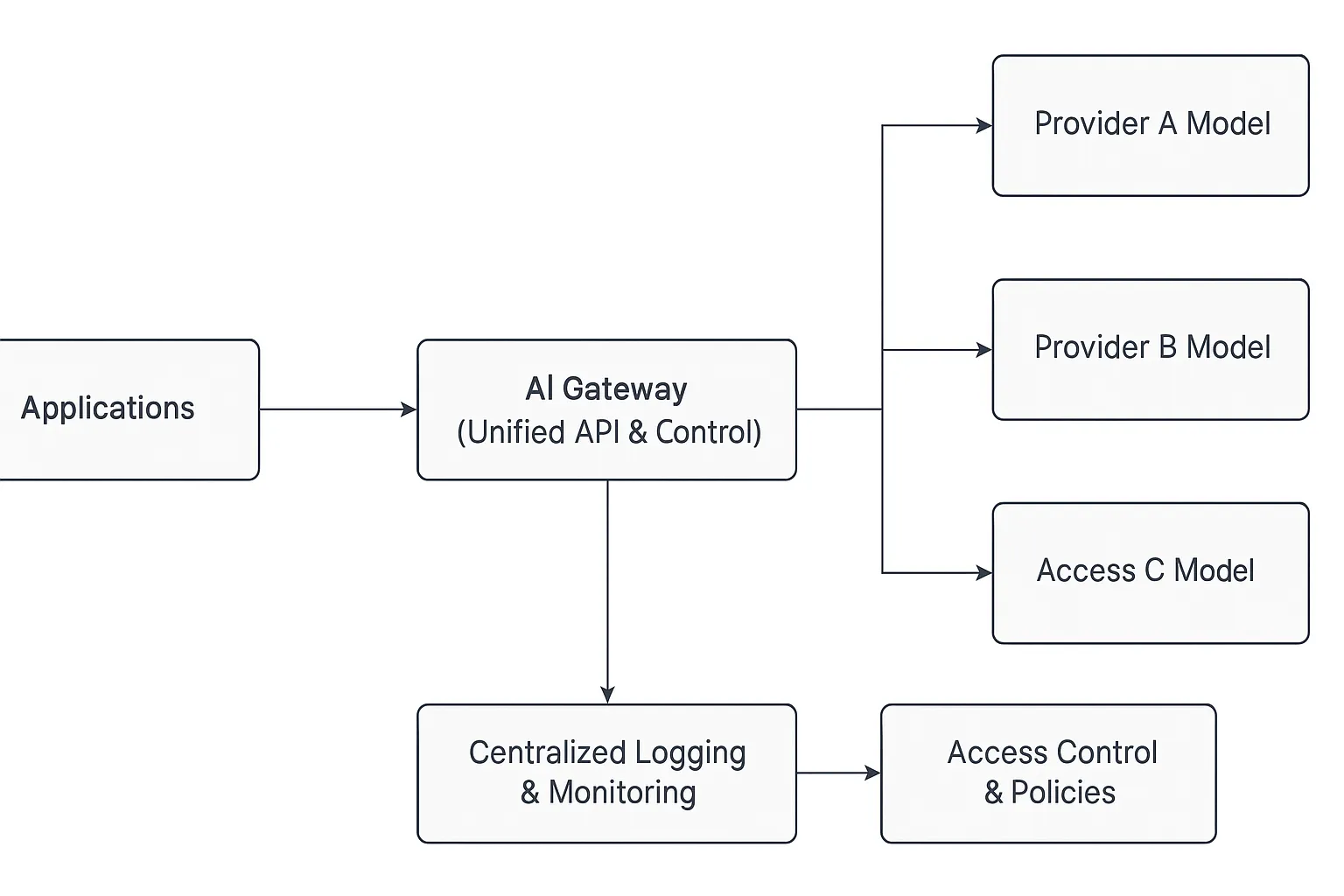
An AI Gateway sits between your users, applications, and model providers, acting as a central control plane for governance. Every prompt and response passes through the gateway, where policies are applied in real time — from authentication and encryption to logging and access control.
By routing all AI traffic through a single layer, gateways provide the enforcement, visibility, and auditability required to make compliance not just achievable, but scalable.
An AI Gateway enforces compliance through built-in governance, security, and monitoring controls. Here, have a look:
Gateways authenticate every request and manage access through role-based policies (RBAC). This ensures that only authorized users or applications can interact with specific models, while administrators retain full visibility and control over usage.
In TrueFoundry, these controls are programmable — compliance rules are enforced instantly across all endpoints.
Through configurable guardrails, AI Gateways enforce data privacy and usage policies automatically. They can mask or redact sensitive information (PII), encrypt all traffic, and validate data schemas before forwarding requests.
TrueFoundry’s AI Gateway applies these safeguards seamlessly, ensuring continuous alignment with GDPR, CCPA, HIPAA, and internal privacy frameworks.
Every model interaction — input, output, latency, and metadata — is logged centrally within the Gateway. This creates a complete, explainable audit trail that helps compliance teams track usage, prove adherence to governance frameworks, and investigate anomalies quickly.
TrueFoundry simplifies audit readiness with structured observability dashboards and queryable logs for any model, user, or timeframe.
For a comprehensive breakdown of how to track these metrics across your entire stack, refer to our deep dive on observability in AI Gateway.
Regulations often dictate that sensitive information must remain within specific borders or on highly secured hardware. Without an automated routing layer, managing these requirements manually across dozens of applications is nearly impossible.
TrueFoundry’s Gateway introduces policy-based routing, allowing enterprises to direct traffic based on geography, risk level, or compliance status — for example:
This makes compliance dynamic and adaptive, not static or manual.
For a deeper look into the technical strategies for keeping data within sovereign borders and complying with local laws, read our guide on geopatriation.
AI Gateways provide real-time observability into every model’s behavior.
TrueFoundry extends this further with continuous telemetry — tracking latency, drift, error rates, and token usage across providers.
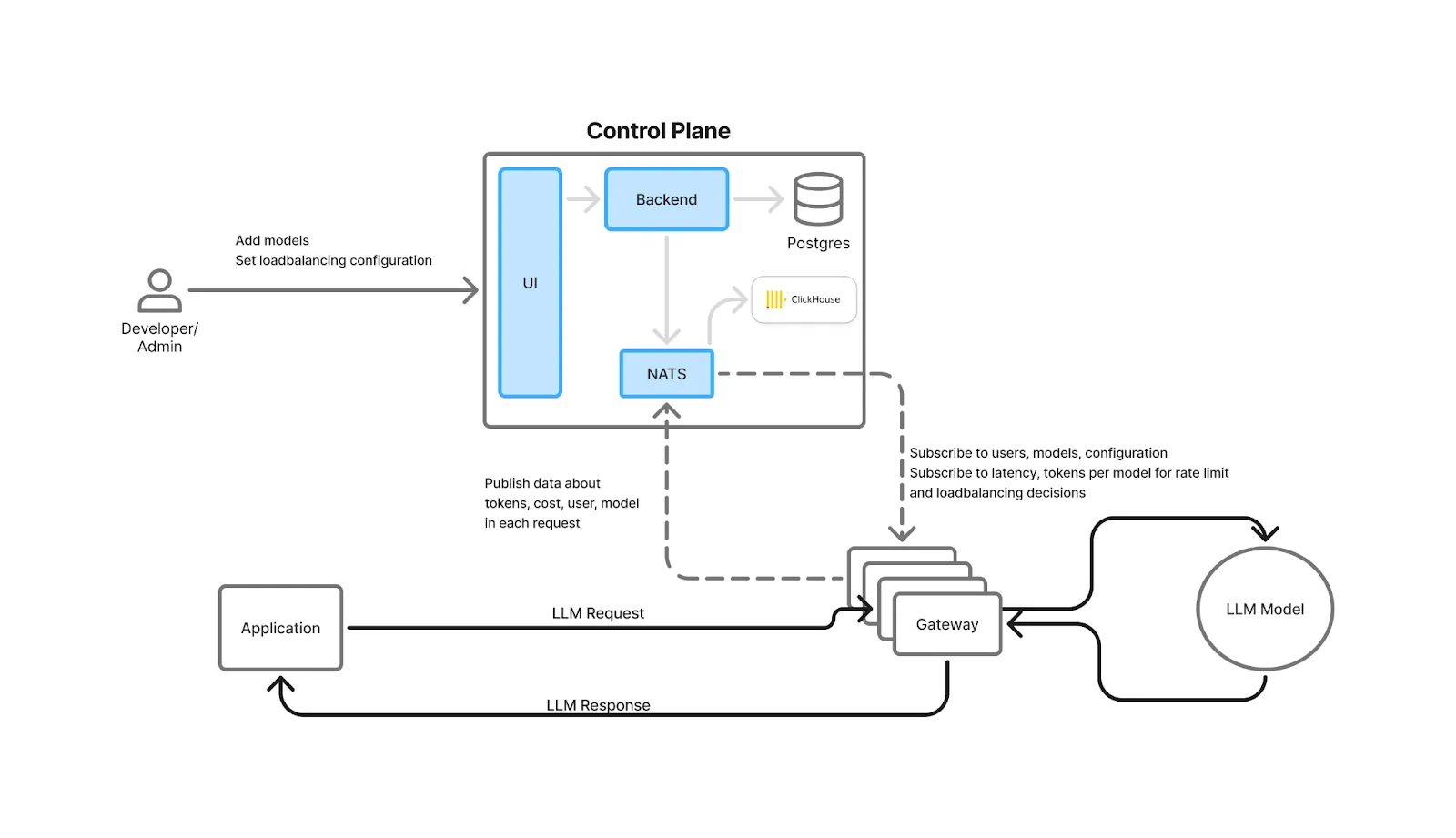
Compliance and security teams can receive alerts for abnormal activity, helping detect bias, model failure, or policy violations before they cause harm.
TrueFoundry extends the capabilities of standard gateways with verified enterprise-grade compliance including SOC 2 Type II and HIPAA certification.
Beyond access and routing, the platform includes:
These controls ensure that compliance isn’t just a framework goal it’s continuously enforced at runtime.
From Manual Oversight to Automated Assurance
By consolidating governance, security, and monitoring in one programmable layer, TrueFoundry’s AI Gateway turns compliance into a continuous, verifiable process.
Every request that flows through the Gateway becomes a governed, observable, and auditable event ensuring consistent application of enterprise and regulatory policies.
AI compliance has evolved from a simple regulatory checkbox into a strategic requirement for responsible innovation. As enterprises scale their use of machine learning and Large Language Models (LLMs), ensuring that every model, dataset, and workflow adheres to principles of fairness, privacy, and accountability is no longer optional, it’s a competitive necessity.
While frameworks like the EU AI Act, NIST AI RMF, and ISO/IEC 42001 provide the essential roadmap, real-world compliance depends on infrastructure that can enforce these rules automatically across diverse providers, teams, and geographic regions.
This is where the AI Gateway becomes indispensable. It transforms compliance from a static policy into a programmable layer of your tech stack, authenticating every model call, masking sensitive data in real-time, and maintaining the detailed audit logs required for global transparency. By embedding these safeguards directly into the infrastructure, organizations can finally move at the speed of innovation without compromising on trust or security.
Don't let regulatory complexity slow down your AI roadmap. TrueFoundry’s AI Gateway provides the enterprise-grade security, regional routing, and unified observability you need to deploy LLMs safely and at scale.
Book a demo with TrueFoundry to see how we can help you turn AI policy into enforceable, automated practice.
TrueFoundry AI Gateway delivers ~3–4 ms latency, handles 350+ RPS on 1 vCPU, scales horizontally with ease, and is production-ready, while LiteLLM suffers from high latency, struggles beyond moderate RPS, lacks built-in scaling, and is best for light or prototype workloads.



AI compliance is the process of ensuring AI systems operate in accordance with legal regulations, ethical principles, and organizational policies. It covers the entire AI lifecycle, helping organizations maintain transparency, accountability, fairness, data privacy, and security while minimizing regulatory and operational risks.
The AI compliance process involves identifying regulatory requirements, assessing AI risks, implementing governance controls, documenting AI systems, monitoring performance, maintaining audit trails, and continuously reviewing compliance. It is an ongoing process that evolves as AI models, regulations, and business needs change.
To become AI compliant, organizations should establish governance policies, conduct risk assessments, protect sensitive data, document AI systems, monitor model performance, and maintain audit logs. Regular reviews and adherence to evolving regulations help ensure AI systems remain compliant throughout their lifecycle.
The EU AI Act is one of the most comprehensive AI regulations, introducing a risk-based approach to AI governance. Other widely adopted frameworks include NIST AI RMF, ISO/IEC 42001, the OECD AI Principles, and the U.S. AI Bill of Rights.
Key AI compliance concerns include algorithmic bias, lack of transparency, data privacy violations, security vulnerabilities, inadequate human oversight, and poor auditability. Organizations must also address evolving regulations, third-party AI risks, and unauthorized AI usage to maintain responsible AI practices.
While requirements vary by framework, five core principles underpin AI compliance: transparency, accountability, fairness, privacy and data protection, and continuous risk management. Together, these principles help organizations develop, deploy, and monitor AI systems responsibly.
A typical AI compliance checklist includes identifying AI use cases, performing risk assessments, documenting models, securing sensitive data, implementing access controls, monitoring model performance, maintaining audit logs, and regularly reviewing compliance with applicable regulations and internal governance policies.
ISO/IEC 42001 is the international standard for Artificial Intelligence Management Systems (AIMS). It helps organizations establish governance processes, manage AI-related risks, define responsibilities, conduct internal audits, and continuously improve AI management practices throughout the AI lifecycle.
AI compliance helps businesses reduce legal, financial, and reputational risks while building trust with customers and regulators. It ensures AI systems are transparent, secure, and accountable, enabling organizations to scale AI responsibly and meet evolving regulatory requirements with confidence.



The latest news, articles, and resources sent to your inbox
.png)

.png)
.png)
.png)
.png)
.png)
.png)
.png)
.png)
.png)
.png)


