


What Is Approximate Nearest Neighbor Search and Why Does It Matter?

Many AI systems work by turning data into vectors and then finding the items whose vectors are closest to a query, a process at the heart of semantic search, recommendations, and retrieval-augmented generation. The exact version of this, comparing the query to every single item, is accurate but far too slow once a collection grows to millions of vectors.
Approximate nearest neighbor search solves this by finding items that are very close to the query, not necessarily the exact closest, but doing so dramatically faster. By accepting a tiny loss in accuracy, it turns an impractical search into one that runs in milliseconds. This guide explains what it is, how it works, and why it matters.
We will cover the definition, how it works, how it compares to exact search, and when to use it.
What is approximate nearest neighbor search?
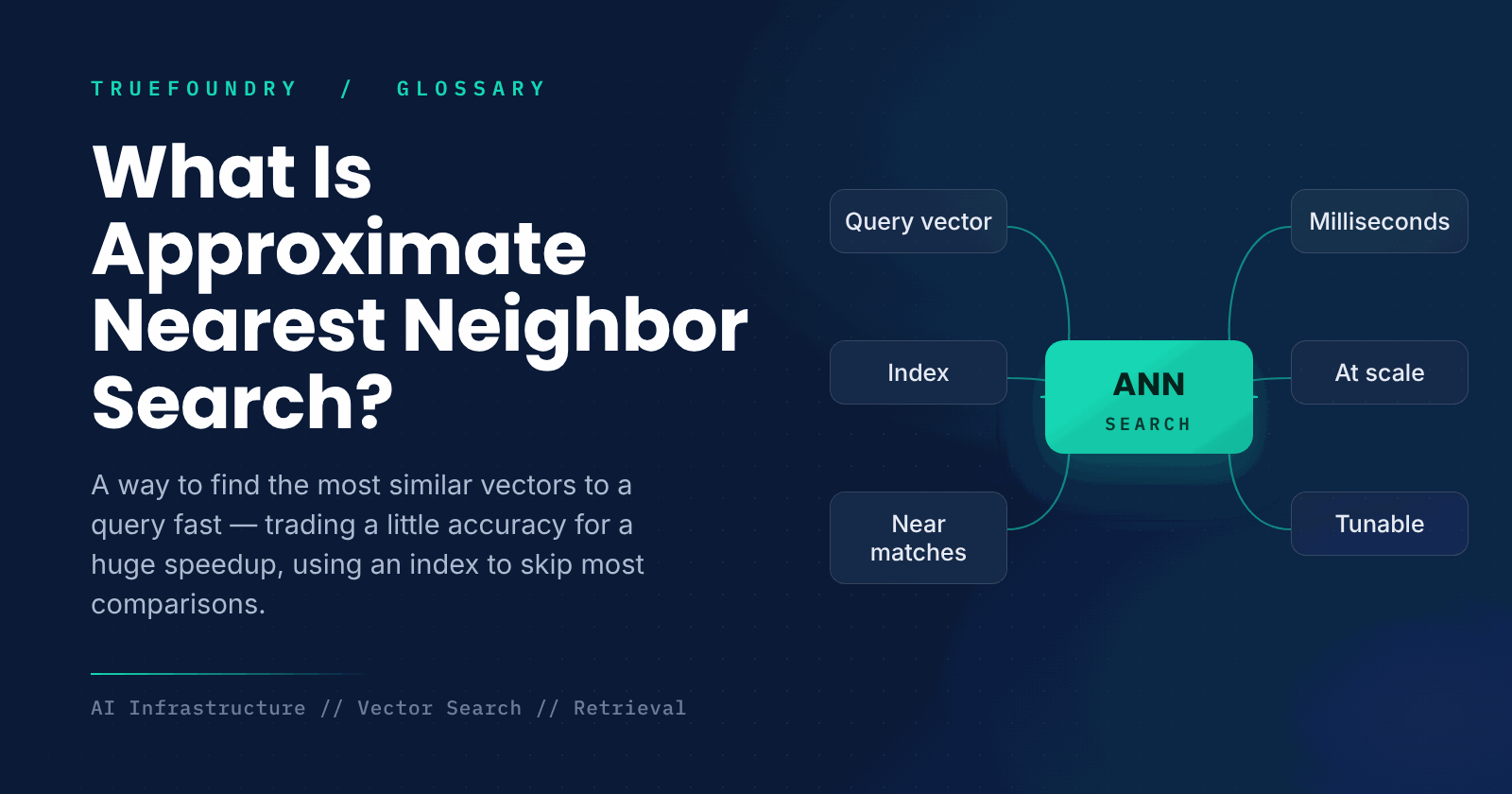
Approximate nearest neighbor (ANN) search is a technique for quickly finding the items in a large dataset whose vectors are most similar to a query vector, accepting approximate rather than exact results in exchange for speed. Instead of guaranteeing the single closest match, it returns matches that are almost always among the closest, far faster than an exhaustive comparison would allow.
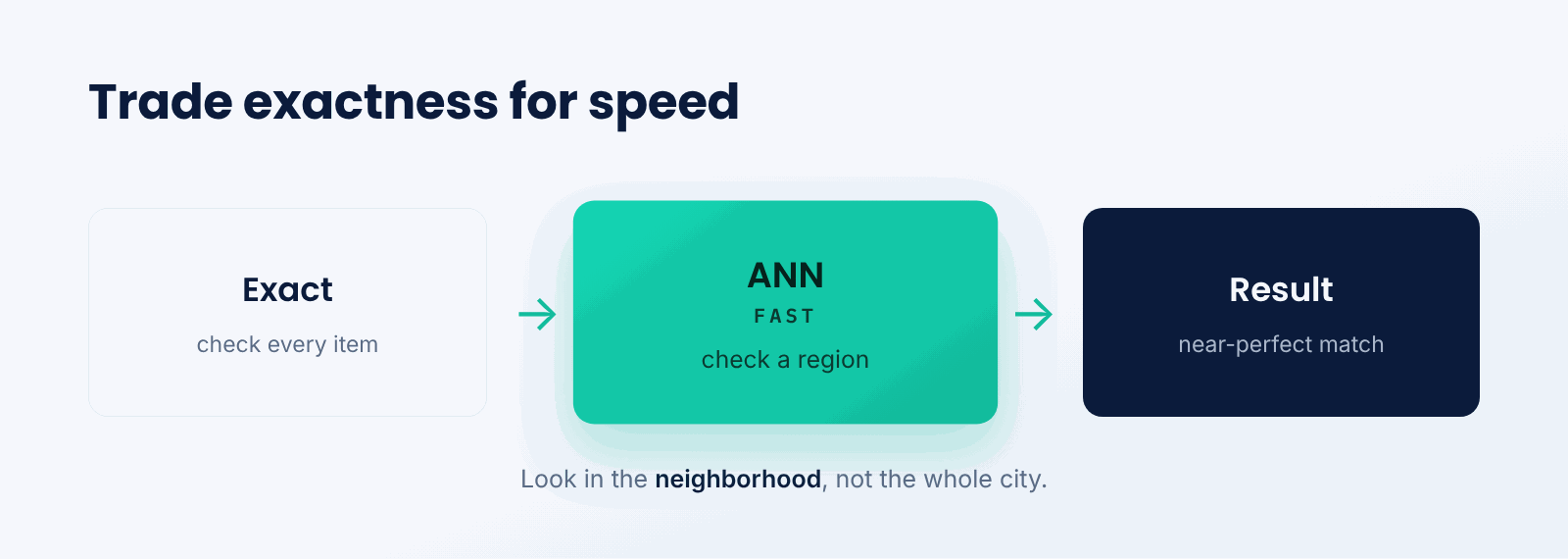
Think of it like finding a nearby coffee shop. You could measure the exact distance to every coffee shop in the city to find the absolute closest, or you could look in your own neighborhood first and pick the nearest one there. The second way is almost always right and enormously faster. ANN search works on that principle.
The key idea is trading exactness for speed. By giving up the guarantee of the perfect match, ANN search avoids comparing the query against every item and becomes fast enough to use on huge collections.
How does ANN search work?
ANN search builds an index that lets it skip most of the comparisons.
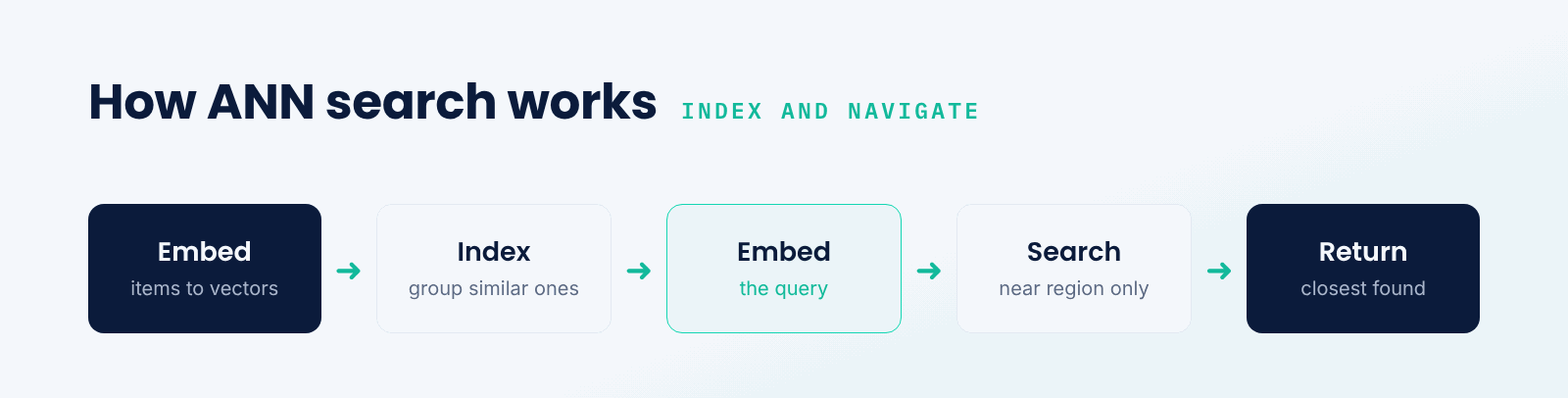
- Embed the data. Turn every item into a vector.
- Build an index. Organize the vectors so similar ones are easy to reach.
- Embed the query. Turn the query into a vector too.
- Search the index. Navigate to the region near the query, not the whole set.
- Return matches. Give back the closest items found there, fast.
The index is what makes ANN fast. Common approaches group nearby vectors, build navigable graphs between them, or hash similar vectors together, so a search only examines a small, promising slice of the data instead of all of it. Tuning the index trades off between speed, accuracy, and memory.
ANN vs. exact nearest neighbor search
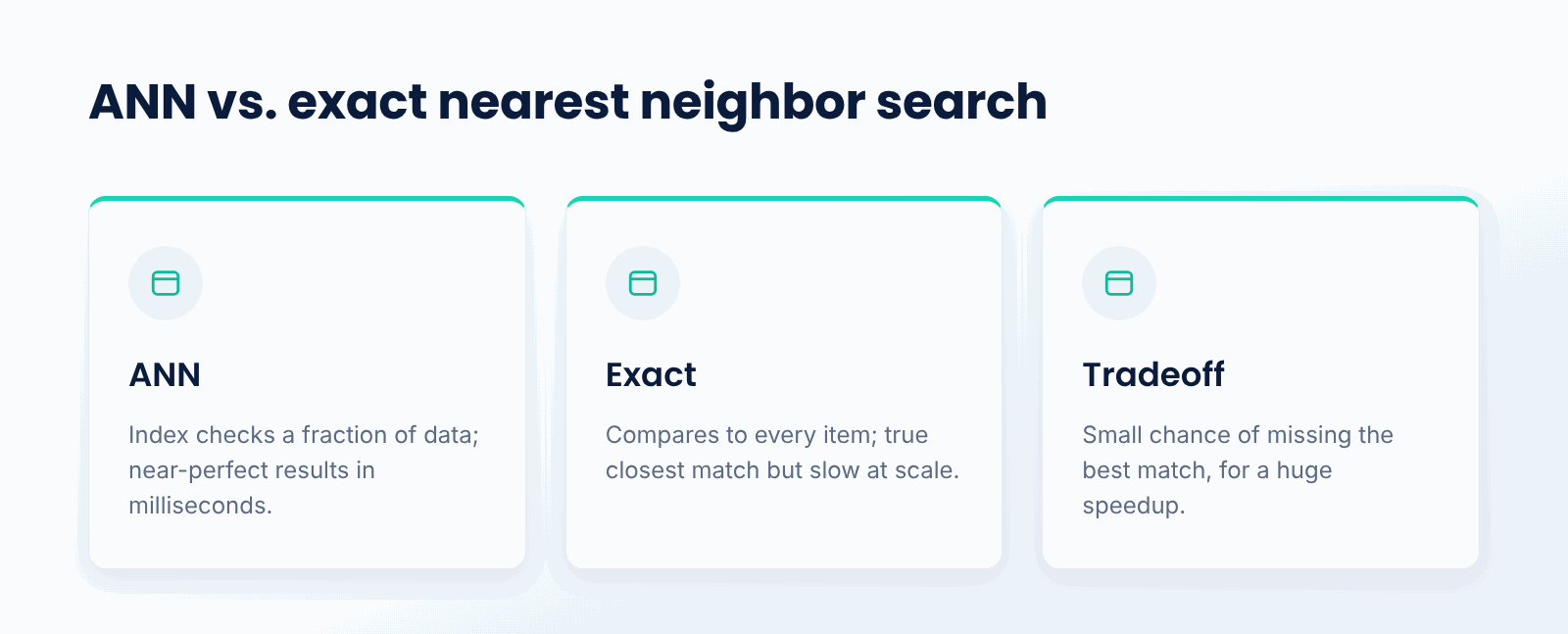
Exact nearest neighbor search compares the query to every item and guarantees the true closest matches. It is perfectly accurate but scales poorly: on millions of vectors, every query becomes slow and expensive, because the work grows with the size of the collection.
ANN search instead uses an index to examine only a fraction of the data, returning matches that are almost always the closest in a tiny fraction of the time. The tradeoff is a small chance of missing the exact best match, which is acceptable for most applications where speed at scale matters far more than perfect recall.
Why does ANN search matter?
- Speed. It returns results in milliseconds on huge datasets.
- Scale. It makes vector search practical on millions of items.
- Cost. It uses far less compute than exhaustive search.
- Enablement. It underpins semantic search, RAG, and recommendations.
- Tunable. You can trade accuracy for speed as needed.
What are the tradeoffs?
- Approximation. It may occasionally miss the exact closest match.
- Index cost. Building and storing the index takes memory and time.
- Tuning. Balancing speed, accuracy, and memory needs care.
- Updates. Some indexes are harder to update as data changes.
When should you use ANN search?
Use approximate nearest neighbor search whenever you need fast similarity search over a large collection of vectors, which is the case for most vector databases and retrieval systems. It is essential when the dataset is too big for exact search to be fast enough, and when a near-perfect result is good enough, as it usually is.
If your dataset is small, exact search may be fast enough and simpler, with no approximation at all. But as soon as scale makes exhaustive comparison too slow, ANN search is the standard way to keep similarity search fast and affordable.
Key points about ANN search
- ANN search finds very similar vectors quickly.
- It trades a little accuracy for a big speedup.
- It uses an index to skip most comparisons.
- It scales to millions of vectors in milliseconds.
- It underpins semantic search, RAG, and recommendations.
- Exact search is fine only for small datasets.
Conclusion
Approximate nearest neighbor search makes similarity search fast at scale by finding items that are almost always the closest to a query, using an index to skip most comparisons. By trading a tiny bit of accuracy for a huge gain in speed, it turns an impractical exhaustive search into one that runs in milliseconds, which is what makes vector search, semantic search, and retrieval-augmented generation practical on large collections.
TrueFoundry helps teams build and serve retrieval and vector-search systems on their own infrastructure, including the approximate nearest neighbor indexes that keep similarity search fast and affordable. When search has to be both fast and scalable, ANN search is the technique behind it.

Govern, Deploy and Trace AI in Your Own Infrastructure
Frequently Asked Questions
What is approximate nearest neighbor search in simple terms?
It is a quick way to find which vectors in a large set are most similar to your query vector. Rather than computing over every vector, it uses an index to look only where good matches are likely, which makes the process much faster while returning results that are almost always the closest.
Why is it approximate?
Because it does not guarantee the one and only closest match. It is very fast because it analyzes only the most promising part of the data rather than all of it, so it may occasionally miss the true best match; in exchange it is enormously faster, and the results are correct most of the time.
How is ANN different from exact nearest neighbor search?
Exact search matches the query against every record and always gives the true closest matches, but it is slow on a huge dataset. ANN searches an index and checks only a portion of the data, giving near-perfect results much faster. The tradeoff is a small chance of missing the exact best match.
What makes ANN search fast?
The index. When vectors are arranged so that similar ones are grouped, connected in a navigable graph, or hashed together, ANN search only examines a small, promising region near the query instead of the whole dataset, which is what gives it its speed.
When should I use ANN search?
For any use case that needs quick similarity search over vectors, such as a vector database or a retrieval system. For small datasets, exact search may be simpler and fast enough. At scale, ANN search is the standard choice.


- © 2022 ENSEMBLE Technologies



Subscribe to our newsletter
The latest news, articles, and resources sent to your inbox


