


What Is Cost per Token and Why Does It Matter?

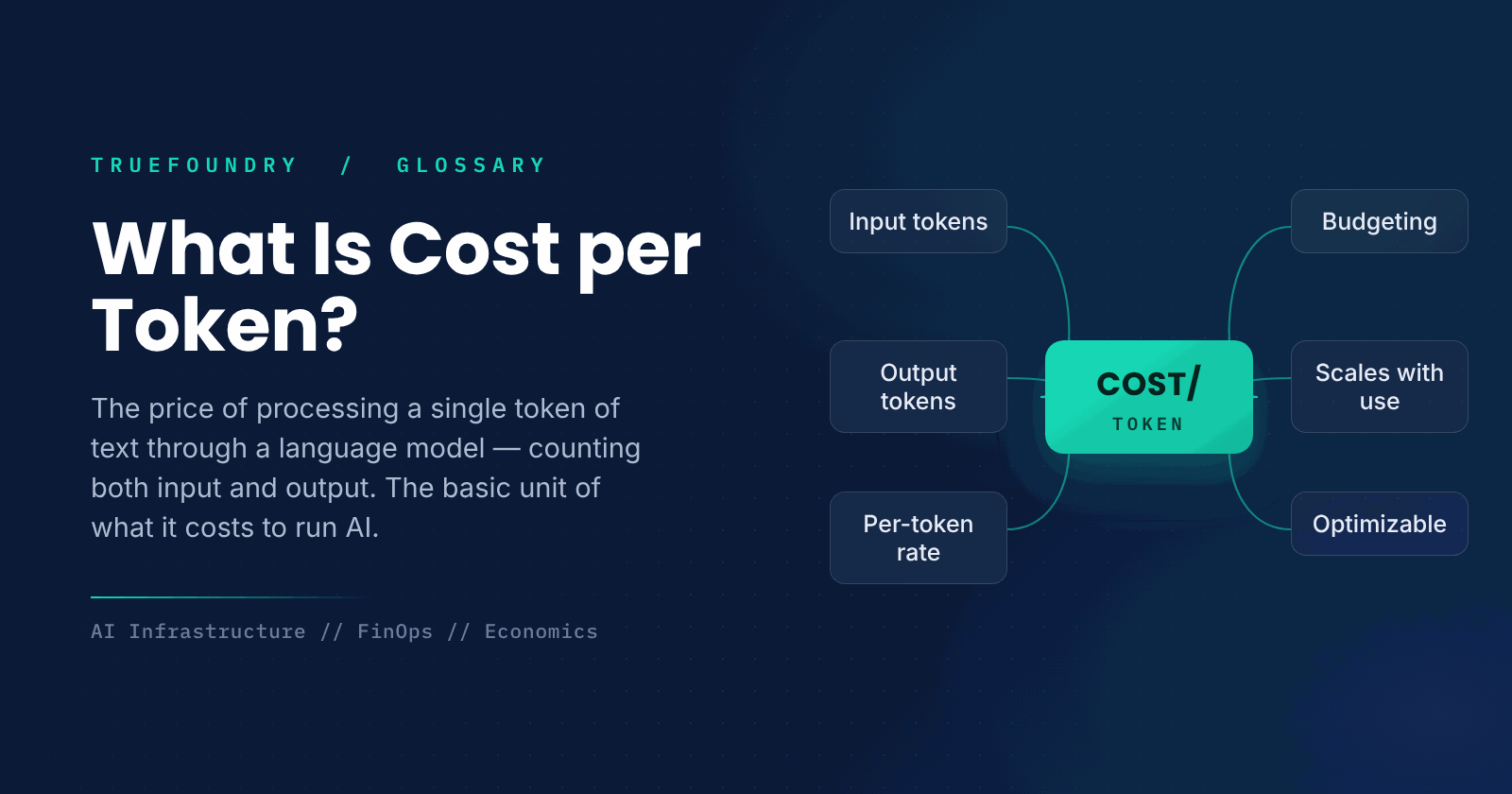
Language models do not charge per request or per hour the way many services do; they charge per token, the small chunks of text they read and write. Every prompt you send and every response you get back is measured in tokens, and you pay for each one. That makes cost per token the fundamental unit of what it costs to run an AI application.
At small scale this is easy to overlook, but as usage grows, token costs add up quickly and can dominate the budget of an AI product. Understanding what a token is, how input and output are priced, and what drives the total is essential to keeping applications affordable. This guide explains cost per token and how to manage it.
We will cover the definition, how token costs add up, how input and output pricing differ, and how to control it.
What is cost per token?
Cost per token is the amount charged for processing one token through a language model. A token is a small piece of text, often roughly a few characters or part of a word, and a model's pricing is stated as a cost per some number of tokens. Both the tokens you send in the prompt and the tokens the model generates in its response count toward what you pay.
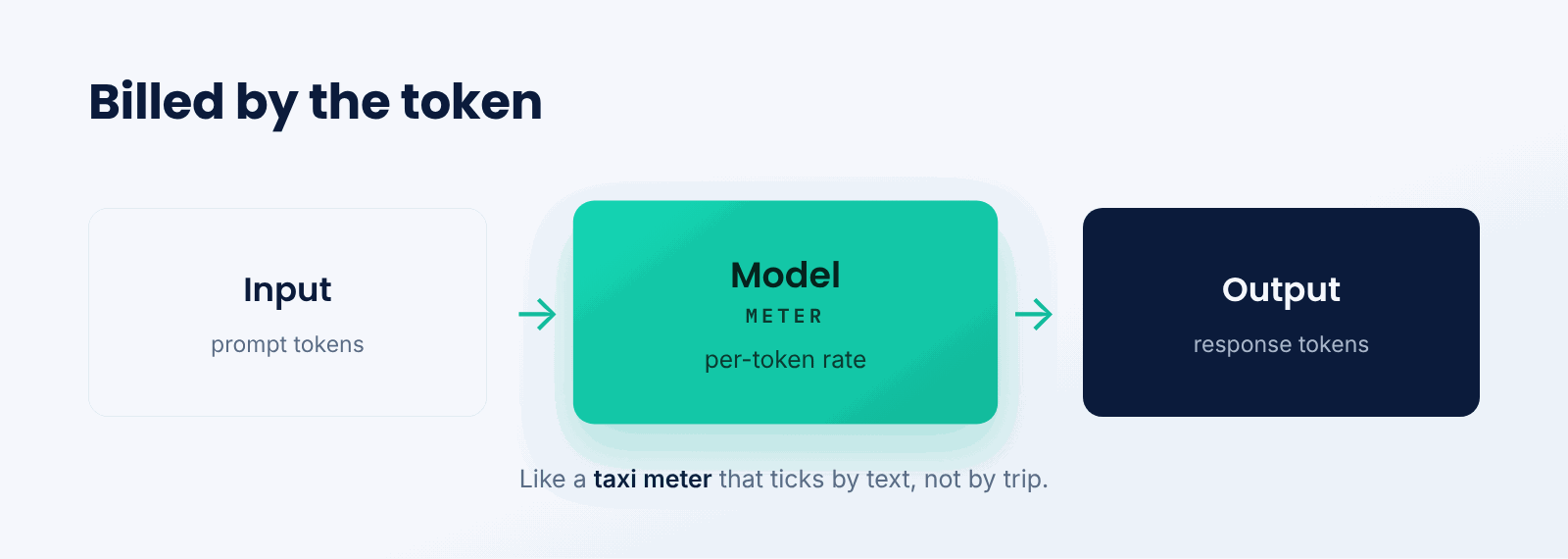
Think of it like a taxi meter that ticks by distance rather than by trip. A short ride costs little and a long one costs more, all at the same per-unit rate. With language models, the tokens are the distance: the more text goes in and comes out, the more you pay, at the model's per-token rate.
The key idea is that text is billed by the token. Because everything a model reads and writes is measured this way, cost per token is the lens through which all AI usage cost is understood.
How do token costs add up?
Total cost is the tokens used times the per-token rate, across every request.
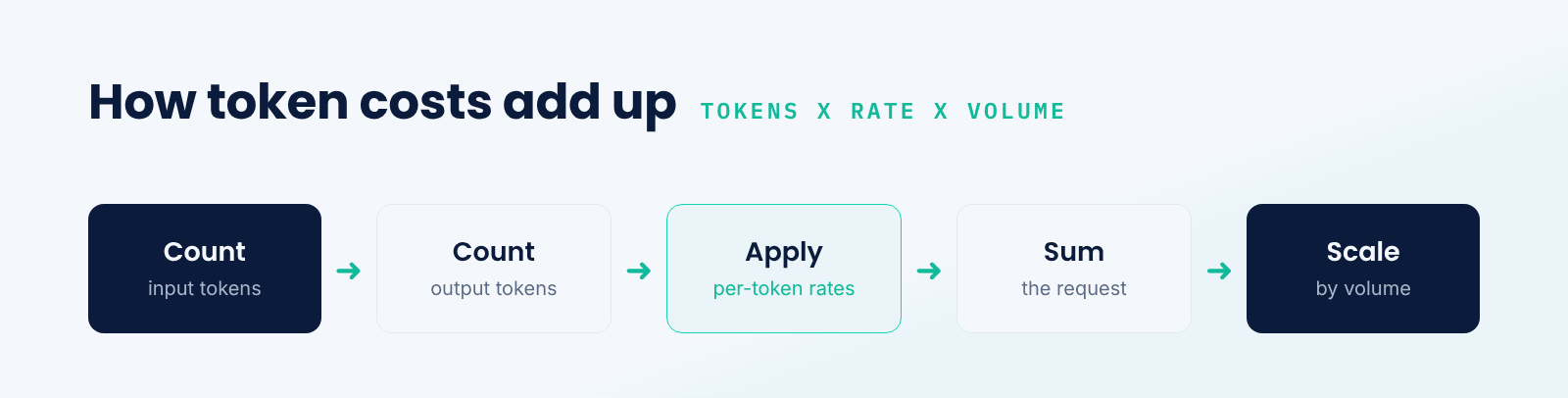
- Count input. The prompt, context, and any history are tokenized.
- Count output. The model's generated response is tokenized too.
- Apply rates. Input and output tokens are each priced per token.
- Sum the request. Add input and output cost for one call.
- Multiply by volume. Across many requests, it scales with usage.
A single request's cost is small, but production systems make millions of them, so the per-token rate and the number of tokens per request both matter enormously. Long prompts, large context windows, and verbose outputs all raise the token count, and therefore the cost, of every call.
Input vs. output token cost
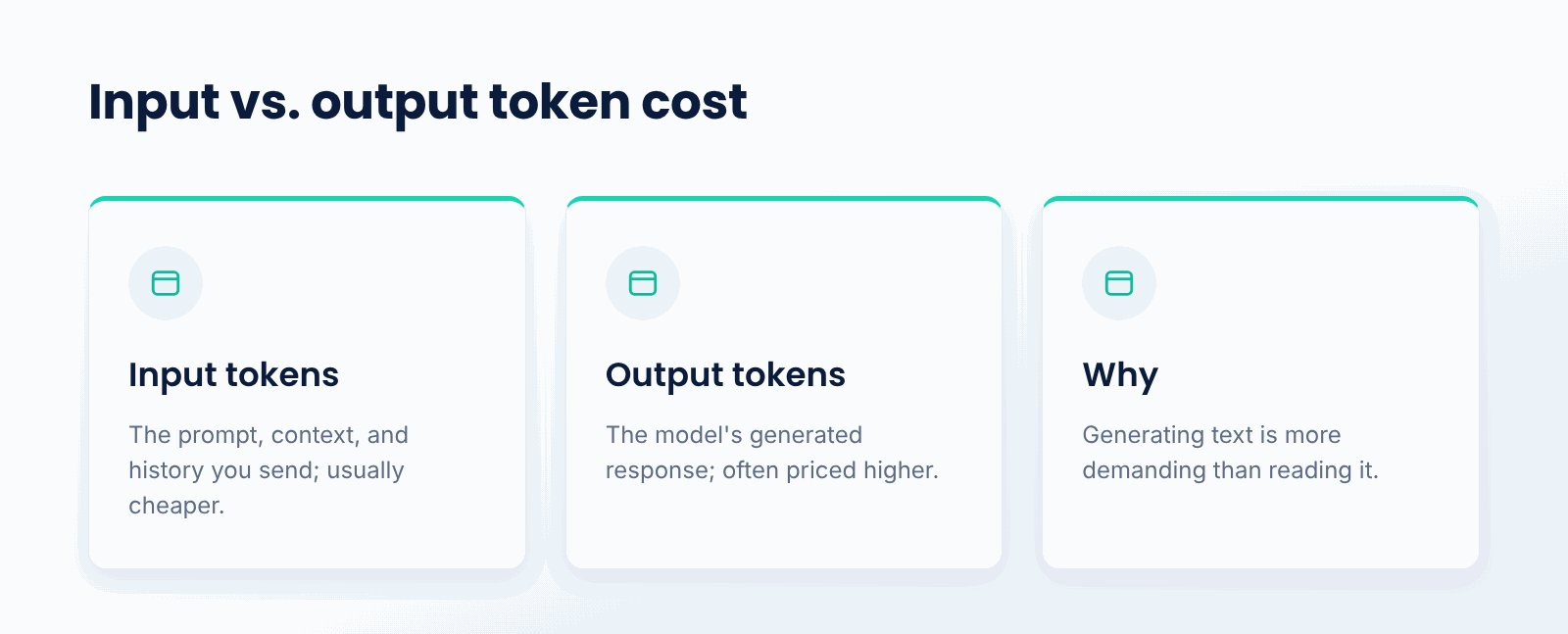
Most providers price input and output tokens differently, and output tokens are often more expensive, because generating text is more computationally demanding than reading it. A request that produces a long response can therefore cost much more than its short prompt would suggest.
This distinction shapes how teams optimize. Trimming unnecessary context reduces input cost, while asking for concise responses reduces the pricier output cost. Knowing which side dominates a given workload tells you where to focus, and is key to estimating and controlling spend accurately.
Why does cost per token matter?
- Budgeting. It is the basis for estimating AI spend.
- Scale. Small per-call costs become large at high volume.
- Optimization. It shows where to trim prompts and outputs.
- Model choice. It helps compare models on a cost basis.
- Viability. It can decide whether a product is economical.
How can you manage cost per token?
- Trim prompts. Send only the context the model actually needs.
- Limit output. Ask for concise responses and cap length.
- Choose models wisely. Use smaller models where they suffice.
- Cache and reuse. Avoid re-sending the same context repeatedly.
- Monitor usage. Track tokens per request to catch waste.
When should you pay attention to it?
Pay attention to cost per token whenever you run a language model application at any meaningful scale, especially one serving many users or making frequent calls. At that point token costs become a real line item, and small optimizations to prompt and output length can translate into large savings.
For occasional, low-volume use, token cost may be negligible and not worth optimizing. But for any production AI system, understanding and managing cost per token is central to keeping the economics sustainable as usage grows.
Key points about cost per token
- Cost per token is the price to process one token.
- Both input and output tokens are billed.
- Output tokens often cost more than input tokens.
- Total cost scales with tokens times volume.
- Trimming prompts and outputs lowers cost.
- It is central to the economics of AI products.
Conclusion
Cost per token is the fundamental unit of what it costs to run a language model, covering both the input you send and the output it generates. Because models bill by the token, this figure drives the economics of every AI application, and at scale it can dominate the budget. Understanding it, and trimming prompts, limiting output, and choosing models wisely, is how teams keep AI affordable as usage grows.
TrueFoundry helps teams deploy and serve models on their own infrastructure, with visibility into token usage and cost that keeps AI spending under control. When the economics of an AI product matter, managing cost per token is where the savings are found.

Govern, Deploy and Trace AI in Your Own Infrastructure
Frequently Asked Questions
What is cost per token in simple terms?
It is the cost of processing one tiny piece of text, known as a token, through a language model. You pay for both the tokens you send in your prompt and the tokens the model generates in its answer, so the more text goes in and out, the more you pay.
What is a token?
A token is a tiny piece of text, usually a couple of characters or part of a word, that a language model uses to read and write. Text is measured and charged in tokens, not words or characters, so token counts are what determine usage and cost.
Why do output tokens often cost more than input tokens?
Because creating text requires significantly more computing power than reading it. Most providers therefore price output tokens higher, which means a request with a long response can cost considerably more than its short prompt alone would suggest.
How can I reduce my cost per token usage?
Trim the prompt to just the context the model needs, request brief answers and cap their length, choose smaller models where they suffice, avoid re-sending the same context, and watch token usage per request to catch waste. Output length is often the biggest lever.
When does cost per token really matter?
At scale, particularly for applications with many users or frequent calls, where even a small cost per call adds up to a large bill. For sporadic, low-volume use it may be negligible, but for any production system it is central to the economics.


- © 2022 ENSEMBLE Technologies



Subscribe to our newsletter
The latest news, articles, and resources sent to your inbox


