


What Is Differential Privacy and Why Does It Matter?

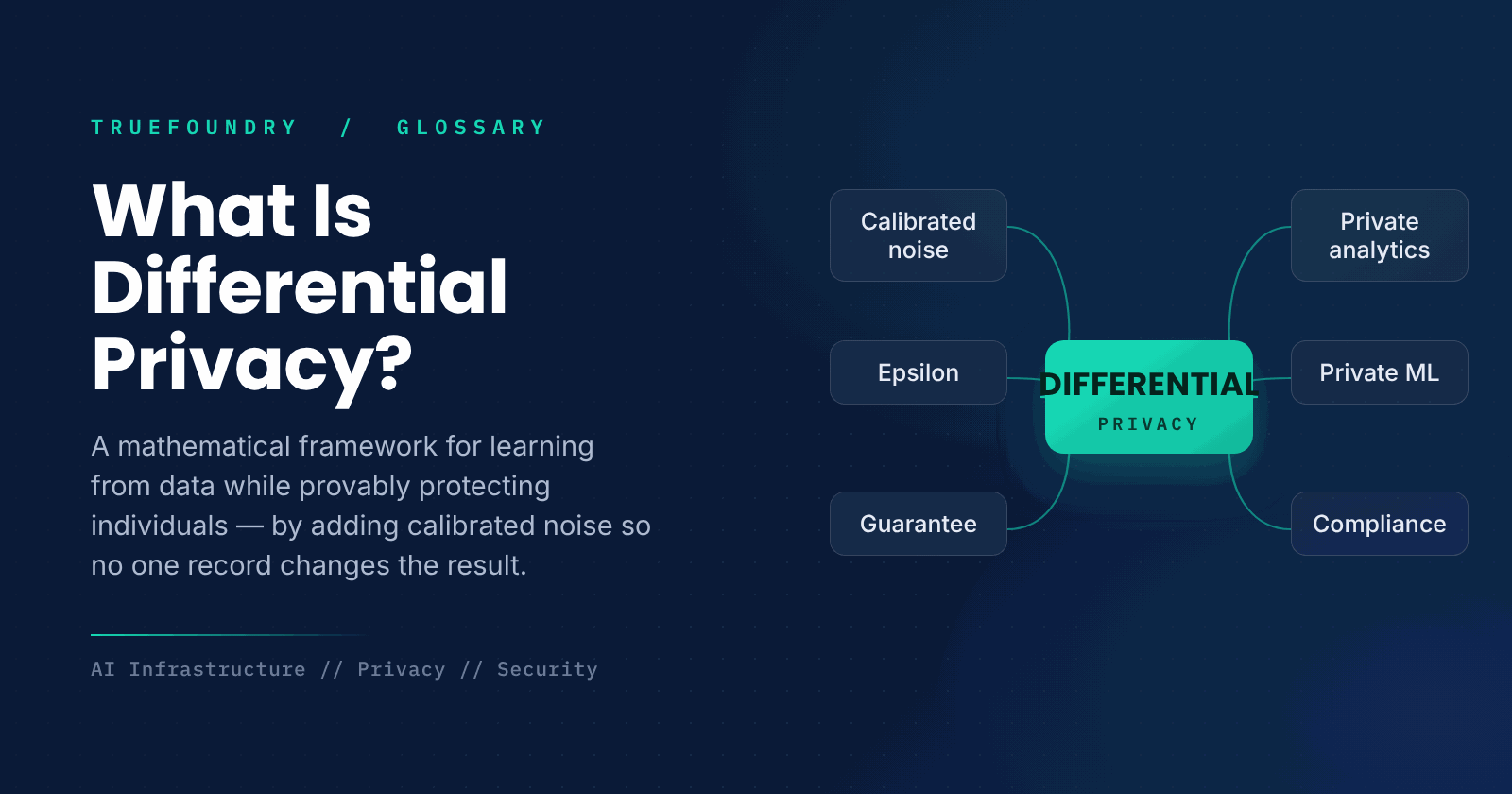
Organizations want to learn from data about people without exposing those people. The trouble is that even aggregate statistics and trained models can leak information about individuals, and simply removing names is not enough, because other details can re-identify someone. Differential privacy offers a rigorous answer: a mathematical guarantee that limits how much any single person's data can affect, and therefore reveal through, a result.
Rather than a specific tool, differential privacy is a property a process can have. It is achieved by injecting a precise amount of random noise so that the presence or absence of any one individual barely changes the output. This lets organizations publish statistics or train machine learning models on sensitive data with a provable bound on privacy loss.
This guide explains what differential privacy is, how it works, how it compares to older anonymization, and when to use it.
What is differential privacy?
Differential privacy is a formal definition of privacy for algorithms that analyze data. An algorithm is differentially private if its output is statistically almost the same whether or not any single individual's record is in the input. That similarity is what guarantees an observer cannot confidently tell whether a given person was in the dataset, and so cannot learn much about them from the result.
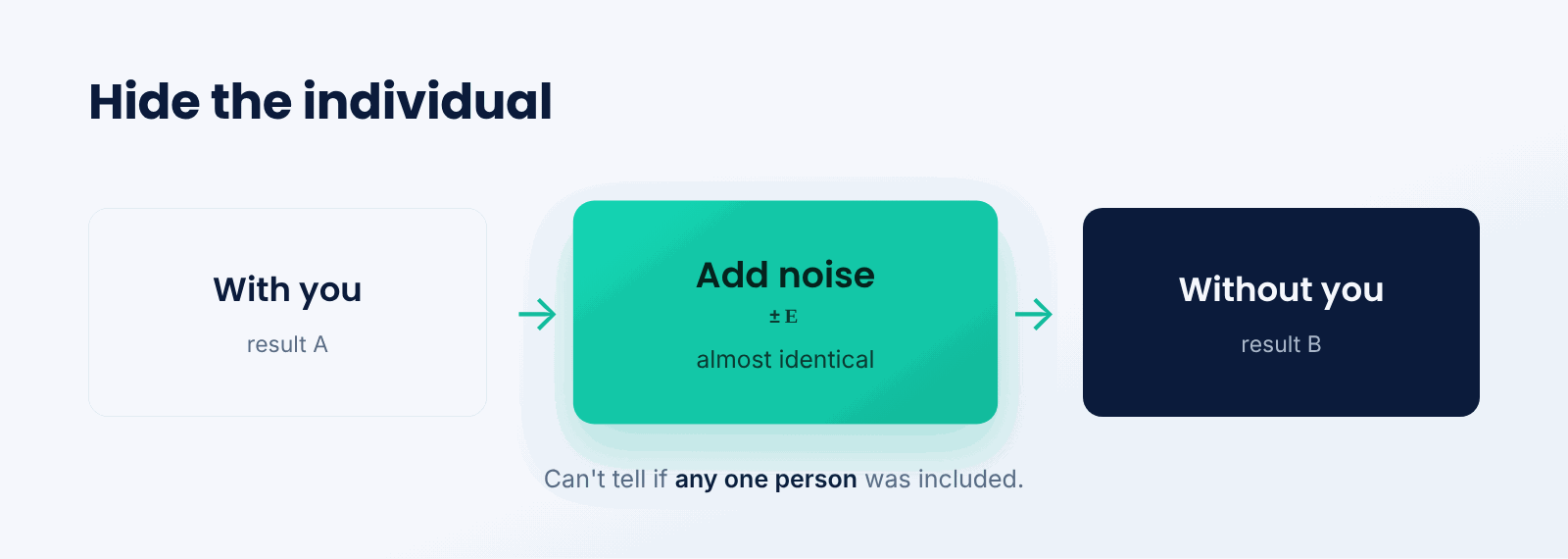
Think of it like blurring a crowd photo just enough that no single face can be identified, while the overall scene, how many people, roughly where they stand, remains clear. Differential privacy blurs results with calibrated noise so individual contributions are hidden while the aggregate signal still comes through.
The key idea is a provable, quantifiable guarantee. Unlike ad-hoc anonymization, differential privacy gives a mathematical bound on privacy loss that holds no matter what outside information an attacker has, which is what makes it so strong.
How does differential privacy work?
It adds random noise calibrated to how much any one individual could influence the result, governed by a privacy budget.
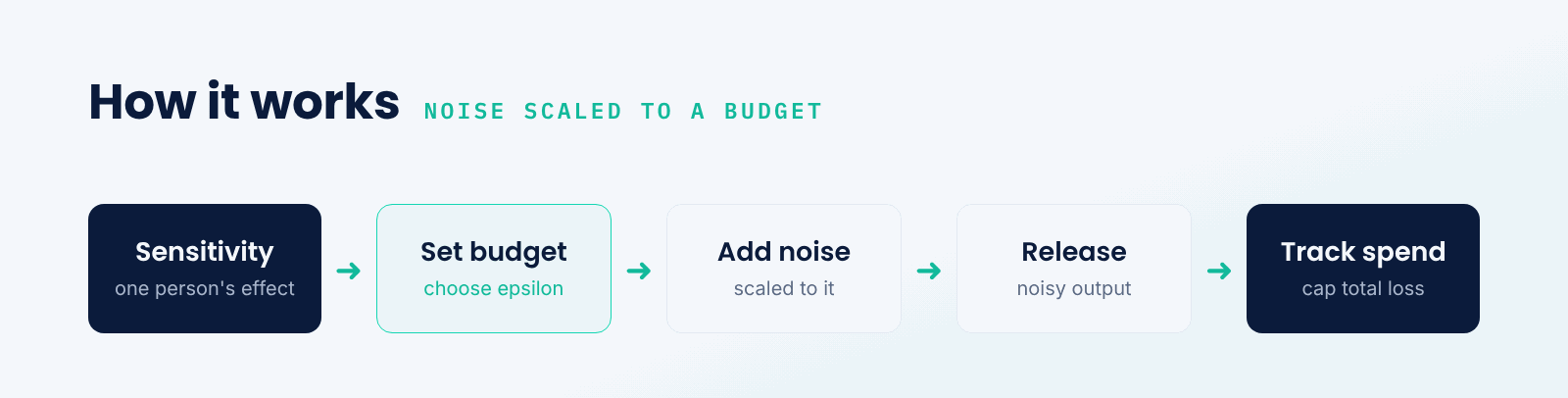
- Measure sensitivity. Determine how much one person's data can change the output.
- Set a budget. Choose epsilon, the privacy budget that controls the strength of the guarantee.
- Add calibrated noise. Inject random noise scaled to the sensitivity and budget.
- Release the result. Share the noisy output, which hides individual contributions.
- Track spend. Account for privacy budget used across multiple queries.
The privacy budget, epsilon, is the central dial: a smaller epsilon means more noise and stronger privacy but less accuracy, while a larger epsilon means the reverse. Because each query or training run spends some of the budget, the total privacy loss across many releases can be accounted for and capped.
Differential privacy vs. traditional anonymization
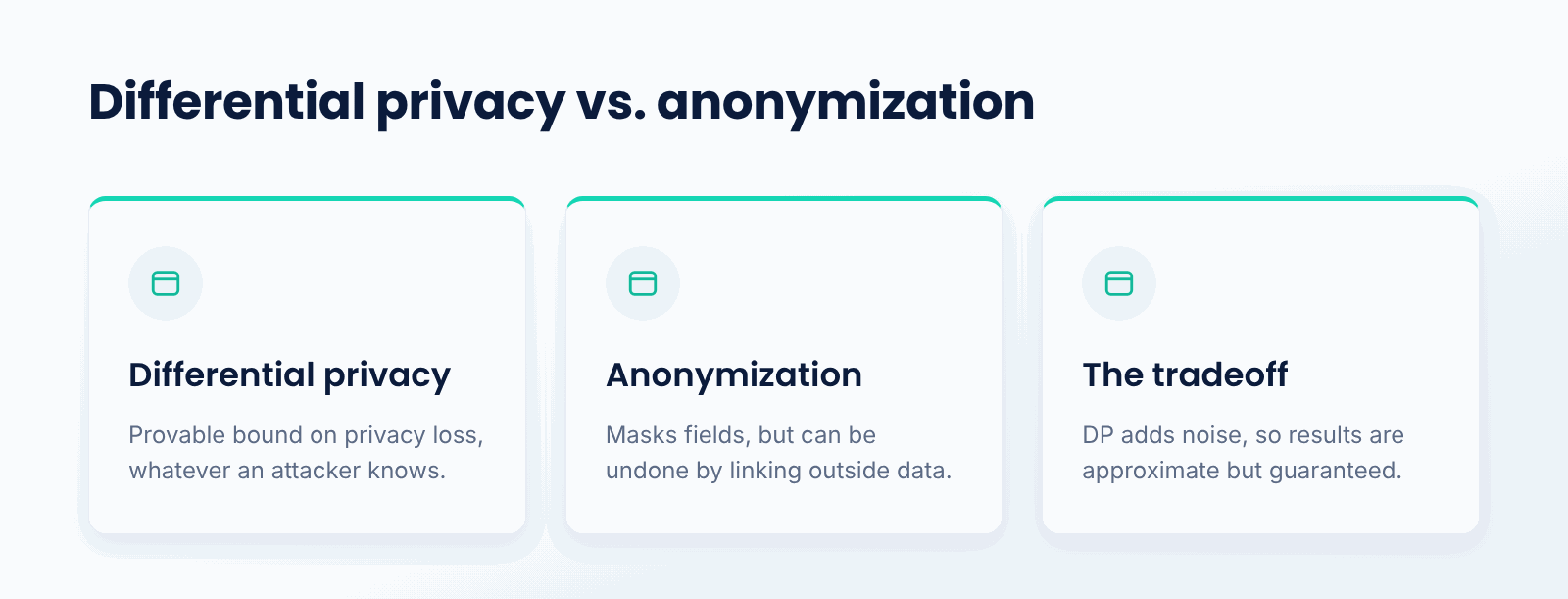
Traditional anonymization removes or masks identifying fields like names and IDs. The problem is that remaining attributes can often be combined with outside data to re-identify people, so these methods offer no firm guarantee. Differential privacy instead provides a mathematical bound on privacy loss that holds regardless of what an attacker knows, rather than relying on hiding specific fields.
The tradeoff is accuracy. Anonymization leaves exact data for the records that remain, while differential privacy deliberately adds noise, so results are approximate. In return, it gives a guarantee that anonymization cannot, which is why it is preferred when strong, provable privacy is required.
Why does differential privacy matter?
- Provable privacy. It gives a mathematical guarantee, not just best effort.
- Robustness. The guarantee holds regardless of an attacker's side information.
- Safe analytics. It lets organizations share statistics on sensitive data.
- Private ML. It allows training models on sensitive data with bounded leakage.
- Compliance. It supports strong privacy claims for regulated data.
What are the tradeoffs?
- Accuracy cost. Adding noise reduces the precision of results.
- Budget limits. Each query spends privacy budget, limiting how many you can run.
- Tuning. Choosing epsilon balances privacy against usefulness and is not trivial.
- Complexity. Implementing it correctly requires care and expertise.
When should you use differential privacy?
Use it when you need to analyze or learn from data about individuals and must provably protect their privacy, such as publishing statistics on sensitive populations or training models on personal data. It is especially valuable when the data is regulated or when a strong, defensible privacy guarantee is required.
If your data is not sensitive, or aggregate results carry no re-identification risk, the accuracy cost of differential privacy may not be justified. It shines specifically where the stakes of leaking individual information are high and a mathematical guarantee is worth the noise.
Key points about differential privacy
- It provably bounds what can be learned about any individual.
- It adds calibrated noise to outputs or training.
- Epsilon, the privacy budget, tunes privacy versus accuracy.
- Its guarantee holds regardless of an attacker's outside knowledge.
- It enables private analytics and private model training.
- It trades some accuracy for provable privacy.
Conclusion
Differential privacy is a rigorous framework that lets organizations learn from data while provably protecting the individuals in it, by adding calibrated noise so no single person's data meaningfully changes the result. Governed by a privacy budget that balances privacy against accuracy, it provides a guarantee that traditional anonymization cannot, which is why it underpins private analytics and private machine learning on sensitive data.
TrueFoundry helps teams build and deploy machine learning on their own infrastructure, including workflows that handle sensitive data under strong privacy requirements. Where provable privacy matters, differential privacy is the standard for learning from data without exposing the people in it.

Govern, Deploy and Trace AI in Your Own Infrastructure
Frequently Asked Questions
What is differential privacy in simple terms?
It is a way to learn from data about people without revealing any individual. It adds a carefully measured amount of random noise so the result is almost the same whether or not any one person is included, which means no one can learn much about that person from it.
What is epsilon, the privacy budget?
Epsilon controls the strength of the privacy guarantee. A smaller epsilon adds more noise for stronger privacy but less accuracy; a larger epsilon does the reverse. Because each query spends budget, epsilon also caps how much total privacy loss you allow across releases.
How is differential privacy different from anonymization?
Anonymization removes identifying fields but can often be undone by combining other attributes with outside data. Differential privacy instead gives a mathematical bound on privacy loss that holds no matter what an attacker knows, at the cost of adding noise to results.
Does differential privacy hurt accuracy?
Yes, somewhat, because it deliberately adds noise. The amount depends on the privacy budget: stronger privacy means more noise and less precise results. The aggregate signal usually still comes through, but individual-level precision is intentionally reduced.
When should I use differential privacy?
When you need to analyze or train on data about individuals and must provably protect them, especially for regulated or sensitive data. If the data is not sensitive and results carry no re-identification risk, the accuracy cost may not be worth it.


- © 2022 ENSEMBLE Technologies



Subscribe to our newsletter
The latest news, articles, and resources sent to your inbox


