


What Is Federated Learning and Why Does It Matter?

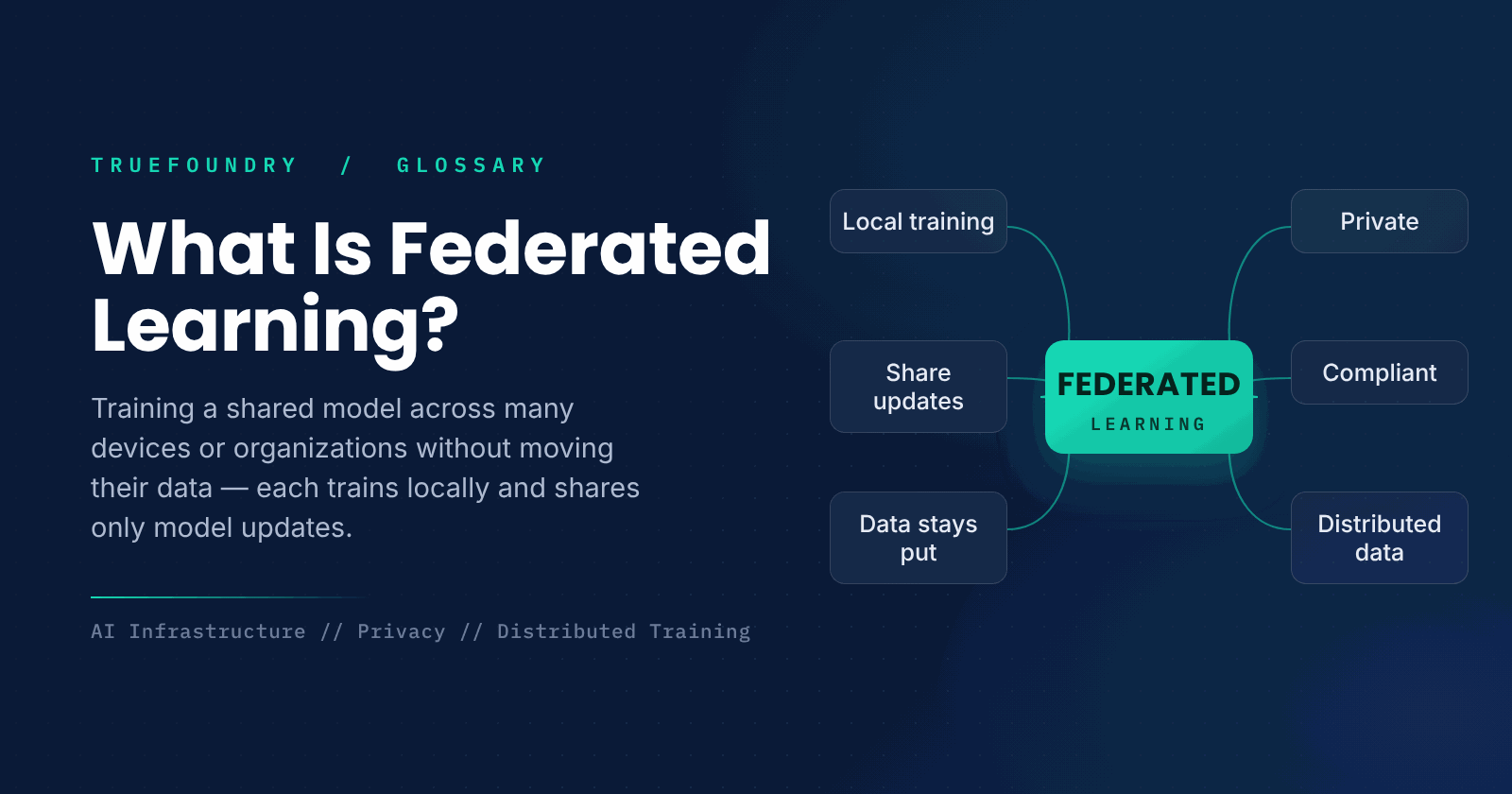
Training a model normally means gathering all the data in one place. But much valuable data cannot or should not be centralized, because it is private, sensitive, or spread across many devices and organizations. Medical records, phone keyboards, and data held by separate companies all fall into this category. Federated learning is a way to train on such data without ever moving it.
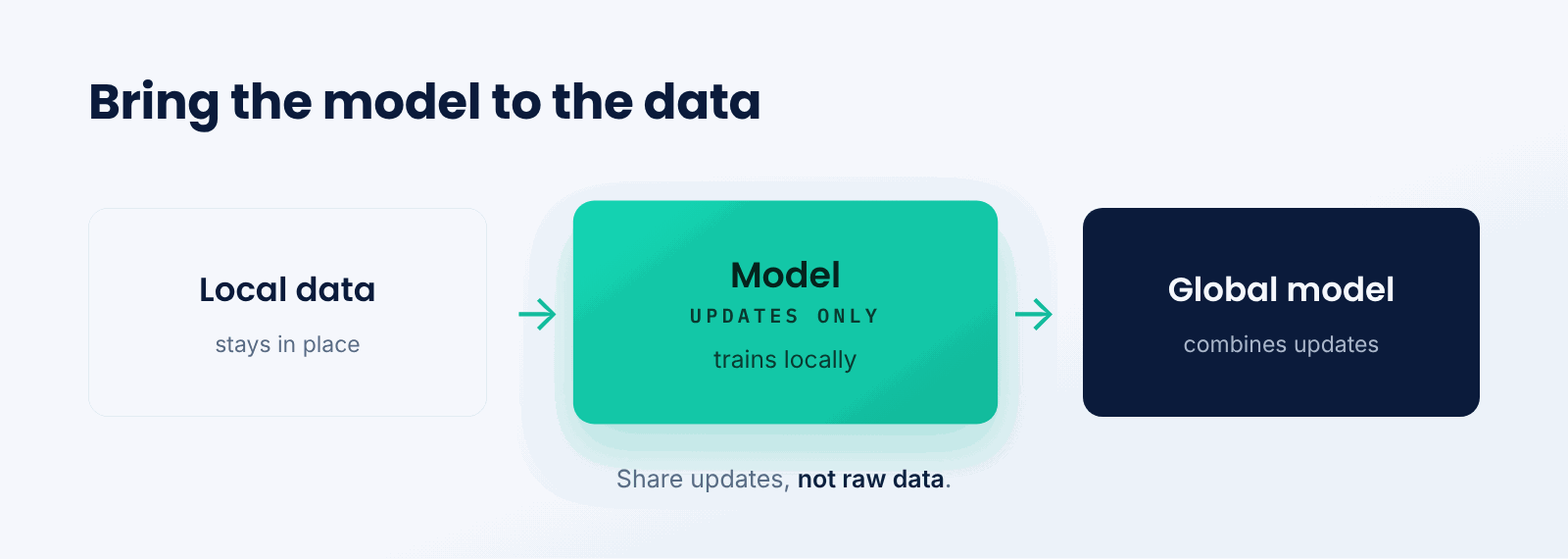
Instead of collecting the data, federated learning sends the model to where the data lives. Each participant trains on its local data and shares only the resulting model updates, which are combined into a shared model. The raw data stays put. This makes it possible to learn from distributed, private data, which is why federated learning matters for privacy. This guide explains how it works.
We will cover the definition, how it works, how it compares to centralized training, and when to use it.
What is federated learning?
Federated learning is a machine learning approach in which a shared model is trained across many decentralized participants, such as devices or organizations, each holding its own local data, without that data ever being gathered into one place. Participants train the model locally and send only their model updates to be combined, so the global model learns from everyone's data while the data itself stays local.
Think of it like a group of chefs improving a shared recipe without revealing their secret ingredients. Each cooks with their own ingredients at home and reports back only what adjustments improved the dish. The recipe gets better from everyone's experience, but no one hands over their private ingredients.
The key idea is bringing the model to the data, not the data to the model. By sharing only updates rather than raw data, federated learning keeps sensitive information where it belongs while still learning from it collectively.
How does federated learning work?
A shared model is sent out, trained locally, and its updates are combined centrally.
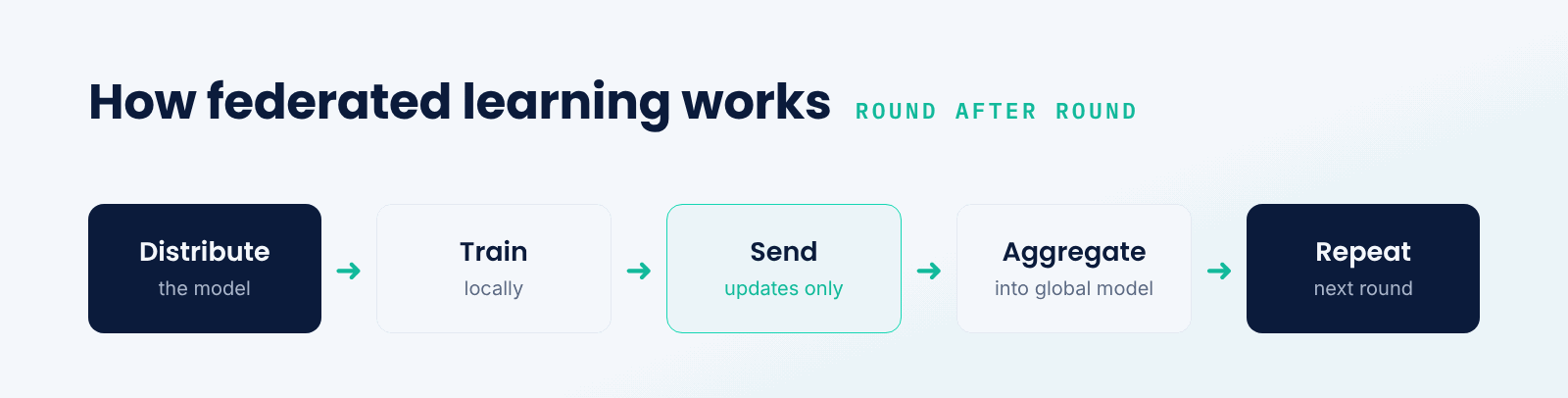
- Distribute the model. Send the current global model to each participant.
- Train locally. Each trains on its own data, producing an update.
- Send updates. Participants return only their model updates.
- Aggregate. Combine the updates into an improved global model.
- Repeat. Send the new model out and train again, round after round.
This cycle repeats over many rounds, with the global model improving each time from everyone's local training. Because only updates are shared, the raw data never leaves its owner. Additional techniques, such as encryption or added noise, can further protect the updates themselves from revealing private information.
Federated vs. centralized learning
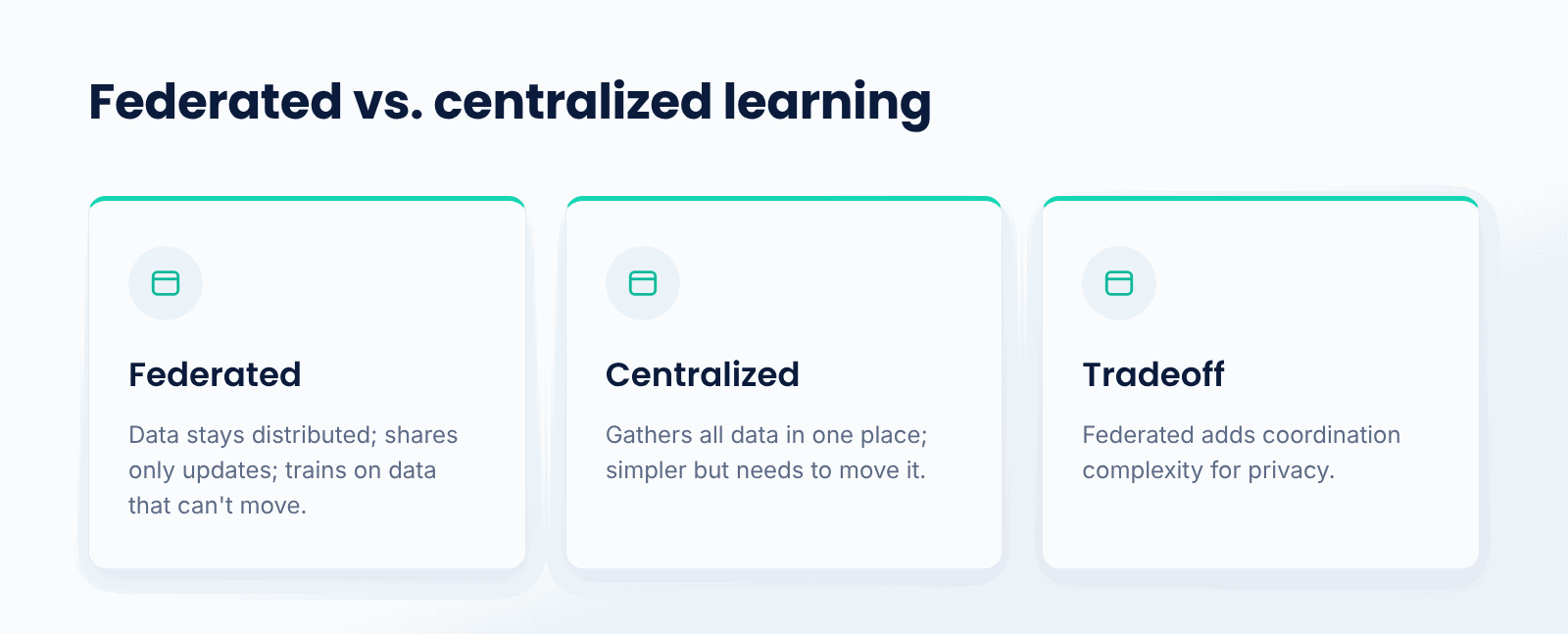
Centralized learning gathers all the data in one place and trains on it directly. It is simple and can be very effective, but it requires moving and storing all the data centrally, which may be impossible for privacy, legal, or practical reasons when data is sensitive or distributed.
Federated learning keeps the data where it is and shares only model updates, enabling training on data that could never be centralized. The tradeoff is added complexity: coordinating many participants, handling unreliable or uneven devices, and managing the extra engineering. When data cannot move, federated learning makes training possible where centralized learning cannot.
Why does federated learning matter?
- Privacy. Raw data never leaves its owner.
- Access. It learns from data that cannot be centralized.
- Compliance. It helps meet data-protection requirements.
- Scale. It taps data across many devices or organizations.
- Collaboration. Parties can train together without sharing data.
What are the challenges?
- Complexity. Coordinating many participants is harder to engineer.
- Uneven data. Local data can differ a lot between participants.
- Communication. Sending updates each round has overhead.
- Update privacy. Updates alone can sometimes leak information.
When should you use federated learning?
Use federated learning when you need to train on data that cannot be centralized, because it is private, regulated, or spread across many devices or organizations. It is ideal for learning from sensitive data like health or personal information, from data held on users' devices, or across organizations that cannot share their data directly.
If your data can simply be gathered in one place, centralized training is simpler and usually more straightforward. But whenever privacy, regulation, or distribution prevents centralizing the data, federated learning is the approach that still lets you learn from it.
Key points about federated learning
- Federated learning trains without centralizing data.
- Participants train locally and share only updates.
- Updates are combined into a shared global model.
- The raw data never leaves its owner.
- It enables training on private, distributed data.
- It adds coordination complexity over centralized training.
Conclusion
Federated learning makes it possible to train a shared model across many devices or organizations without moving their data, by sending the model to the data, training locally, and combining only the updates. This lets a model learn from private, distributed data that could never be centralized, which is why it matters for privacy-sensitive and regulated settings. The cost is added coordination complexity, but the privacy benefit is substantial.
TrueFoundry helps teams train and deploy models on their own infrastructure, including setups that keep sensitive data in place while still learning from it. When data cannot be centralized, approaches like federated learning are how training stays both possible and private.

Govern, Deploy and Trace AI in Your Own Infrastructure
Frequently Asked Questions
What is federated learning in simple terms?
It is a method of training a single model across multiple devices or institutions without consolidating all their data. Every participant trains locally on its own data but sends back only the model updates, which are combined into a single global model, so the raw data never has to move.
How does federated learning protect privacy?
By keeping the raw data where it is and sharing only model updates, never the data itself. The data never leaves its owner, and additional measures such as encryption or added noise can further protect the updates from revealing private information.
How is federated learning different from centralized training?
Centralized training gathers all the data in one location and trains on it directly. In federated learning, the data stays decentralized and the model is sent to it, combining only the updates. This lets it train on data that cannot be centralized, at the cost of more coordination complexity.
What are the main challenges of federated learning?
Coordinating many participants, dealing with local data that differs a lot between them, the communication overhead of sending updates each round, and the fact that updates alone can sometimes leak information, which is why extra privacy techniques are often added.
When should I use federated learning?
When you need to train on data that cannot be centralized, because it is private, regulated, or spread across many devices and organizations. If the data can simply be gathered in one place, centralized training is simpler and usually the better choice.


- © 2022 ENSEMBLE Technologies



Subscribe to our newsletter
The latest news, articles, and resources sent to your inbox


