


October 1, 2026
|
5 min read

Published: July 7, 2026
Blazingly fast way to build, track and deploy your models!
Most enterprises did not decide to adopt AI agents across five platforms. It happened to them. Microsoft Copilot arrived with the productivity suite. ServiceNow shipped Now Assist into the ticket queue. Salesforce turned on Agentforce inside the CRM. Other data and SaaS platforms began running agents next to the systems of record. Each platform brought its own AI runtime — and, quietly, its own governance story that stops at the platform’s edge.
The result is a governance gap that is hard for any one application-platform vendor to close alone. When an agent inside one platform calls an API, who authorized it? When an agent in another summarizes a sensitive document, which policy governed the response? And when an agent misbehaves in production, who can quickly contain it — without coordinating across multiple vendor consoles or support queues?
This is not a future-state risk. It is the operational reality for any organization that adopted more than one AI platform independently — which is increasingly common in large enterprises.
Before anyone talks about a solution, it’s worth being precise about why this is genuinely hard. The difficulty is structural, and it shows up in four places at once.
And there is a fifth problem that only becomes visible the moment a user tries to actually do something with a third-party agent: the credential tax.
Consider a routine prompt sent to an official third-party agent installed inside a Copilot-style assistant. The first time a user touches it, the agent can’t answer until the user signs in to that third-party service directly.
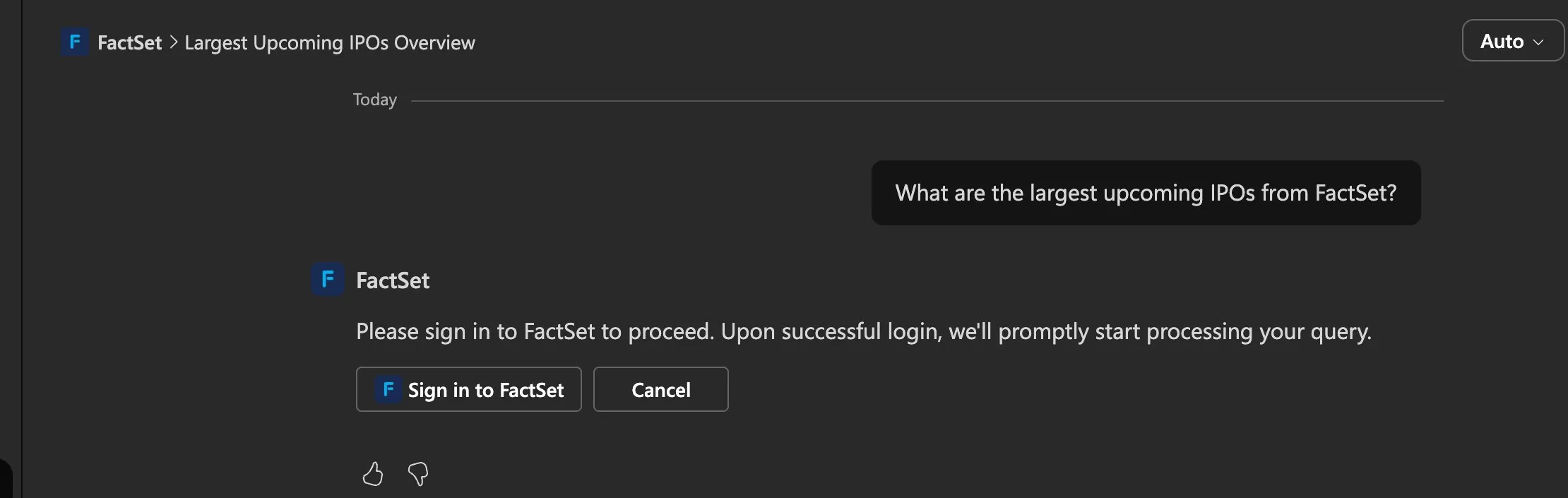
This is not a bug. It is the only safe architecture when each agent is a separately-vended product. But stacked across an enterprise’s full tool inventory, it has real operational consequences:
An architectural pattern that addresses this gap directly is to govern at the layer all these platforms have in common. Every agent, no matter which platform hosts it, eventually makes an LLM call or a tool call. Intercept and govern there, and you govern the agent activity that routes through that shared execution layer — without asking every application platform to rebuild itself.
This is the premise behind TrueFoundry’s Agent Gateway: a dedicated control layer for AI agents in production, sitting in front of the models and tools every agent depends on. TrueFoundry draws a sharp line between an AI gateway, which manages stateless prompts and tokens, and an agent gateway, which is the data plane for agentic AI — stateful sessions, multi-step execution, and the data moving between agents and their tools. It behaves like a service mesh built specifically for agentic systems.
Above the gateways sits a fourth layer: the Agent Harness. A harness is the runtime around an LLM — the orchestration loop that plans, calls tools, manages context, gates sensitive actions through approvals, and records every step into a trace. It is what turns a model call into a reliable, long-running agent.
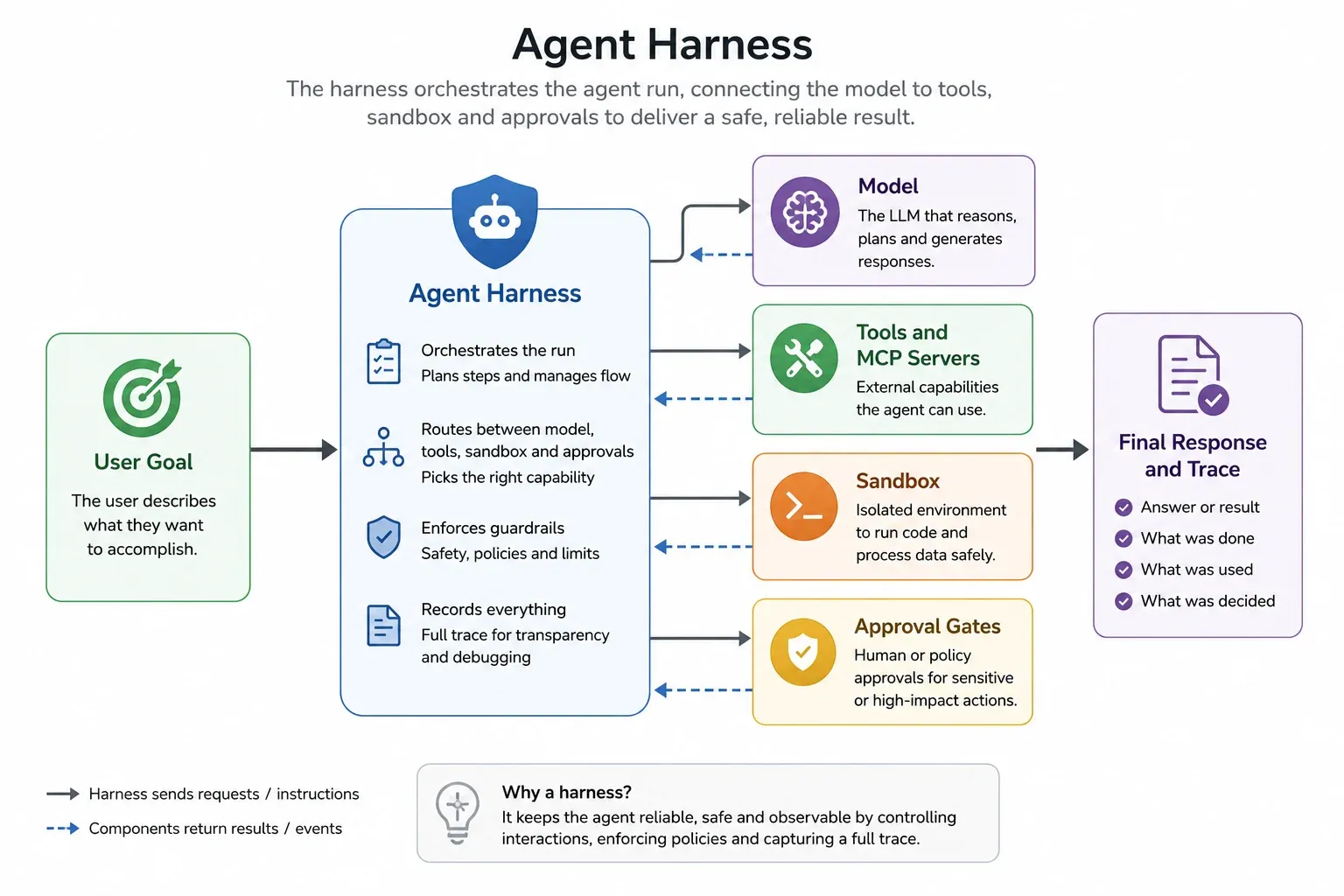
TrueFoundry ships this as a managed service rather than a framework. A sandboxed execution environment runs code and long-running tasks. Human-in-the-loop approval gates pause sensitive tool calls until a user approves. A versioned Skills Registry holds reusable instructions with RBAC. And critically — no API keys or credentials ever live in agent definitions; they live in the gateways, where platform teams configure access once and agent builders never touch secrets.
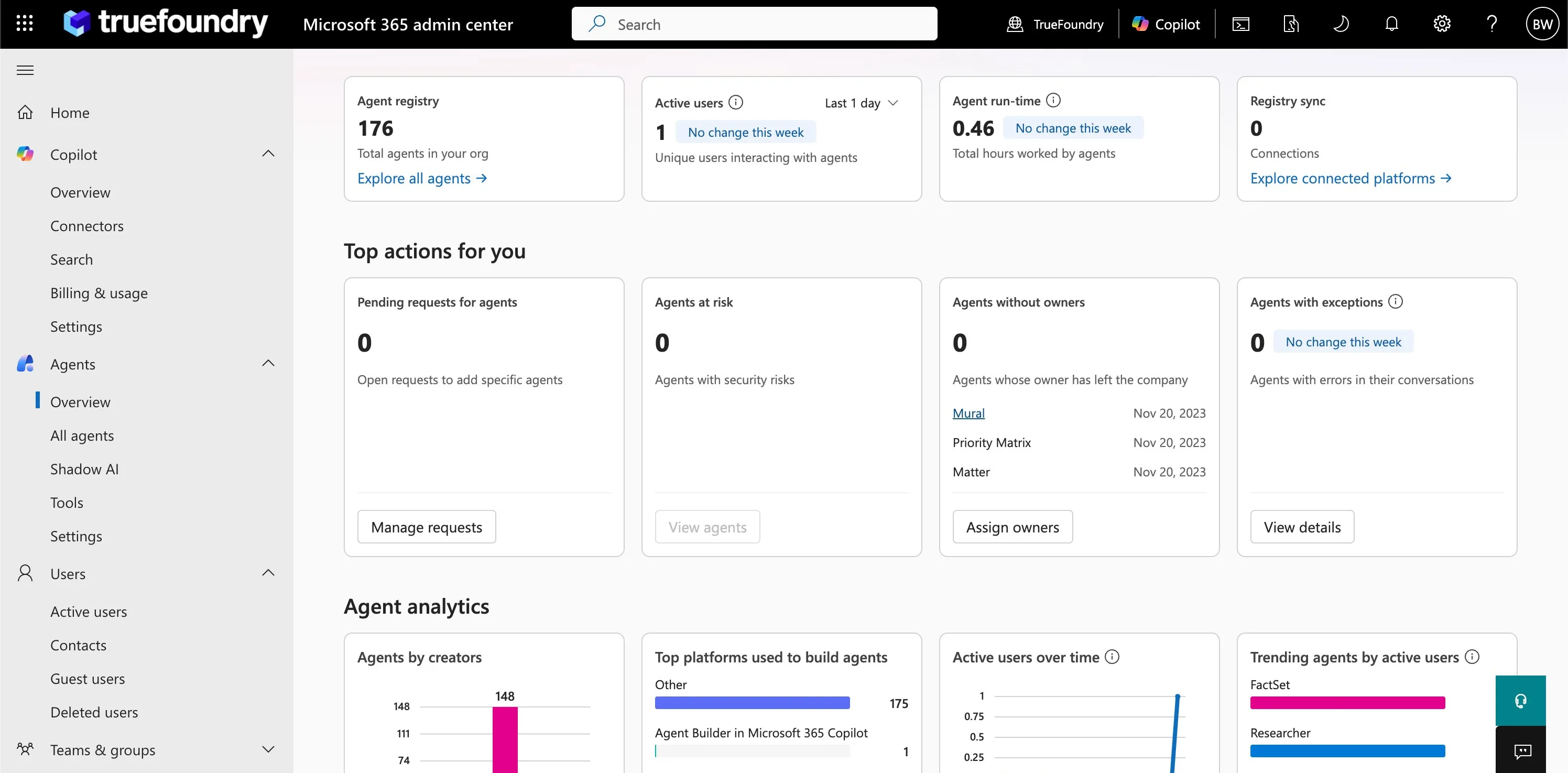
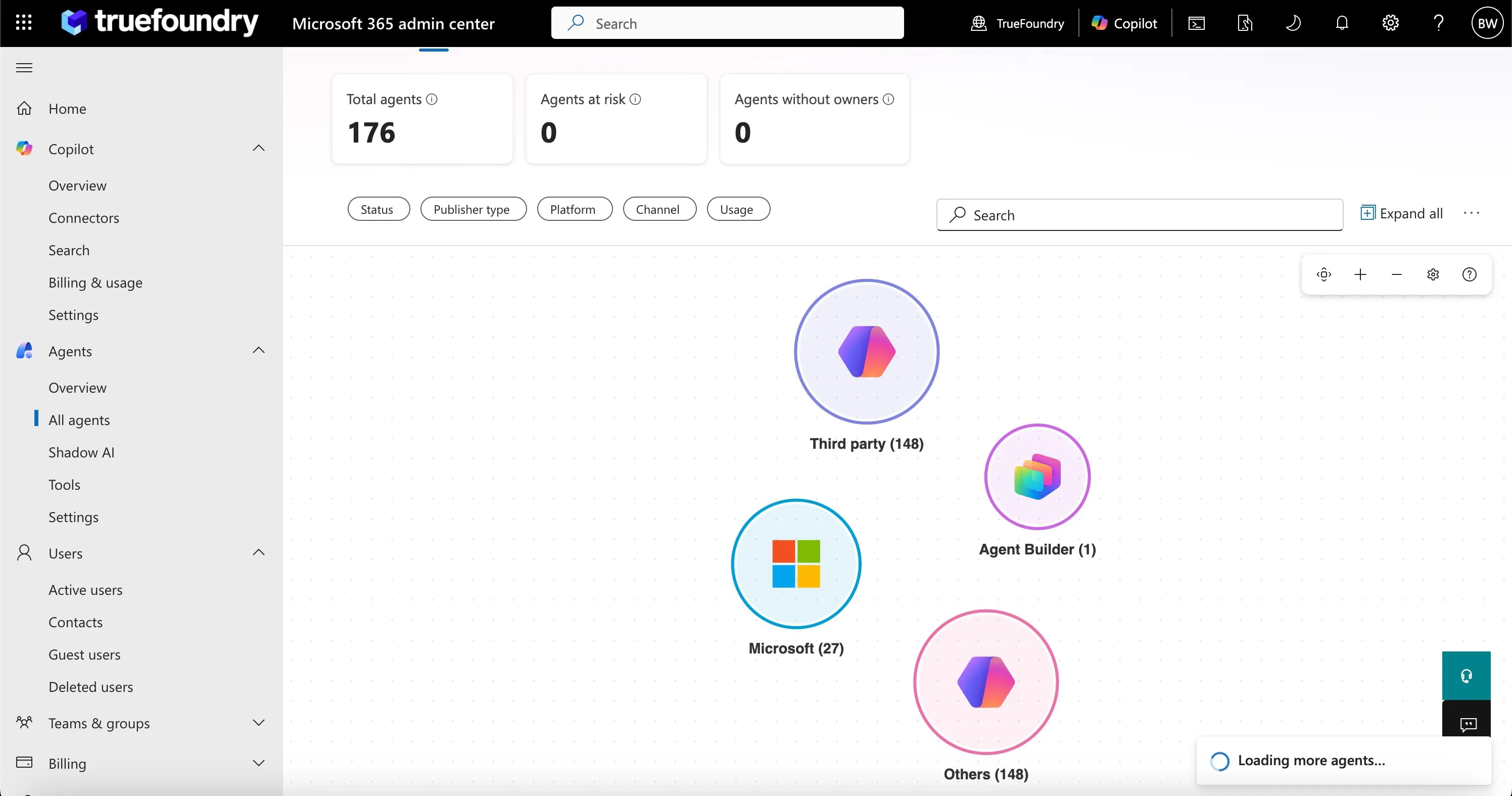
Crucially, discovery isn’t limited to agents you built on the platform. Agents running elsewhere — on Bedrock, LangGraph, a custom HTTP service, or another vendor’s platform — register into the same inventory as remote agents, with the same metadata and the same controls. The fragmented fleet becomes one map.
For teams evaluating how to close this gap, the following five capabilities are worth examining closely — with a note on what each one tends to require under the hood.
A control plane is only useful if it can carry real load without becoming the bottleneck it was meant to remove. TrueFoundry reports the kind of numbers that matter at enterprise scale:
It runs entirely in your environment — VPC, on-prem, air-gapped, or across multiple clouds — so no data leaves your domain, with SOC 2, HIPAA, and GDPR posture maintained by design. And because the underlying agent gateway is a Linux Foundation open-source project, the control layer isn’t a proprietary black box, and you aren’t locked into one vendor’s framework.
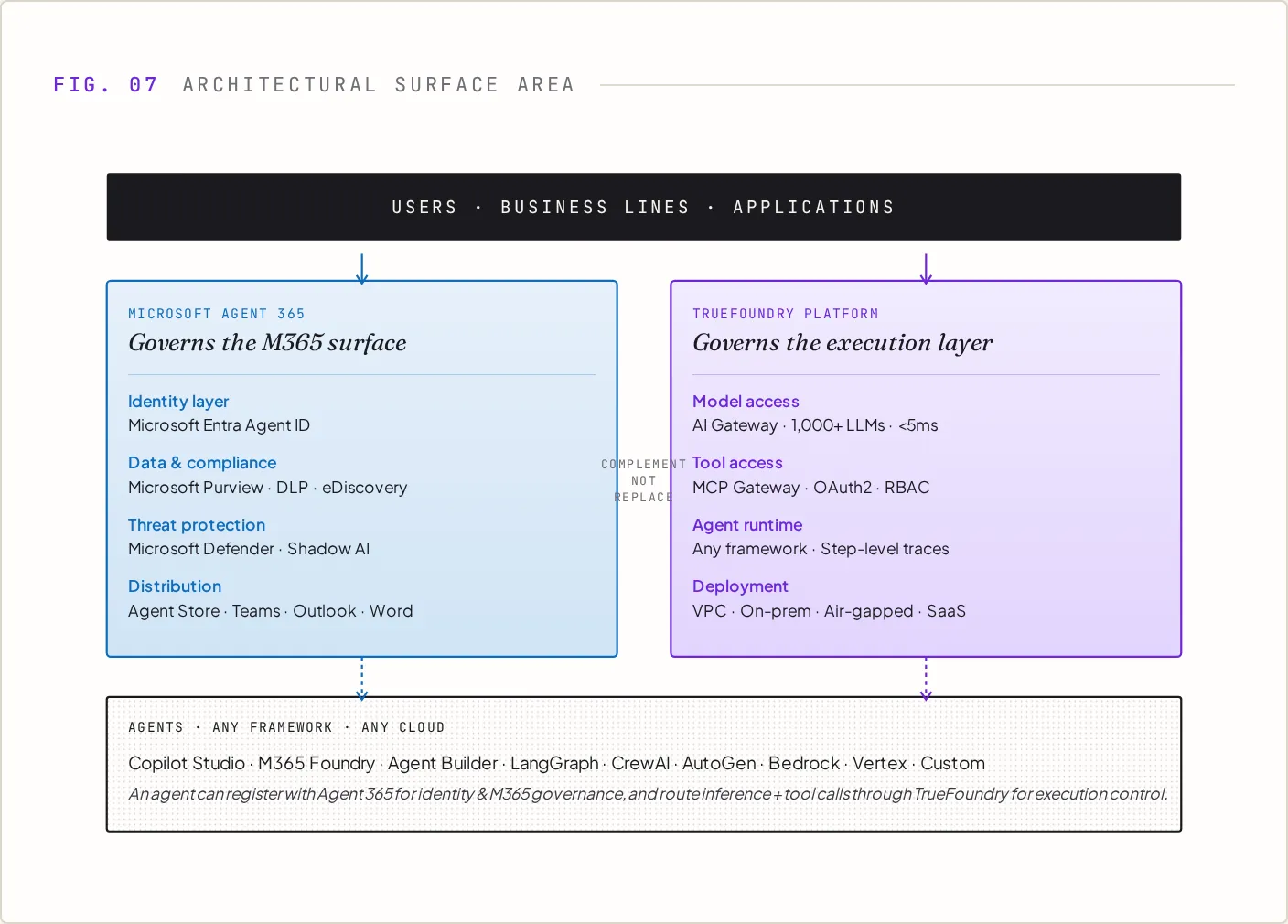
An important clarification, because it’s the most common objection: governing at the execution layer is not a rip-and-replace of the platform-native tools you already use. If your sensitive knowledge-worker data lives in M365, a tool like Microsoft Agent 365 governs that surface well — identity, data, and distribution inside the Microsoft ecosystem. Based on Microsoft’s launch materials and public coverage available as of June 2026, Agent 365 also extended its discovery surface across clouds at GA via Registry Sync to AWS Bedrock and Google Gemini Enterprise — a credible cross-cloud move on the discovery side.
Based on the same launch materials, the SaaS platforms where a significant share of enterprise agent work runs today have not been part of that initial sync scope — agents inside Salesforce Agentforce and ServiceNow AI Agents, both generally available since 2024, were not in the initial Registry Sync coverage, and policy enforcement for any synced agent still flows through Microsoft’s own controls rather than the source platform’s. Microsoft’s connector coverage may expand over time; readers should verify the current list before relying on this detail. The execution layer remains a surface that every platform genuinely shares.
The fastest way to know whether this closes your gap is to prove it on your own traffic, scoped to the capabilities that hurt most today:
⚠ Editorial Disclaimer This article is published by TrueFoundry, Inc. for informational purposes only, based on analysis of publicly available vendor documentation as of June 2026. All views expressed are corporate positions of TrueFoundry, not those of any individual contributor, and do not constitute professional, legal, or purchasing advice. Microsoft has not reviewed, endorsed, or sponsored this article. Product features, pricing, and roadmaps are subject to change without notice; figures shown are sourced from public materials or are illustrative diagrams. Original analysis, text, and diagrams are the property of TrueFoundry, Inc.; all third-party product names and trademarks are the property of their respective owners. Verify all information against current vendor documentation before making architectural or purchasing decisions.
Sources
TrueFoundry AI Gateway delivers ~3–4 ms latency, handles 350+ RPS on 1 vCPU, scales horizontally with ease, and is production-ready, while LiteLLM suffers from high latency, struggles beyond moderate RPS, lacks built-in scaling, and is best for light or prototype workloads.






The latest news, articles, and resources sent to your inbox
.png)
.png)
.png)
.png)
.png)
.png)
.png)
.png)
.png)
.png)
.png)


