


October 1, 2026
|
5 min read


Published: August 27, 2026

Blazingly fast way to build, track and deploy your models!
LangChain pricing can be an issue for many teams for one simple reason: the open-source framework, together with LangGraph, is free of charge, while the billing platform (and the actual bill itself) is not. The hosted platform LangSmith, where all LangChain observability, evaluation, deployment, and agent tooling take place, is charged per unit of use that is hardly predictable upfront.
The purpose of this document is to break down LangChain pricing plan by plan, explain the LCU/LSU usage model, and reveal the hidden pitfalls that lead to unexpected costs. With the picture of pricing fully outlined, we can move onto understanding how these costs change depending on the product development life cycle stage (from prototype to production).
Yes, LangChain and LangGraph frameworks themselves are open-source and are available for free (at least for self-hosting). What you pay LangChain Inc is the usage of its hosted observability, eval, prompt and deployment service - LangSmith.
Therefore, the actual question behind "langchain cost" or "langgraph pricing" searches is: what is the cost of LangSmith at our scale? The fact that the framework is free is the easiest one. LangSmith is the actual budgeting challenge since its cost highly depends on what your agents do after being deployed and not on the particular plan.
LangSmith operates on three tiers and all extra usage is pay-as-you-go.
In theory, this sounds easy enough. An individual gets to build for free, a small team pays a $39 per seat license, and larger organizations have an option to get an Enterprise contract. However, this is where things start becoming complicated since this is just the licensing fee, and the true cost of using LangChain comes from its usage.
There are two different types of units in which usage is calculated at LangSmith: LangChain Compute Unit (LCU), which costs $1.50 and is used for computing and work, and LangChain Storage Unit (LSU), which is priced at $1.00 and includes tracing and storage.
Almost everything in the platform will use either LCU, LSU, or both. Deployments, sandboxes, no-code agents of the Fleet, and the Engine – all of these measure your usage in LCUs and LSUs in some way. While this gives flexibility, this also makes the monthly cost unpredictable – it will depend on how much your agents run, how many traces they produce, and how long this data is stored. Two different teams using the same $39 license will likely get very different bills based on their workload, making budgeting and financial review challenging.
This is just the base cost of the platform; the actual cost of using LangChain tends to go up here:
Nothing is being hidden from you in any malicious way. This is just an example of usage-based pricing, which makes this pricing hard to predict and easy to underestimate.
For example, imagine that a team of five uses Plus plans. Seats by themselves cost $195 monthly. Enable the Engine and add a conservative ten LCUs per run multiplied by 120 runs per month – you get yet another $1,800 monthly bill. Now add an always-on production deployment and its metering, and you are well over $2,000 without trace overages.
Now the traces scale up with usage, increase retention for the traces that matter to you, and the bill keeps rising on an unpredictable curve. The plan was set at $39 per seat. Here is what the invoice looks like. That is the usage-metered pricing pattern to look out for, and it is the perfect time to contrast it with a platform designed for predictability.
Comparing only the entry-level subscription price is one of the easiest ways to underestimate the cost of running AI applications in production. The total cost of ownership often includes much more than the platform license itself, such as:
Looking beyond the advertised seat price and estimating your total cost of ownership - including usage charges, infrastructure, retention, and enterprise features—provides a much more accurate picture of what you'll spend as your AI applications scale.
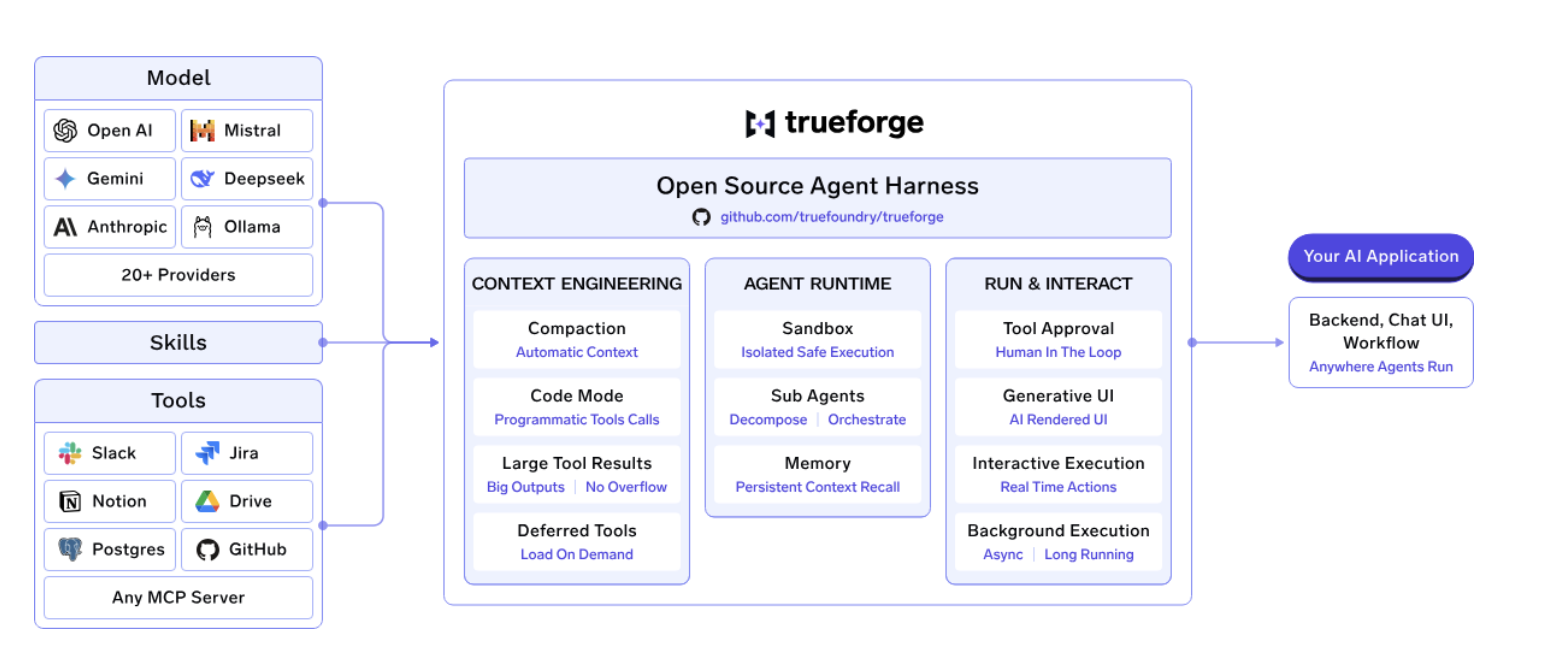
If the LCU/LSU model above is the part of LangChain pricing that's hard to plan around, it's worth knowing there's now an open-source alternative built specifically to avoid that pattern. TrueForge is TrueFoundry's open-source, vendor-neutral agent harness, MIT licensed, with the full runtime in the repo rather than a cut-down free tier.
Getting started takes one command: npx @truefoundry/trueforge runs it locally with no extra infrastructure, and you're chatting with your first agent in a couple of minutes. The quickstart docs walk through picking a model provider and connecting your first MCP server from there.
Repo: https://github.com/truefoundry/trueforge
The pricing model is the opposite of metered compute and storage units: the harness itself has no license fee and no per-run charge. You pay for the models you route to, same as you would anyway, and nothing else.
What you get in that open-source runtime:
LangChain itself is free, but building and operating production AI applications with the LangChain ecosystem isn't. Once you move beyond local development, costs are driven by LangSmith usage, including compute, storage, deployments, trace retention, and other metered services. While this usage-based model offers flexibility, it can also make monthly spending difficult to predict as workloads grow.
Before choosing a platform, look beyond the headline seat price and evaluate the total cost of ownership including infrastructure, observability, governance, and operational overhead. Understanding these costs upfront will help you choose an AI platform that fits both your technical requirements and your budget as you scale.
What is the pricing of LangChain?
The LangChain framework itself is free and open-source. The hosted solution LangSmith is free for the Developer tier ($0) and costs $39/seat/month for the Plus tier with usage charged on top (LCU – $1.50, LSU – $1.00 and per-pay traces).
Is LangChain free and open source?
Yes, the LangChain and LangGraph packages are open source and self-hosting, and therefore you pay only for the underlying compute. Charges start when you use the premium LangSmith offering for monitoring, evaluation, or hosting.
What is the difference between pricing models of LangSmith and LangGraph?
LangGraph is part of the open-source framework. LangSmith is a paid offering where charges for the hosted version of LangGraph are computed via the LangSmith LCU/LSU model.
TrueFoundry AI Gateway delivers ~3–4 ms latency, handles 350+ RPS on 1 vCPU, scales horizontally with ease, and is production-ready, while LiteLLM suffers from high latency, struggles beyond moderate RPS, lacks built-in scaling, and is best for light or prototype workloads.






The latest news, articles, and resources sent to your inbox
.png)
.png)
.png)
.png)
.png)
.png)
.png)
.png)
.png)
.png)
.png)


