



October 1, 2026
|
5 min read


Published: August 21, 2026
.webp)
Blazingly fast way to build, track and deploy your models!
A few months ago, most teams viewed their MCP Servers as lightweight enhancements. You found one in GitHub, connected it to Claude Desktop or Cursor via JSON configuration file, and went on with your business. This approach was effective for a limited number of servers.
However, once you start scaling up your utilization to dozens of MCP Servers across multiple teams, each requiring separate authentication, uptime expectations, ownership, etc., you quickly run out of capacity to manage them all.
All these different teams end up with duplicate Servers, with their Credentials scattered throughout the environment, and no way to know which tools are using which Agent.
At the same time, the Model Context Protocol's rapid evolution has made it an industry-standard integration layer for agentic AI. Fast-growing support from major AI ecosystems and tens of thousands of servers has caused the MCP ecosystem to evolve much faster than the infrastructure available to support it.
This is where MCP registries come in. MCP registries serve as the integration and discovery layer for MCP servers. They vary widely in scope, from simple discovery catalogs to platforms that attempt to solve hosting, governance, and enterprise control problems.
Choosing the wrong approach can result in:
In this guide, we analyse the best MCP Registries for 2026, looking at how they perform with respect to Discovery, Governance, Hosting and Enterprise preparedness. This will allow you to select the correct platform for setting up your AI agent infrastructure.
.webp)
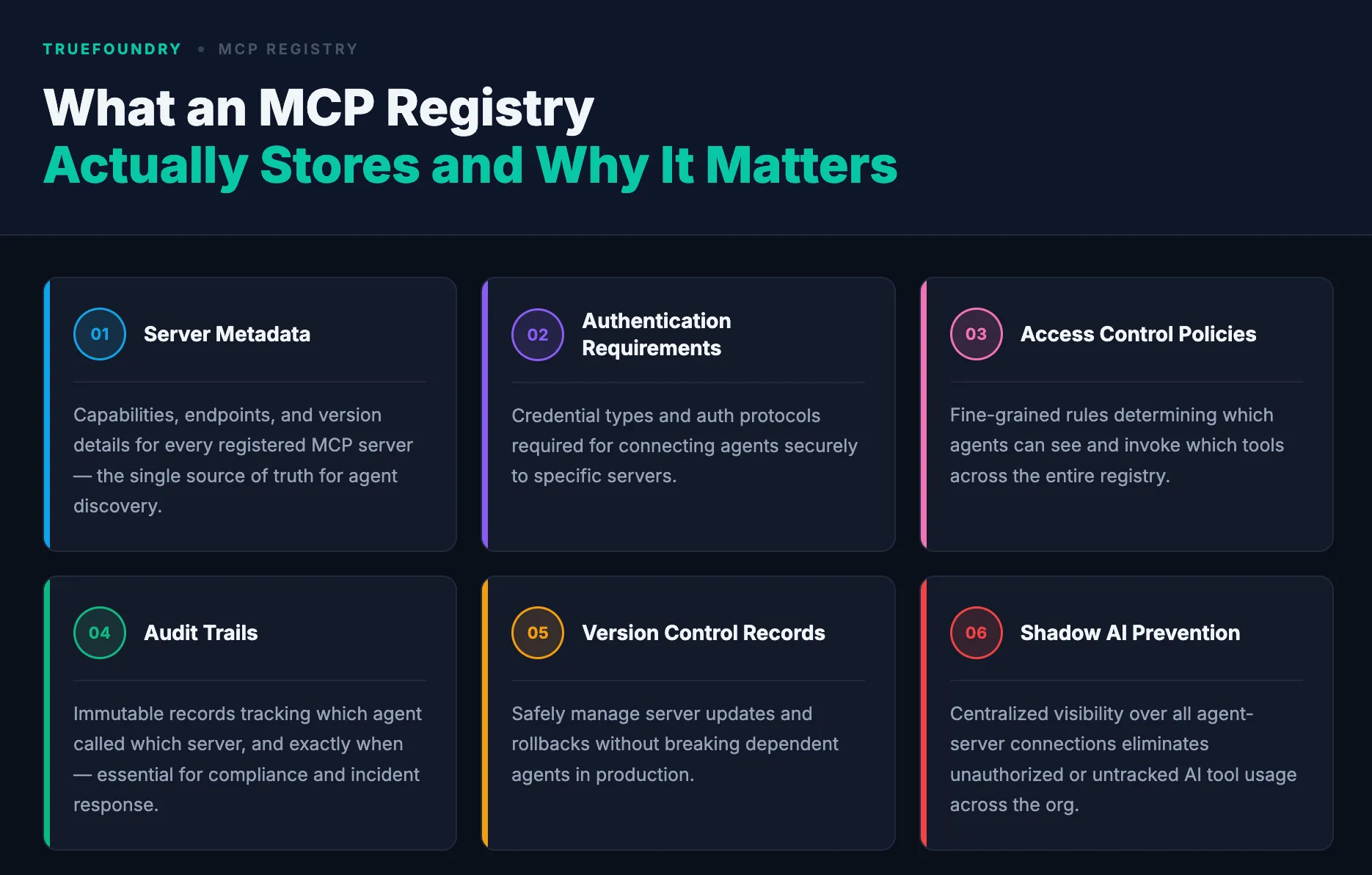
An MCP registry is a centralized catalog that keeps track of all MCP servers, their capabilities, and how to connect to them. You can think of the MCP registry as the discovery layer for your AI tools.
MCP registries are not the same as the actual servers. They store server metadata such as:
The actual servers exist where they have been deployed, whether locally, in the cloud, or with a third party. This distinction becomes more important as systems expand in size.
Developers can configure servers manually when there are only a few to manage. When agents multiply and tools connect to many systems at once, fragmentation issues emerge:
Companies are increasingly aware of this growing problem: shadow AI. Teams can connect automation agents to external tools without oversight, any way to manage these potentially dangerous data-exposure connections, or any access control.
Without a central MCP registry, there is no mechanism to track or administer these connections. The MCP registry provides the visibility and control that platform teams need before tool sprawl becomes a systemic issue.
.webp)
MCP Registries exist for many reasons; some include finding a server, providing a place to host an application, or managing the overall use of MCPS within the enterprise.
Below is a summary of the best MCP Registries compared based on their function and capabilities.
A centralized repository of public metadata for MCP servers, backed by Anthropic, GitHub, PulseMCP and Microsoft. It is a METAREGISTRY—this means that while it contains metadata about packages, it does NOT contain the actual code or binaries (which live on npm, PyPI, Docker Hub; etc).
Limitation:
Best for
Smithery is the closest equivalent to Docker Hub in the MCP ecosystem. This tool has over 7,000 available servers which can be either installed locally using the CLI or run on Smithery’s infrastructure as hosted remote servers. For hosted servers, Smithery will manage the runtime and provide OAuth modals for Server Authors, so they will not have to create their own authentication flow from scratch. The time from identifying your tool to getting it up and running is typically less than one minute.
Limitation:
Best for:
Developers or small teams that want to prototype agent workflows by enabling fast discovery and setup or conduct experiments involving MCP integrations.
Glamas is a centralized source for public MCP server metadata, maintained by Anthropic, GitHub, PulseMCP, and Microsoft, and acts as a metaregistry. It contains all of the MCP package metadata but does not store the actual source code or binary files. Source code and binary files are available in the standard repositories (NPM, PyPI, Docker Hub) and can be accessed through Linda.
Limitations:
Best for:
An online marketplace for MCP tools, MCPMarket.com lists over 10,000 for MCP servers across 23+ categories, including Developer Tools, API Development, Data Science & ML, and Productivity & Workflow.
This is a 'Community Curated' directory with a browsable web UI that allows you to filter by category, see featured or official MCP servers, and get installation details. If you're using Cline, the install workflow is more integrated, however the directory itself is client agnostic.
Limitations:
Best for:
Developers who are interested in browsing and discovering MCP servers by category through a web UI, rather than querying an API. A useful tool for obtaining a quick visual overview of what is available within the MCP ecosystem.
MCP.so is a community-led directory for third-party MCP servers. It is among the biggest directories available today, with over 19,000 servers submitted. Any individual can add an entry to the directory by submitting an issue on GitHub; this is both what makes it popular and what causes it to be hard to use.
Limitation:
Best for:
Broad discovery if you want to see the largest selection possible of MCP servers. This can be good for gathering background information or to find obscure MCP servers that may not be listed on other curated lists.
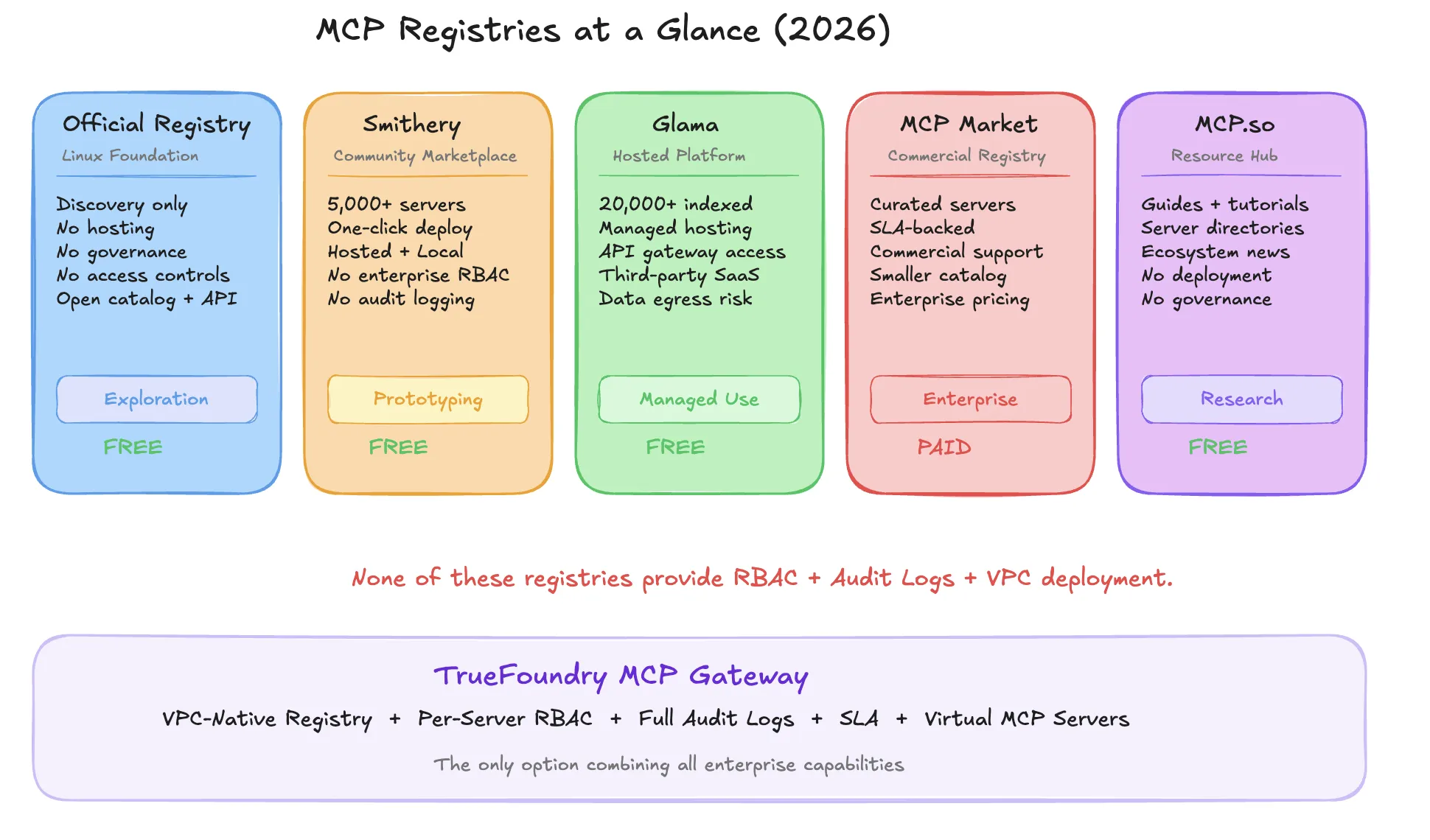
Let’s compare the top five MCP registries along key parameters:
The functional limitations of many MCP registries create four important gaps for enterprise-level personnel:
These capabilities are not optional. They are required by any organization subject to compliance audits or operating sensitive systems in regulated industries.
.webp)
Publicly available MCP servers help you determine what tools exist. Organizations must also determine who may access those tools and under what conditions. An internal registry provides three critical capabilities:
1. One Source of Information on All Public and Private Servers
Many organizations use a mix of externally-sourced and custom-developed servers to host their MCPs. The internal registry creates a centralized, controlled location for archiving both types of servers.
2. Approval Workflow Restrictions to Prevent Shadow MCP Use
Before agents can access a server, the server must be vetted so the security team can manage the agent's access.
3. Version Control and Rollback Functionality Provide Stability
Platform Managers will be able to assign and pin an agent to a specific server version and, if necessary, revert to the previous version.
Without these capabilities, organizations that adopt MCP technology at scale will face the same challenges created by earlier movements toward shadow IT. The software supply chain risks posed by ungoverned MCP servers are analogous to those posed by unmanaged traditional software components in modern software supply chains.
.webp)
.webp)
MCP registries allow agents to discover which tools exist, but they do not enforce access control, track usage, or protect sensitive systems from backend changes. TrueFoundry provides a complete control plane that extends the registry into a governed infrastructure layer.
Within a control plane deployed in their own environment (AWS, GCP, Azure, or on-prem), users can register both self-hosted and public MCP server instances using TrueFoundry. All interactions will remain inside the user's network perimeter, and the agents will only be able to interact with authorized servers for teams subject to GDPR or data residency requirements; this is a must-have for control.
Not every agent should have access to every tool. TrueFoundry uses role-based access control (RBAC) at the server level, so each team/agent can view and invoke only the tools they are authorized to use. Platform teams define the access level a team or agent will have once and then TrueFoundry will enforce that across all access to the tool.
All tool usage is automatically captured with very detailed and structured metatag data; this includes the user who called the tool (the agent), the identity of the agent, the identity of the server that received the call, the date and time the call occurred, any input to the call and any output of the call. This provides automated audit trails that meet compliance for regulations such as SOC 2 and GDPR without requiring logging to separate infrastructure.
By creating a virtual MCP Server, TrueFoundry provides an abstraction layer that allows agents to communicate with back-end services (TrueFoundry can thus accommodate changes to the services without changing the agent's logic). Consequently, this will provide organizations with consistently stable production processes, regardless of any changes made to the infrastructure behind the scenes (this invariance holds even after the infrastructure has been changed).
.webp)
Community-based MCP registries are appropriate for experimentation and exploration. However, when organizations begin deploying MCPs into production environments, they are not sufficient for the governance and control that regulated or multi-team enterprise systems require.
As an organization scales its use of MCPs, common challenges emerge: limited visibility into tool usage, uncontrolled access to external services, fragmented credential management, and software delivery pipelines that lack policy checks. Without a governed internal layer, these issues can quickly become compliance and security liabilities. The risks mirror those seen with shadow AI in earlier waves of ungoverned technology adoption.
TrueFoundry enables organizations to move beyond a simple MCP registry by providing a control plane that includes server discovery, access control, audit logging, and VPC-native deployment on a single platform. This gives MCP adopters a solid foundation for reliably running MCP infrastructure in production environments.
An MCP registry is a centralized catalog of MCP servers storing server metadata about tools dynamically discoverable by agents. Your agents can discover tools without hardcoding them into your configuration. Registries track capabilities, connection endpoints, and authentication requirements, acting as the discovery layer for the MCP ecosystem across development teams and production environments.
The MCP registry is a discovery mechanism for the tools and resources available in the MCP ecosystem. The MCP gateway acts as the enforcement mechanism. The registry lists the tools; the gateway controls who has access control, how requests are routed, and how they are logged. Both are necessary for governed enterprise deployments.
Publicly available MCP servers and public MCP registries work well for discovery and prototyping. However, they lack the institutional governance, access control, and audit logging needed to protect sensitive data and sensitive systems in production environments subject to compliance requirements.
Publicly available MCP servers and public MCP registries work well for discovery and prototyping. However, they lack the institutional governance, access control, and audit logging needed to protect sensitive data and sensitive systems in production environments subject to compliance requirements.
Enterprises typically combine a MCP gateway, role-based access control, approval workflows, and centralized authentication to govern which automation agents can access which tools. This control plane approach prevents unauthorized automation workflows and creates the audit trails needed for compliance verification.
TrueFoundry AI Gateway delivers ~3–4 ms latency, handles 350+ RPS on 1 vCPU, scales horizontally with ease, and is production-ready, while LiteLLM suffers from high latency, struggles beyond moderate RPS, lacks built-in scaling, and is best for light or prototype workloads.






The latest news, articles, and resources sent to your inbox
.png)


.png)
.png)
.png)

.png)
.png)
.png)
.png)
.png)
.png)
.png)


