September 18, 2026
|
5 min de lecture


Accédez instantanément à un environnement TrueFoundry en direct. Déployez des modèles, acheminez le trafic LLM et explorez la plateforme complète : votre sandbox est prête en quelques secondes, aucune carte de crédit n'est requise.



Published: October 6, 202615
Une méthode incroyablement rapide pour créer, suivre et déployer vos modèles !
AI agent portability is the property that an agent's logic stays the same while the model underneath it can change. The agent refers to a model by name and calls a stable interface. Which provider actually serves the request, and which credentials are used, live outside the agent entirely.
Contrast that with the common starting point. An agent is written against a specific provider SDK, the provider's API key sits in the agent's environment, and the model name is scattered through the code. Every one of those is a thread tying the agent to one vendor. Portability is what happens when you cut all three.
The payoff is practical: you can adopt a newer model the day it ships, fall back to a second provider when the first has an outage, route cheap requests to a smaller model, and keep self-hosted and commercial models behind the same interface. None of that should require touching the agent.
For a single-turn chatbot, swapping models is close to a one-line change already. Agents raise the difficulty for a few reasons worth naming, because they shape what a good portability layer has to handle.
A portability layer that only swaps a model string but leaves credentials, routing, and fallbacks inside the agent has not really made the agent portable. It has just moved the problem.
TrueFoundry's approach is to manage model access once, at the AI Gateway, and let every agent reference models by name. The gateway holds the provider credentials, enforces access policies, and routes traffic. Agents inherit all of it.
Every model, whether it is OpenAI, Anthropic, Azure OpenAI, Google Vertex, AWS Bedrock, Databricks, Together AI, or something you host yourself, sits behind a single OpenAI-compatible API. You point your code at the gateway once and switch models by changing the model name in the request. Same URL, same credentials.
from openai import OpenAI

client = OpenAI(
    api_key="your-truefoundry-api-key",   # a gateway token, never a provider key
    base_url="https://gateway.truefoundry.ai",
)

# Today:
resp = client.chat.completions.create(
    model="openai-main/gpt-4o",
    messages=[{"role": "user", "content": "Draft the release notes"}],
)

# Tomorrow, swap the model. Nothing else changes:
resp = client.chat.completions.create(
    model="anthropic-main/claude-sonnet-4",
    messages=[{"role": "user", "content": "Draft the release notes"}],
)
The agent code did not change in any meaningful way. The credential did not change. The only edit is the model name, and even that can be abstracted away, which is the next piece.
In TrueFoundry's Agent Harness, the model is a selection in the builder, not a value in code. You pick any model enabled for you in the gateway, and switching is a one-click change with no code edits and no new credentials.
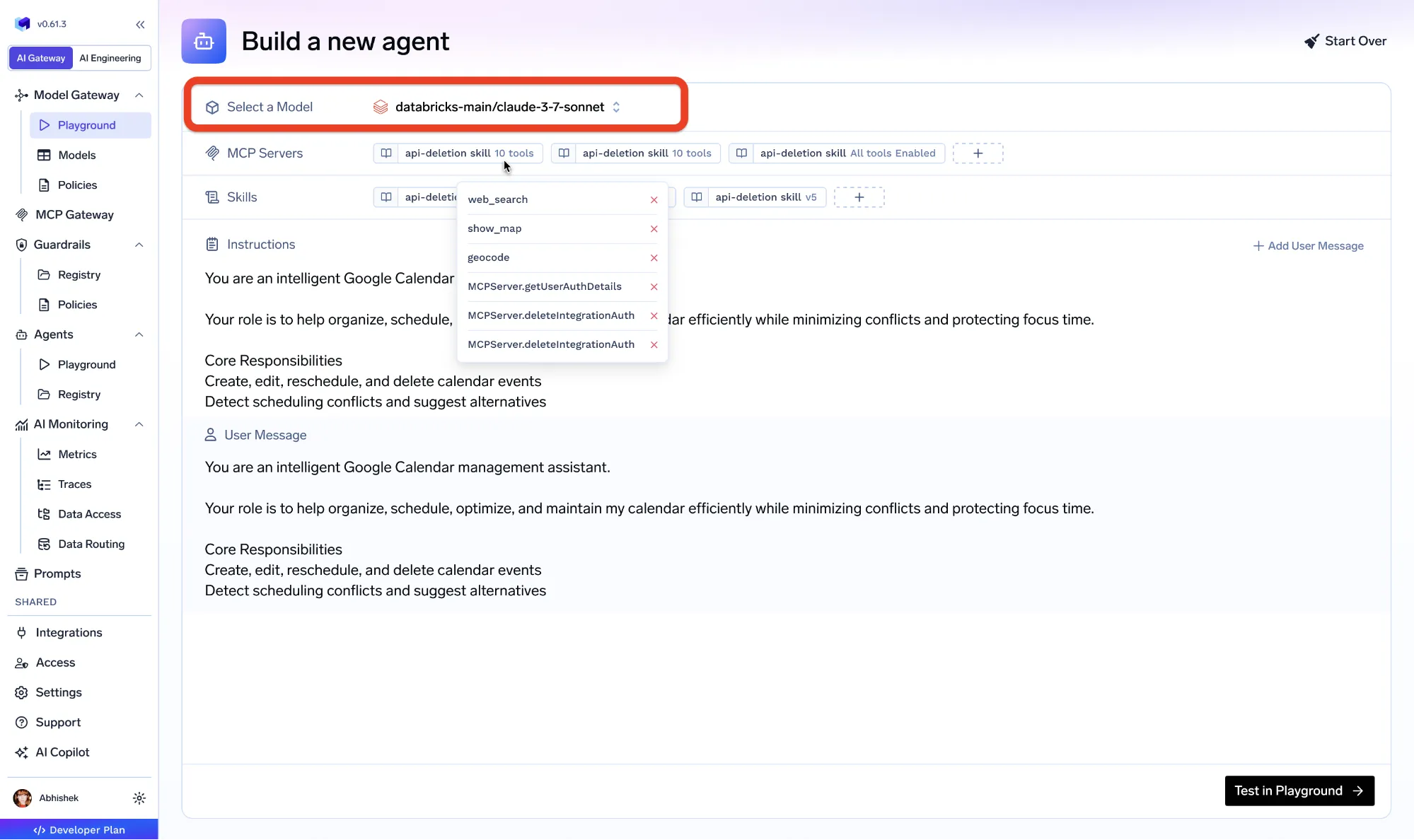
The difference from other managed-agent products is where credentials live. In several of them you supply provider API keys when you create an agent, or register them per workspace. In TrueFoundry, model access is managed once at the gateway layer and agents simply reference model names.
Because governance lives in the gateway, a platform team can add a new provider, rotate a key, or change a policy without anyone touching an agent definition. That is portability at the fleet level, not just for one agent.
Portability is not only about manual swaps. A virtual model lets an agent call one stable name while the gateway decides which real model serves each request, using weight-based, priority-based, latency-based, or complexity-based routing, with retries and cross-provider fallbacks built in. If a provider returns an error or times out, the request falls over to the next candidate automatically, so an outage at one vendor does not take your agents down.
name: smart-chat
type: gateway-load-balancing-config
rules:
  - id: primary-with-fallback
    type: priority-based-routing
    when:
      models: ["my-group/smart-chat"]
    load_balance_targets:
      - target: openai-main/gpt-4o
        priority: 1
        fallback_status_codes: ["429", "500", "502", "503"]
      - target: anthropic-main/claude-sonnet-4
        priority: 2      # takes over automatically if the primary fails
Auto Routing goes a step further by classifying each request as simple, medium, or complex and sending it to the cheapest model that can handle it. In TrueFoundry's benchmarks that cut cost by 50 to 70 percent while holding roughly 98 percent of quality. The agent still calls one model name. The portability is what makes all of this a configuration decision rather than a rewrite.
The strategic reason to care about portability is leverage. When moving off a provider is a one-line change, you are never stuck with a model that got more expensive, slower, or simply overtaken. You can run a bake-off between two models on real agent traffic, shift a percentage of requests to the challenger with weight-based routing, and promote it when it wins, all without a migration project.
It also keeps self-hosted models as first-class citizens. Because the gateway fronts open-weight models on backends like vLLM the same way it fronts commercial APIs, an agent can move between a hosted frontier model and a model running in your own cluster without noticing the difference. That optionality is difficult to reclaim once agents are hard-wired to one vendor, which is why building portability in from the start matters more than it first appears. It pairs naturally with agent identity and access control: the agent stays the same principal with the same permissions no matter which model serves it.
The gateway does all of this in the hot path without becoming the bottleneck, adding roughly 3 to 4 ms of overhead and sustaining 350+ RPS on a single vCPU across 1,000+ models.
AI agent portability turns the constant churn of model releases from a liability into an advantage. When the model behind an agent is a name the gateway resolves, not an SDK and a key baked into code, you can adopt the best model of the month, fall back across providers during an outage, and route cheap traffic to smaller models, all without rebuilding anything. That is what keeps a fleet of agents flexible instead of frozen.
See how TrueFoundry lets your agents switch across 1,000+ models from one control plane. Book a demo or start free.
TrueFoundry AI Gateway offre une latence d'environ 3 à 4 ms, gère plus de 350 RPS sur 1 processeur virtuel, évolue horizontalement facilement et est prête pour la production, tandis que LiteLM souffre d'une latence élevée, peine à dépasser un RPS modéré, ne dispose pas d'une mise à l'échelle intégrée et convient parfaitement aux charges de travail légères ou aux prototypes.





Les dernières nouvelles, articles et ressources envoyés dans votre boîte de réception

.webp)


.png)
.png)
.png)
.png)
.png)
.png)